
Signs Your Attic Needs More Insulation in Boulder City, NV - and How to Tell Which Sign You’re Actually Seeing
The signs that your attic needs more insulation are higher summer bills, rooms that won’t cool, and an HVAC that runs past dark. But in Boulder City those three complaints point to three different problems: radiant gain off an overheated attic deck, air leakage through the ceiling plane, or genuinely low R-value. Here the answer is a measured baseline, then air sealing, then insulation to spec - not “add R-value” and hope. We’re Envelope Insulation Boulder City, and this is how we separate the signals. Call (844) 320-7926 for a free estimate.
Why Boulder City’s Signs Don’t Read Like Anyone Else’s
Start with the bill. If your July power bill runs about 30% above June’s and the air handler keeps cycling at 11 p.m., that’s more than “not enough insulation.” It’s an attic deck that spends all afternoon absorbing desert sun and radiates that heat back down into the house long after sunset. Boulder City summers routinely cross 100°F with hard, direct solar load, and a roof deck with no radiant barrier turns the attic into a heat lamp. Adding fiberglass over that deck without addressing the radiant path is one of the most common incomplete jobs we’re called to redo.
The housing stock sharpens the problem. The federally built Boulder Homes from the 1930s and ’40s were designed for a desert before air conditioning, and many went up with no wall insulation at all. When our technicians open a wall in one of these houses, they still find 1930s newspaper or horsehair batting as the only thing between the interior and the outdoors. In those homes, “my bill is high” has never been a single-cause complaint. It’s usually all three causes at once.
That’s why diagnosing by symptom alone goes wrong. The three classic signs split into three different physical paths:
- Rooms that heat unevenly during the day usually point to radiant gain from the attic deck. A radiant barrier addresses this; more rolled insulation often doesn’t.
- Rooms that stay hot after sundown usually point to air leakage. Conditioned air is escaping, or hot attic air is entering, and a blower-door test measures it.
- Bills that stay high regardless of time of day usually point to low R-value at the ceiling plane, where heat moves through the assembly itself rather than around it.
You can have all three. In Boulder City’s older homes, you usually do.
The Boulder City Sign That Isn’t an Attic Problem at All
Here’s the misread we see most. In July, an interior plaster wall in a 1930s solid-masonry Boulder Home feels warm to the touch by mid-afternoon. Homeowners assume the attic needs work; sometimes the actual heat path is the mass wall itself, absorbing sun and re-radiating it inward. Solid masonry holds heat and releases it slowly. That’s thermal mass doing what masonry does, not insulation failing above you.
Book attic work against that symptom and you’ll spend money on the wrong surface. The wall keeps releasing heat, the room still feels warm, and the bill doesn’t move the way you expected. This is where a building-envelope view matters: walls, ceiling, attic and floor are one system, and heat enters where the assembly is weakest. Our technicians have up to 10 years of experience reading which surface is actually driving the load before anyone quotes a job.
Visual Signs You Can Spot Without a Meter
Look for dust tracks on the ceiling drywall or plaster, especially near recessed light fixtures and along the top plates of partition walls. Those gray streaks are air movement made visible. Under Haven Standard: Document What We Find, we photograph them - in a pressurized house, conditioned air is escaping through those gaps; in a depressurized house, 150°F attic air is entering. Either way, the gaps are real, and the air-sealing scope needs to come before any insulation is added.
That order is not negotiable here. We won’t blow insulation over an unsealed attic floor - doing so buries the leaks, and the new material doesn’t perform the way the invoice suggested it would. Sealed first, then insulated, in that order.
Turning Vague Signs Into One Number
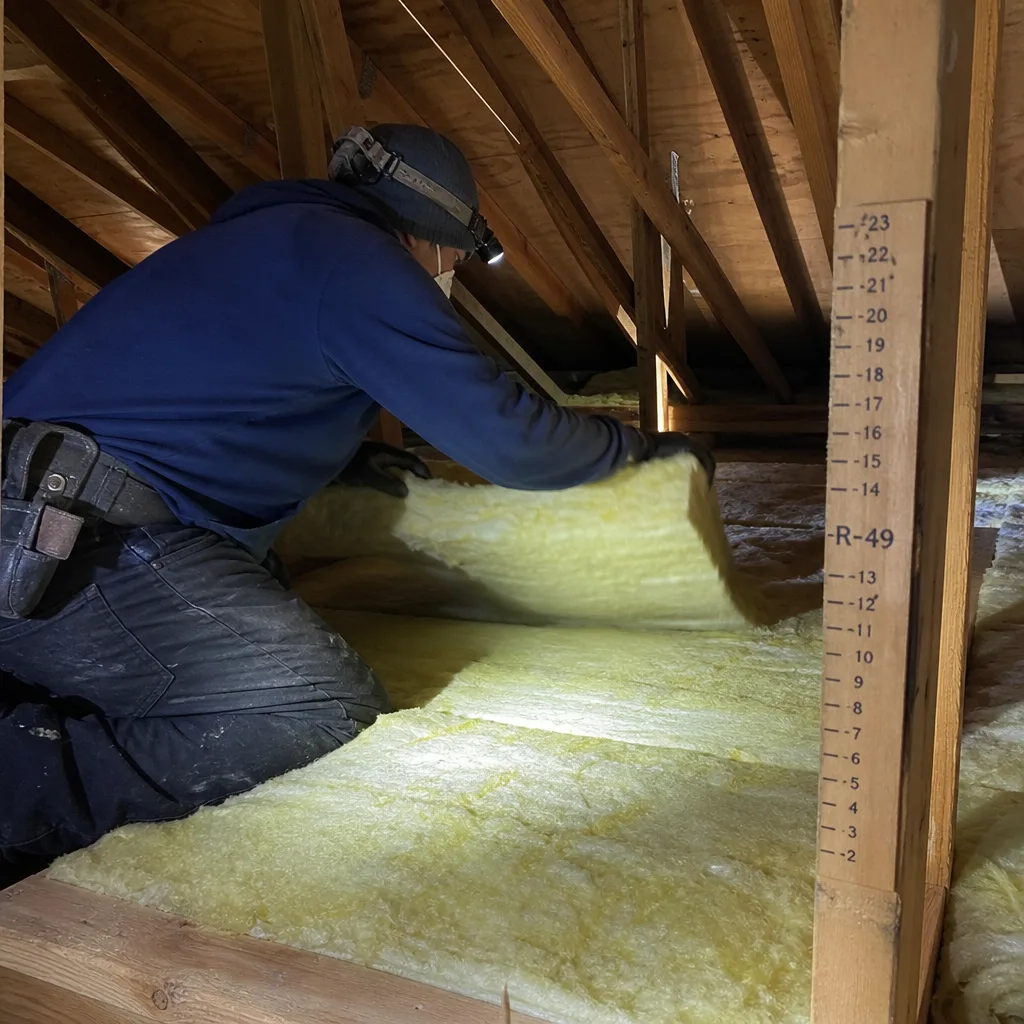
A blower-door test converts “the back bedroom is hot” into a single figure: the ACH50 reading - air changes per hour at 50 pascals of pressure - measured before any work starts. That one number separates the air-leakage contribution from the R-value contribution, so you can budget against the actual problem instead of a guess. Our customers who’ve had the test can tell you their pre-work number, because we publish the before-and-after blower-door readings on the job report.
If the house still carries its original newspaper batting, you don’t have a documented R-value at all. The starting point isn’t “add more” - it’s establish a measured baseline, seal, then insulate to spec. Here’s how a typical scope breaks down for a Boulder City home of this vintage:
| Scope item | Typical range | What it resolves |
|---|---|---|
| Blower-door baseline test | $350 - $500 | Separates air leakage from R-value |
| Attic air sealing (top plates, can lights, penetrations) | $900 - $1,800 | Stops the after-sundown heat load |
| Blown-in attic insulation (GreenFiber or Owens Corning) | $1,600 - $3,400 | Raises R-value at the ceiling plane |
| Radiant barrier installation | $1,200 - $2,400 | Cuts daytime radiant gain off the deck |
| Old insulation removal (newspaper, horsehair, degraded fill) | $800 - $1,600 | Establishes a clean, measured starting point |
Those are ranges for a standard single-story Boulder City footprint. A full-package job - baseline test, sealing, removal and re-insulation - usually lands between $4,000 and $7,500. You’ll see a flat written price before any work starts, so the number on the page is a reference point, not a teaser.
What Sealing First Actually Looks Like
Air sealing means chasing the physical gaps: top plates where wall studs meet the ceiling, recessed can lights, plumbing and wiring penetrations, and the seam where the attic floor meets the exterior wall. Each one is a hole in the pressure boundary, and the blower-door reading is what proves the work closed them. On a job where the baseline read 4,200 CFM50 before sealing, a good result lands well under half that after - we publish the before and after so you can check our work against the measurement.
Materials come from Owens Corning, Johns Manville, Knauf and GreenFiber, chosen to the specific assembly rather than a single house product. If a radiant barrier belongs in the Scope, it goes in before the ceiling is covered. If the walls are solid masonry, we tell you plainly that attic work won’t solve the warm-plaster sign - that’s a wall question, and we’ll say so.
If you’d rather read how the full installation sequence works end to end, our insulation installation in Boulder City page lays out the order of operations. From our home page you can reach the rest of the service line, from attic cleaning to crawl space encapsulation.
Key Takeaways
- Three classic signs, three different causes: daytime heat = radiant gain, after-sundown heat = air leakage, constant high bills = low R-value.
- Warm interior plaster in a July afternoon is masonry thermal mass, not an attic problem - misreading it leads to work that doesn’t fix the heat path.
- Dust tracks near fixtures and top plates are visible proof of air movement; sealing comes before insulation, always.
- A blower-door reading is the one number that tells you what you’re actually paying to fix.
- Original Boulder Homes often have no documented R-value - the starting point is a measured baseline, not “add more.”
FAQs
A blower-door test tells you which: if the house leaks heavily, sealing comes first; if the ceiling plane is simply under-insulated, R-value is the fix. In Boulder City’s older homes you usually need both, in that order.
After-sundown heat almost always means air leakage, not missing insulation - conditioned air is escaping or hot attic air is entering through ceiling gaps. A blower-door test measures the leak rate precisely. Call (844) 320-7926 for a free estimate.
Yes. Newspaper and horsehair batting were the common fill in federally built Boulder Homes, and finding them means the house has never had a documented R-value. The fix starts with a measured baseline, then sealing, then insulation to spec.
Most single-story Boulder City jobs run $4,000 to $7,500 for the full package - baseline test, air sealing, old material removal and new blown-in insulation. Smaller scopes start around $1,600. Call (844) 320-7926 for a written price before any work starts; estimates are free.
If you’d rather have it looked at, Envelope Insulation Boulder City offers a no-pressure assessment in Boulder City - call (844) 320-7926. You’ll get a written price before anything starts and a documented photo record when the work is done.
Written by the team at Envelope Insulation Boulder City, serving Boulder City, NV.