
GreenFiber Crawl Space Encapsulation: The Boulder City Owner’s Guide
We install GreenFiber-compatible crawl space encapsulation in Boulder City, and most full jobs here run between $4,200 and $9,800 depending on square footage, liner thickness, and how much floor prep the crawl needs first. Because we’re an independent contractor and not affiliated with GreenFiber, we source the liner and the GreenFiber insulation that pairs with it separately, so you see a flat written price for the whole assembly before any work starts. Boulder City’s dry, high-desert climate sounds like it would make crawl spaces easy. It does the opposite. Owners usually discover a failing encapsulation when they pull a stored box out of the crawl and find the liner sagging off the foundation wall, standing water pooled in a low corner after a monsoon week, or a musty smell that climbs through the floor registers into the living room.
Which GreenFiber Models This Applies To
GreenFiber itself makes loose-fill cellulose insulation, not encapsulation liners, so the “GreenFiber crawl space encapsulation” system is really two parts working together: a vapor barrier liner sealed to the walls and piers, and GreenFiber cellulose blown into the rim joist or subfloor cavity above. That distinction matters when you’re matching parts. The liner has to be a reinforced poly product rated at 12-mil or heavier for a vented-to-sealed retrofit, and the GreenFiber cellulose only performs if the liner underneath it is sealed tight, because cellulose is moisture-absorbing by nature. The first thing you’ll notice on a failing liner is moisture wicking up the cellulose, which turns it dark and heavy and eventually crumbles at a corner. Identify the material by the manufacturer print stamped on the underside: GreenFiber cellulose carries a bag code and R-value per inch on the packaging, and if that material was installed before the liner was sealed, the R-value has already been compromised by ground vapor moving up through it.
For the liner, ask to see the mil rating and the perm rating printed on the face of the material. OEM liner isn’t a meaningful category here, because GreenFiber doesn’t make one. What you’re choosing is a quality reinforced aftermarket liner that meets the ASTM E1745 class for under-slab and crawl use. We don’t stock liners or carry parts on a truck. When we quote a Boulder City encapsulation, the liner gets specified to the actual crawl dimensions and sourced to that spec, and we won’t install a GreenFiber cellulose layer over a liner we haven’t pressure-tested for seal at the seams and the foundation transition.
Signs Your GreenFiber Crawl Space Encapsulation Is Failing
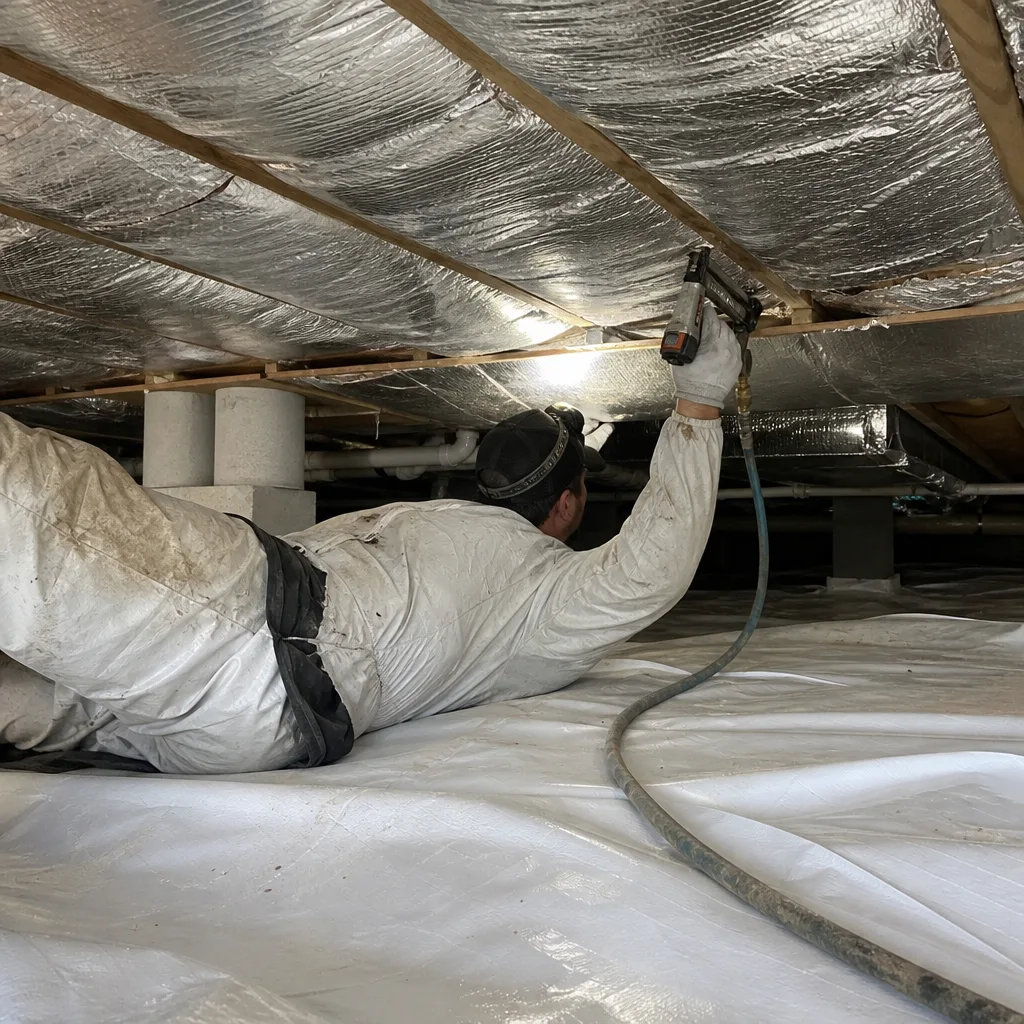
- Liner sagging away from the foundation wall. This usually means the mechanical fastener tape failed at the top edge, letting warm air in behind the liner and condensing on the cooler foundation face.
- Standing water in the low corner after a rain week. The liner’s drainage path is compromised, often because a pier wrap was cut short or the sump pit was never tied into the liner. Boulder City sits on caliche-heavy soil that drains slowly after summer storms, so water collects faster than the liner can route it.
- Musty smell that’s worse in summer. Cellulose that has absorbed ground vapor off an unsealed liner will off-gas moisture into the floor cavity, and the smell climbs through gaps at the subfloor.
- Dark streaks or crumbling at the liner seams. Tape failure at the seams is the most common GreenFiber encapsulation failure we see, and it usually follows the seam where the liner meets a pier or footing rather than the flat runs.
- Cold floors that got cold again after encapsulation. If the home’s floors lost their thermal improvement, the cellulose above the liner has lost R-value to moisture and needs replacement along with the liner.
Replacement Cost & What’s Included
Most complete GreenFiber-compatible encapsulation replacements in Boulder City fall between $4,200 and $9,800 installed. On a 1,200-square-foot crawl, a standard 12-mil reinforced liner, sealed at the foundation wall, piers, and sump, plus replacement of the GreenFiber cellulose above, typically lands near the lower end. Larger crawls, thicker liner, added drainage mat, or a sump pit tie-in push it toward $9,800.
- Liner material, cut and seam-sealed to the crawl dimensions: $1,300 to $2,600
- GreenFiber cellulose replacement above the liner, per R-value specified: $900 to $1,800
- Labor, including crawl access and prep: $1,800 to $4,200
- Drainage mat or sump tie-in, when needed: $300 to $1,200
Under Haven Standard Clause 1, you get a flat written price before any work starts, a written scope, and a written warranty, and the price doesn’t move once it’s written. Our 365-Day Done Right Promise covers the encapsulation itself, and if a seam fails, we make it right. We include a Documented Photo Record on every visit so you can see the seal at the foundation line and the piers before the liner is covered. The before-and-after blower-door readings we publish on applicable jobs show how much air movement through the floor cavity changed.
DIY or Call Us?
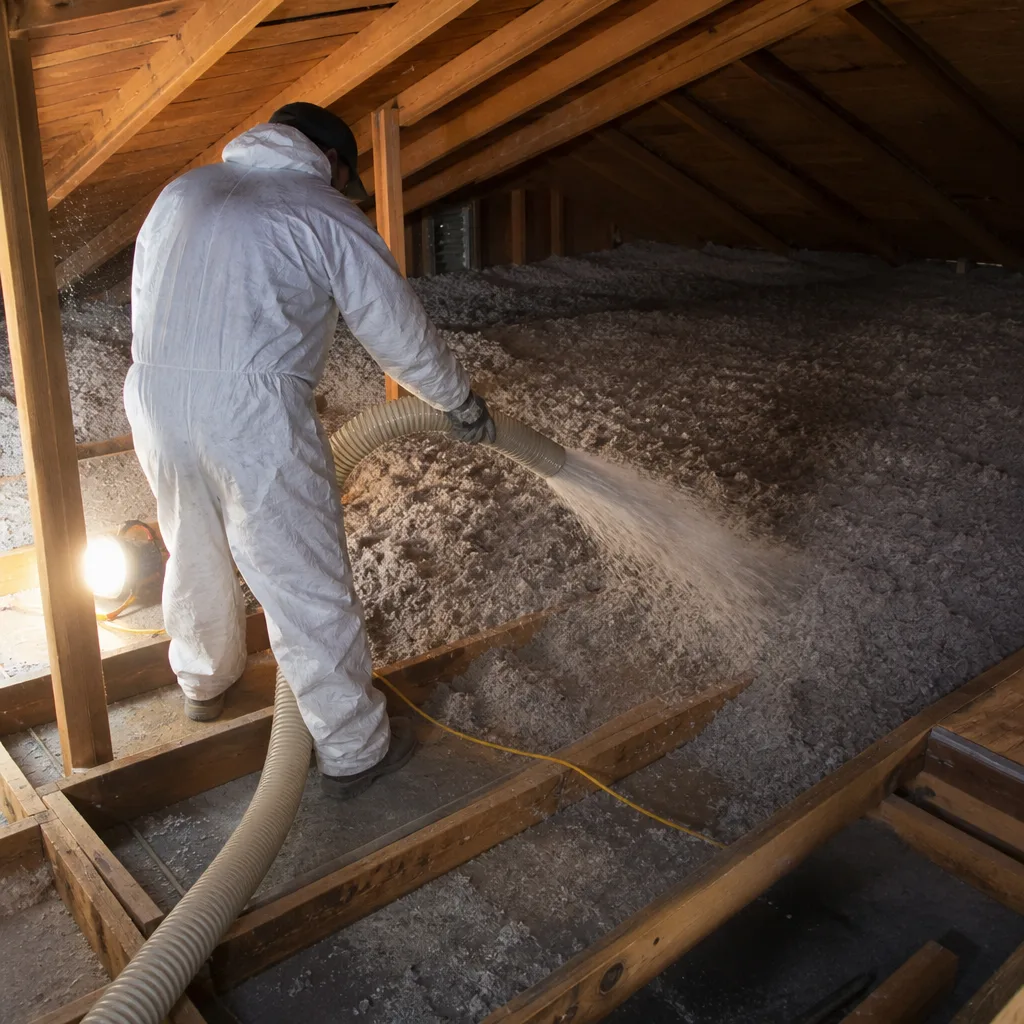
You can safely inspect the crawl and photograph what you see, and pulling up the corner of a liner that’s already loose tells you useful things about the water path. But the swap itself isn’t a homeowner job. Crawl spaces carry a real risk of confined-space air, mold, and structural pest contamination, and getting the liner seal wrong at the foundation transition is exactly what causes the next failure. For the GreenFiber cellulose above the liner, we don’t recommend disturbing it yourself either. If you’ve found a loose liner, a dark seam, or water pooling in a low corner, call (844) 320-7926 and we’ll send a technician to look at it. Most of what we do there is a free second opinion on the crawl conditions before you commit to anything.
FAQs
A properly sealed 12-mil reinforced liner paired with GreenFiber cellulose above typically lasts 15 to 25 years here, but the dry-desert climate in Boulder City stresses the material differently than you’d expect: UV exposure through vent openings and caliche soil expansion both shorten the liner’s life, and the seams fail years before the flat panel does. Call (844) 320-7926 for an assessment if yours is past the 12-year mark.
Sometimes, yes. If the liner is intact and the failure is one seam or a failed tape run at a pier, we can reseal it without a full replacement, and the cost runs a fraction of a full job. Once the cellulose above has absorbed moisture and lost R-value, though, that layer needs replacement even if the liner gets patched. We’ll tell you which one you’re looking at from the photo record.
A full liner and GreenFiber cellulose replacement in a typical Boulder City crawl takes one to two working days, weather and crawl access permitting. Small crawls with a clean access hatch often finish in a day.
We source the liner to the actual measured crawl, usually reinforced poly rated at 12-mil or heavier, and we source the GreenFiber cellulose from the manufacturer’s distribution network. No proprietary lock-in: we also work with other materials and with Reflectix reflective barrier where it’s a fit. Nothing gets carried on a truck; the parts are specified for your job before anyone shows up.
If you’re in Boulder City and you’ve got a liner failing under the house, the fastest path to a written price is a phone call. Reach us at (844) 320-7926 for a free estimate and a free second opinion on any written quote you’re holding. A technician will take a look at the crawl, tell you whether you need a reseal or a full replacement, and leave you with the written scope, the photo record, and the price before any work starts.
Written by the team at Envelope Insulation Boulder City, serving Boulder City and nearby areas.