
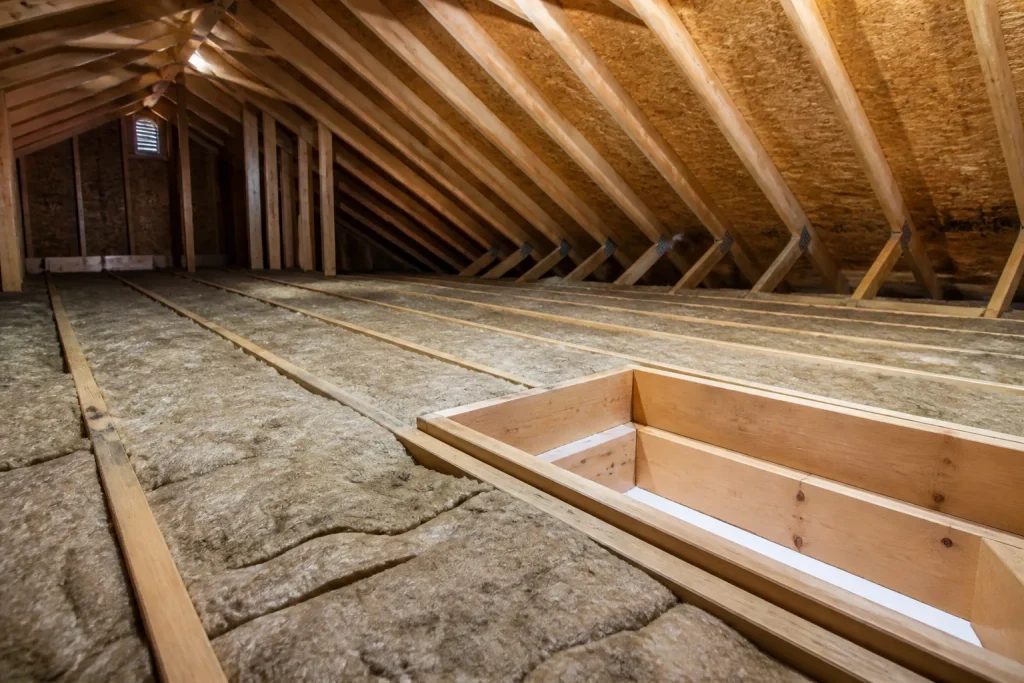
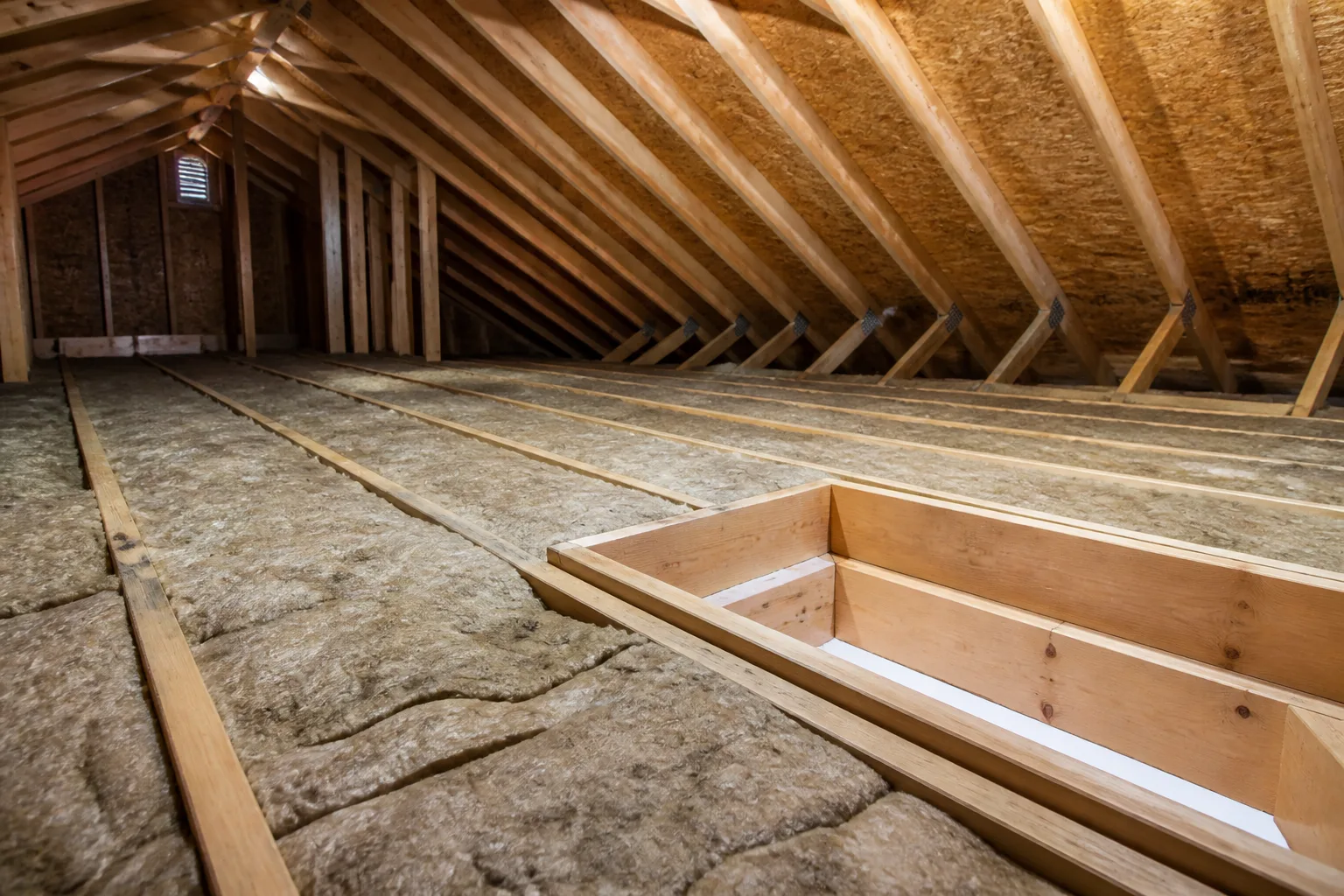
Rockwool Attic Insulation in Boulder City: A Homeowner’s Guide
Fiberglass melts at roughly 1,000°F and starts losing structural integrity before that. Rockwool mineral wool is rated non-combustible to 2,150°F and gets used as a fire-stop material in commercial construction. When Boulder City’s Red Rock Canyon fire corridor puts embers on rooftops, what your attic is made of stops being an abstract question. The short answer: Rockwool attic insulation in Boulder City, NV, is a denser, fire-rated mineral wool that performs well under extreme attic heat – and costs more per bag than fiberglass, which only pays off if the attic floor is air-sealed first. If you’d rather not sort through bag charts and blower calibration on your own, call (844) 320-7926 and we’ll walk you through it.
What actually makes Rockwool “non-combustible”?
Non-combustible is a defined ASTM E136 classification, not a marketing phrase. It means a material, tested in a furnace, does not ignite, support combustion, or contribute measurable fuel load. Rockwool mineral wool (spun from basalt rock and slag) passes that test. Fiberglass is also technically non-combustible as a raw material, but the paper or foil facings and binders on many batts are not, and the glass fibers themselves soften and lose integrity near 1,000°F. “Fire resistant” and “flame spread rated” are looser terms – flame spread measures how fast a fire travels across a surface, not whether the material adds fuel.
What matters in a Boulder City attic is ember behavior. Wildland-urban interface fire risk here isn’t usually a wall of flame reaching your house; it’s embers landing on and around the roof, working into vents and soffits. A mineral wool insulation layer that will not burn and will not melt gives you time. In our experience, that’s the honest reason to pay the Rockwool premium – not because it makes a home fireproof, but because it doesn’t add fuel in a space where fiberglass and foam can.
How does Rockwool’s density change performance in a Boulder City summer?
Attic temperatures in Boulder City commonly climb past 140°F in July and August. That heat does two things to insulation: it drives conduction through the material, and it creates convection – air looping within the insulation itself, carrying heat from the hot top of the layer down toward the ceiling. Lower-density products loop more. Rockwool loosefill runs roughly 1.7 to 2.5 lb/ft³. Fiberglass loosefill runs about 0.5 to 1.0 lb/ft³. The denser material resists that internal air movement, so the R-value you paid for holds up closer to its rated number under real summer conditions.
That density difference also shows up as a materials decision. A higher-density product requires more mass to hit the same R-value, so rockwool coverage charts and bag counts read differently from fiberglass. We’ve seen homeowners buy fiberglass bag-count charts and apply them to rockwool – the attic ends up under-insulated. Get the depth right or the whole comparison is academic.
Why does Rockwool cost more per bag – and when is that worth it?
Rockwool loosefill typically runs higher per bag than fiberglass, and in Boulder City that premium only translates into performance if the envelope underneath is tight. Here’s the reasoning: mineral wool slows conductive and convective heat loss, but it does not stop air from moving through it. If top plates, can lights, and plumbing penetrations are open, conditioned air escapes straight up through the insulation. Your expensive rockwool becomes a filter, not a barrier. The performance gap between a good product and a mediocre one closes once air is leaking freely around both.
- Sealed and rockwool-insulated attic: you get the fire rating and the dense thermal performance you paid for.
- Unsealed attic with any insulation: you’ve paid a premium for a product that can’t do its job.
- The order that matters: air sealing first, then insulation – never the reverse.
That’s the whole reason we won’t blow insulation over an open attic floor. Under the Haven Standard, air sealing is treated as a prerequisite, not an upsell. On applicable jobs we also publish before-and-after blower-door readings – a pressurization test that shows, in one number, how much air the house was losing before and after. A reading that drops from, say, 4,200 CFM50 to 2,100 means the envelope actually got tighter, and you can see it rather than take our word for it.
Installation: why rockwool needs a different setup than fiberglass
Rockwool loosefill isn’t a drop-in swap for fiberglass. Two things change. First, the blower: mineral wool is denser and heavier, so it needs a pneumatic machine calibrated for higher-density material and a feed rate set accordingly. Run it through a fiberglass-tuned machine and you get inconsistent coverage and voids. Second, depth markers: because bag-count-per-square-foot charts are product-specific, we set physical depth markers in the attic and measure installed depth before calling a job done, rather than trusting a bag tally.
The documentation is the part homeowners should expect. On every job we leave a Documented Photo Record – the depth readings, the sealed penetrations, the finished field. When we hand over the photos, the before-and-after blower-door figures, and the written scope, you’re not guessing whether the crew hit R-value. Under Haven Standard: Have it in writing, that record is standard, not something you have to ask for.
Does Rockwool quiet an attic above a living space?
Often, yes, and it’s an underrated reason to choose it. The same density that resists convective looping also attenuates sound – measured as STC, Sound Transmission Class. If you have a bedroom or home office directly under a hot attic, the rockwool layer adds mass between the noisy space and the ceiling below. It won’t replace proper wall assembly for sound, but homeowners who live under an attic they hear every time the HVAC kicks on tend to notice the difference.
For Boulder City homes where the attic sits over the main living area – common in the older single-story stock – that’s a real, secondary benefit that fiberglass at half the density doesn’t deliver as well.
When to call a pro
Air sealing an attic floor and calibrating a high-density blower are not weekend projects, and the wrong depth or an unsealed penetration quietly undercuts everything you spent. If your attic already has old insulation, rodent contamination, or you’re weighing rockwool against foam, that’s the point to get an in-person look. A free second opinion on any written estimate is available too – bring us a competing quote and we’ll read it with you, line by line.
Related services in Boulder City: Attic Insulation in Boulder City and Spray Foam Insulation in Boulder City. If moisture or venting is part of the picture, see Crawl Space Encapsulation & Vapor Barrier in Boulder City, and start at our Envelope Insulation Boulder City home page.
Key takeaways
- Rockwool is ASTM E136 non-combustible to about 2,150°F; fiberglass softens near 1,000°F and its facings and binders add fuel load.
- Rockwool loosefill (≈1.7-2.5 lb/ft³) resists convective looping better than fiberglass (≈0.5-1.0 lb/ft³) – a real advantage in 140°F+ Boulder City attics.
- It costs more per bag, so air sealing first is non-negotiable; otherwise the premium buys you nothing.
- Installation needs a higher-density-calibrated blower and measured depth markers, not fiberglass bag charts.
- Density also improves sound attenuation (STC) for attics above living spaces.
The Bottom Line
Rockwool attic insulation in Boulder City makes sense when you want a genuinely non-combustible layer, better thermal performance under extreme summer heat, and some acoustic benefit over a living space – and you’re willing to seal the attic floor first so the premium actually pays off. Skip the air sealing and you’ve bought an expensive product that can’t perform. We’ve completed thousands of seal-and-insulate jobs and every one started with a written price before any work began, closed with a documented photo record, and came backed by our 365-Day Done Right Promise. If you’re in Boulder City and want a straight comparison of rockwool against fiberglass or foam, Envelope Insulation Boulder City offers free estimates – call (844) 320-7926. A live person answers any time, and you’ll have the price in writing before anyone lifts a tool.
Frequently Asked Questions
For fire behavior and high-heat thermal performance, yes – Rockwool is non-combustible to about 2,150°F and its density resists convective looping that fiberglass allows at 140°F+ attic temperatures. Fiberglass costs less per bag. The right choice depends on your fire-risk exposure and budget; call (844) 320-7926 and we’ll give you the price both ways before you decide.
No. Non-combustible means the insulation itself won’t ignite or add fuel load – it does not fireproof a house. It buys time against ember intrusion in a wildland-urban interface corridor like Red Rock Canyon, but roofing, vents, and overall assembly matter just as much. We’ll walk you through where rockwool helps and where it doesn’t on a free estimate.
Sometimes, after an inspection – but never over an unsealed attic floor, and never over contaminated or rodent-damaged material, which needs removal first. The order is always air seal, then insulate. Call (844) 320-7926 and we’ll tell you what your Boulder City attic actually needs.
Pricing depends on square footage, target R-value, and how much air sealing the attic needs first – factors we price in writing rather than over the phone. Because rockwool runs higher per bag than fiberglass, the estimate breaks out sealing and material separately so you can see where the money goes. Call (844) 320-7926 for an exact written quote; estimates are free.
Written by the team at Envelope Insulation Boulder City.
Need Insulation Help?
Call Envelope Insulation Boulder City - licensed & insured, here with fast after-hours help in Boulder City.
(844) 320-7926