
5 Mistakes to Avoid With Spray Foam Insulation
Most spray foam failures we get called out to inspect in Boulder City were decided before the spray gun ever came off the truck. The wrong product for the assembly, a substrate nobody cleaned, a single pass where the spec called for two – by the time foam is on the wood, the expensive decisions are already made. Open-cell foam sprayed against an unvented roof deck without a vapor retarder is the mistake we see most often. Correcting it after the fact runs $4,000 – $8,000. If you’d rather skip the guesswork entirely, call (844) 320-7926 and we’ll walk through your assembly before anyone sprays anything.
Key Takeaways
- Open-cell foam (3 – 10 perms) can’t act as its own vapor retarder in an unvented Climate Zone 3B assembly. Closed-cell runs under 1 perm.
- Foam sprayed over dusty, wet, or cold substrate delaminates – and desert construction sites in Boulder City make dust a real problem.
- Closed-cell foam usually needs two passes. A single 2-inch pass often leaves the job under-spec’d.
- Without a post-install blower-door reading, nobody knows whether the air seal actually worked.
- Open-cell foam left exposed to UV degrades in 12 – 18 months. Boulder City’s solar intensity shortens that.
Mistake 1: Choosing Open-Cell Foam for an Unvented Roof Deck Without a Vapor Retarder
This is the mistake that shows up at resale, and it’s the one that costs the most to unwind. Open-cell spray foam has a water vapor permeance of roughly 3 – 10 perms. Closed-cell foam runs under 1 perm. That difference matters because Climate Zone 3B – which covers Boulder City – requires a vapor retarder on the warm side of open-cell foam in unvented assemblies. Open-cell foam is too permeable to serve as its own retarder. Installed without one, moisture can migrate through the foam and condense against the cold roof deck.
You won’t see the problem the week it’s installed. You’ll see it two or three winters later as staining, soft sheathing, or a home inspector’s note that stops a sale. The correction means removing the foam, drying the assembly, and re-spraying – typically $4,000 – $8,000 depending on roof area. We’ve torn out enough of it in Boulder City to tell you the fix is always more expensive than the correct spec would have been.
What correct looks like depends on the assembly:
- Unvented roof deck with open-cell: a vapor retarder (often a vapor-retarder primer or membrane) applied on the warm side, sized to the assembly’s permeance requirements.
- Unvented roof deck with closed-cell: closed-cell at sufficient thickness can itself act as the vapor retarder, though the total R-value and thickness still have to be calculated.
- Vented attic floor: a completely different assembly with different rules. Don’t let anyone spray a roof deck spec onto an attic floor or the reverse.
If you’re spec’ing foam for a Boulder City home, start with Spray Foam Insulation in Boulder City and read the assembly requirements before you read the product brochure.
Mistake 2: Spraying Over Wet, Dusty, or Cold Substrate
Spray foam adheres by bonding to the substrate. That bond fails when the substrate is wet, dusty, or below the product’s minimum application temperature. In Boulder City we deal with a specific version of this: desert construction sites with blowing sand. Dust settles on sheathing and framing, and if nobody wipes or blows it off before the spray rig fires up, the foam skins over on top of the dust instead of bonding to the wood.
The failure mode is delamination – the foam pulls away from the substrate, usually in sheets, and creates a hidden air channel between the foam and the structure. From the attic hatch it looks fine. Under a blower-door test it reads like the foam isn’t there at all.
Before any spray, three conditions get checked and documented:
- Substrate moisture: wood framing and sheathing need to be within the product’s acceptable moisture range. Wet framing gets dried first, not sprayed over.
- Surface condition: dust, sand, and debris removed from every surface the foam will touch. On a Boulder City site after a windy week, that’s a real step, not a formality.
- Temperature: substrate and ambient temperature within the Technical Data Sheet limits for the specific product. Cold substrate is a common cause of poor adhesion in winter installs.
Ask any contractor what their substrate prep looks like and whether it gets photographed. Under our Haven Standard, every visit includes a Documented Photo Record, which means you have pictures of the clean substrate before the foam went on – not just the finished wall.
Mistake 3: Inadequate Thickness on Closed-Cell Foam
Closed-cell foam generates heat as it cures, and the product’s Technical Data Sheet – the manufacturer’s spec sheet for that exact product – limits how thick a single pass can be to avoid exothermic cracking. Spray too thick in one pass and the foam can crack, shrink, or cure with internal voids. The common failure we see is the opposite problem: an installer sprays a single 2-inch pass when the job needs more, and the home ends up under-spec’d on both R-value and vapor retardance.
The right install is usually two passes: spray to the first-pass limit, let it cure, then spray the second pass to reach the target thickness. That takes longer and costs more in labor hours. Skipping it is one of the easiest ways to shave a quote – which is why a low bid on closed-cell foam deserves a careful read.
Here’s what to verify on any closed-cell quote for a Boulder City home:
- Target thickness in inches, spelled out, not just “R-value met.”
- Pass schedule – how many passes, at what thickness each.
- Product name and manufacturer – Demilec, Johns Manville, and Owens Corning all publish TDS limits you can look up.
- Verification method – how thickness gets checked after curing, and whether you get the numbers.
Under Haven Standard Clause 1, you get a flat price, a written scope, and a written warranty before anyone lifts a tool. The scope should state target thickness and pass count. If it doesn’t, ask why.
Mistake 4: Skipping the Post-Install Blower-Door Test
Spray foam is sold as an air barrier, and it usually is one – when it’s applied correctly. But delamination, missed penetrations, and thin spots are invisible from the outside. The only way to know whether the air seal was actually achieved is a blower-door test – a pressurization reading that shows, in a single number, how much air your building envelope is losing, measured in CFM50.
Without a post-install reading, neither the contractor nor the homeowner knows what they paid for. A foam job that looked perfect can read the same as the house did before. That’s not a hypothetical – we’ve re-tested Boulder City homes where a prior foam install had no measurable effect because the foam had delaminated from dusty sheathing.
What good documentation looks like:
- A before blower-door reading, taken prior to any air sealing or foam.
- A written scope listing every penetration, top plate, and can light that gets sealed – because foam over an unsealed attic floor is just expensive foam.
- An after blower-door reading, published so you can compare the two numbers side by side.
Sealed first, then insulated – in that order. We won’t blow or spray insulation over an unsealed assembly. On Attic Insulation in Boulder City jobs, the air-sealing step and the before-and-after blower-door numbers are both part of the written record. If your contractor can’t tell you what the house read before and after, you don’t have a verified air seal – you have a promise.
Mistake 5: Leaving Spray Foam Exposed to UV
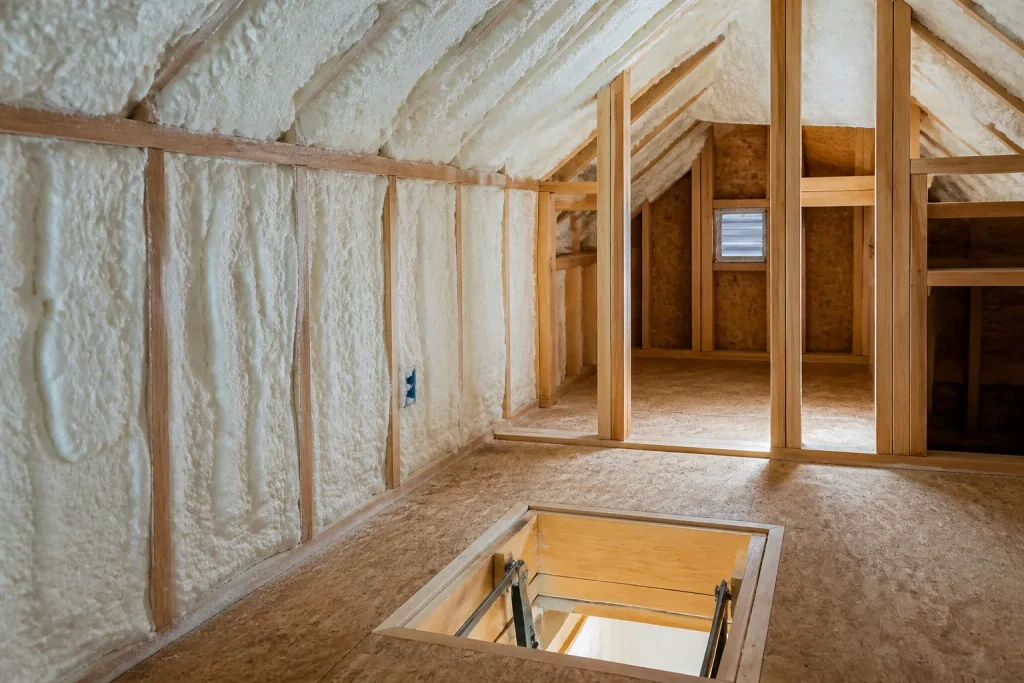
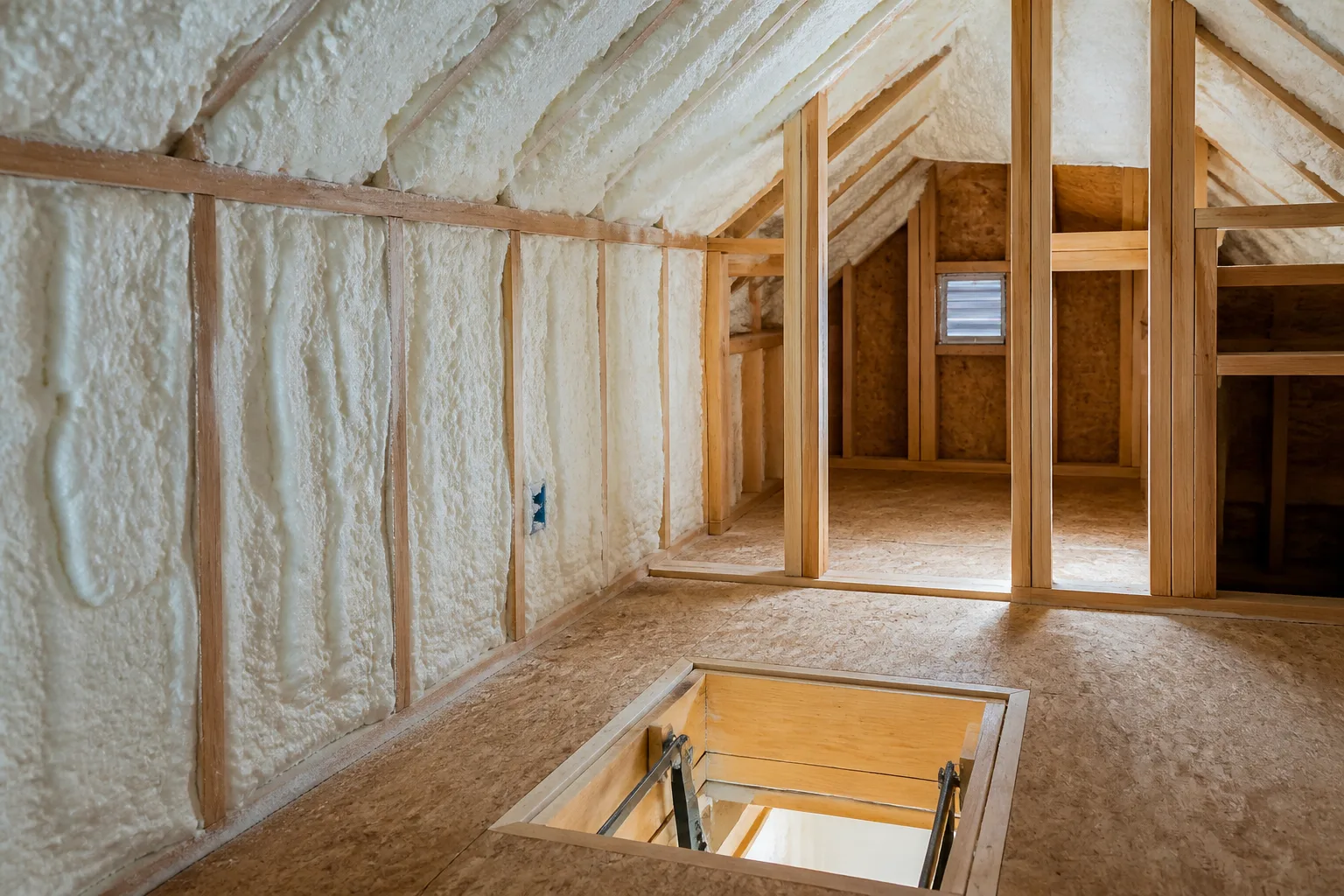
Open-cell spray foam degrades when exposed to ultraviolet light. Without a thermal barrier coating or a cover, exposed foam in a vented attic space starts breaking down within 12 – 18 months – yellowing, dusting, and losing structural integrity on the surface. Boulder City’s solar intensity accelerates that timeline. An attic with a decent amount of daylight coming through a gable vent is not a safe place to leave open-cell foam bare.
The fix is simple and cheap if it’s planned: a thermal barrier coating applied over the foam, or a cover material. It becomes expensive if it’s forgotten and discovered two years later, because the degraded surface has to be dealt with before the barrier goes on.
Two things to check before the crew leaves:
- Every exposed foam surface has a barrier or cover. Attic spaces, rim joists, and any area near a vent or gable opening.
- The photo record shows it. Your Documented Photo Record should include the coated or covered surfaces, not just the spray.
If your Boulder City home also has a crawl space, the same UV and vapor logic applies down there – see Crawl Space Encapsulation & Vapor Barrier in Boulder City for how the vapor barrier requirement differs from the roof deck.
When to Call a Pro
Spray foam involves isocyanates, high-pressure equipment, and exothermic cure temperatures that can scorch framing if applied wrong. It’s not a homeowner job – and the spec decisions above (permeance, pass schedule, vapor retarder) need someone who has read the assembly code and the product TDS. If you’re planning a foam install in Boulder City and want a second read on a quote you’ve already received, we offer a Free Second Opinion on any written estimate. Bring it in and we’ll read it with you, line by line – target thickness, pass count, vapor retarder, blower-door testing, and UV protection. No charge, no obligation, and no pressure to switch contractors. Sometimes the other quote is fine and we say so.
Related services in Boulder City: Envelope Insulation Boulder City home · Spray Foam Insulation in Boulder City · Attic Insulation in Boulder City
The Bottom Line
The five mistakes that cost the most in a Boulder City spray foam job are all decided before the spray rig fires up: wrong product for the assembly, skipped substrate prep, a single pass where the spec calls for two, no post-install blower-door test, and exposed foam left to degrade in the sun. Each one is preventable with a written scope and a documented record – and each one is expensive to fix after the fact. If you’re in Boulder City and need help sorting out the right spec, Envelope Insulation Boulder City offers free estimates – call (844) 320-7926. Our technicians have up to 10 years of experience, and we source foam from manufacturers like Demilec, Johns Manville, and Owens Corning so you’re not locked into a proprietary product.
Frequently Asked Questions
Not by itself – but open-cell foam in an unvented roof deck without a vapor retarder generally fails Climate Zone 3B requirements, because open-cell’s 3 – 10 perm permeance means it can’t serve as its own vapor retarder. Correcting it after the fact typically runs $4,000 – $8,000. Call (844) 320-7926 for a free estimate on the correct spec for your assembly.
You usually can’t see it – delamination creates hidden air channels between the foam and the substrate. A blower-door test is the reliable check: a pressurization reading shows whether the assembly is actually holding air. If your install never had an after reading, that’s the first thing to get. Call (844) 320-7926 to schedule one.
Target thickness depends on the assembly and the climate zone requirement, usually two or more passes to reach it – single-pass limits are set by the product TDS to prevent exothermic cracking. The written scope should state target thickness in inches and pass count. Call (844) 320-7926 for a free estimate with the numbers written down.
Yes. Open-cell foam left exposed to UV degrades within 12 – 18 months, and Boulder City’s solar intensity makes that faster. A thermal barrier coating or cover protects the foam and should be in the written scope. Call (844) 320-7926 for a free estimate on the right coating for your attic.
Written by the team at Envelope Insulation Boulder City.
Need Insulation Help?
Call Envelope Insulation Boulder City - licensed & insured, here with fast after-hours help in Boulder City.
(844) 320-7926