
CertainTeed Attic Insulation in Boulder City: A Homeowner’s Guide
Every bag of CertainTeed loose-fill fiberglass prints a coverage chart showing how many bags you need per square foot to hit a given R-value. That chart was generated at a 75°F mean temperature. ASTM C518, the standard test method behind almost every R-value you’ll see quoted, specifies that same 75°F mean. Your Boulder City attic does not run at 75°F. Through July and August it sits at 110 – 130°F, and fiberglass R-value falls as mean temperature climbs. The coverage chart rarely mentions this, which is why so many Boulder City attics get insulated to a number that looks right on paper and underperforms the first hot week of summer.
If you’d rather have someone else climb into a 130°F attic with a depth rod and a bag count, call (844) 320-7926. Estimates are free and the price is written down before anything starts.
Key Takeaways
- CertainTeed’s published coverage charts are calibrated at 75°F, and Boulder City attics run far hotter.
- Fiberglass R-value measured at 75°F is roughly 10 – 15% higher than at a 110°F mean, so deeper installed coverage is needed to deliver code performance in summer.
- InsulSafe SP, Spirit loosefill, and CertainTeed’s spray options suit different attic types; 1980s – 2000s flat-ceiling truss construction is the most common layout in Boulder City.
- Air sealing comes first. Insulation over an unsealed attic floor traps the leaks you’re trying to fix.
- Keep the depth-rod photos, product lot numbers, and the written air-sealing scope. NV Energy rebate paperwork and any future resale ask for them.
Why does R-value drop when your Boulder City attic heats up?
R-value is a measure of heat resistance, and heat resistance changes with temperature. The number on the bag was established at 75°F mean, which is a laboratory condition, not a Clark County rooftop in August. When the mean temperature of the material climbs toward 110°F, fiberglass loses thermal resistance – roughly 10 – 15% versus its 75°F rating, depending on density and product. That means the R-38 printed on a CertainTeed coverage chart delivers something closer to R-33 or R-34 in real summer conditions in Boulder City.
This is not a knock on CertainTeed specifically. InsulSafe and Spirit carry some of the longest published coverage tables in the loose-fill fiberglass category, which is exactly why they get spec’d so often. The temperature dependence is a property of the material class. We’ve measured attic temps of 128°F in Boulder City homes off Nevada Way in early August, and at that mean the R-value you paid for and the R-value your house actually gets are two different numbers. The practical fix is depth: install to a slightly higher nominal R-value than the code table suggests so the delivered performance in summer still lands where it should.
Which CertainTeed product fits your Boulder City attic?
CertainTeed makes three formats that show up in residential attics, and the right one depends on the construction, not on preference.
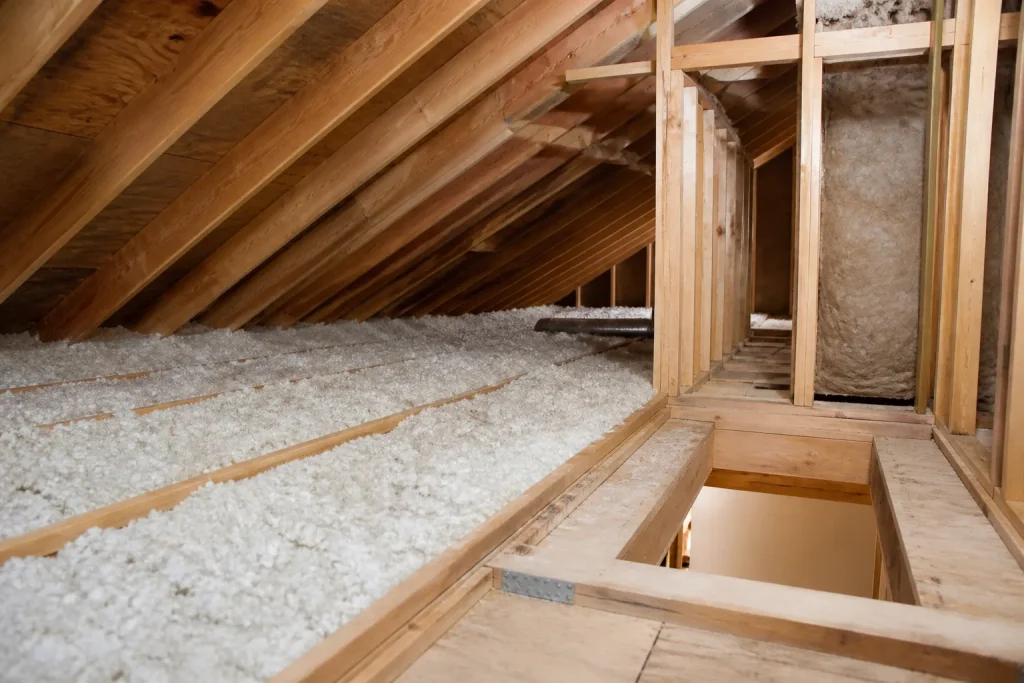
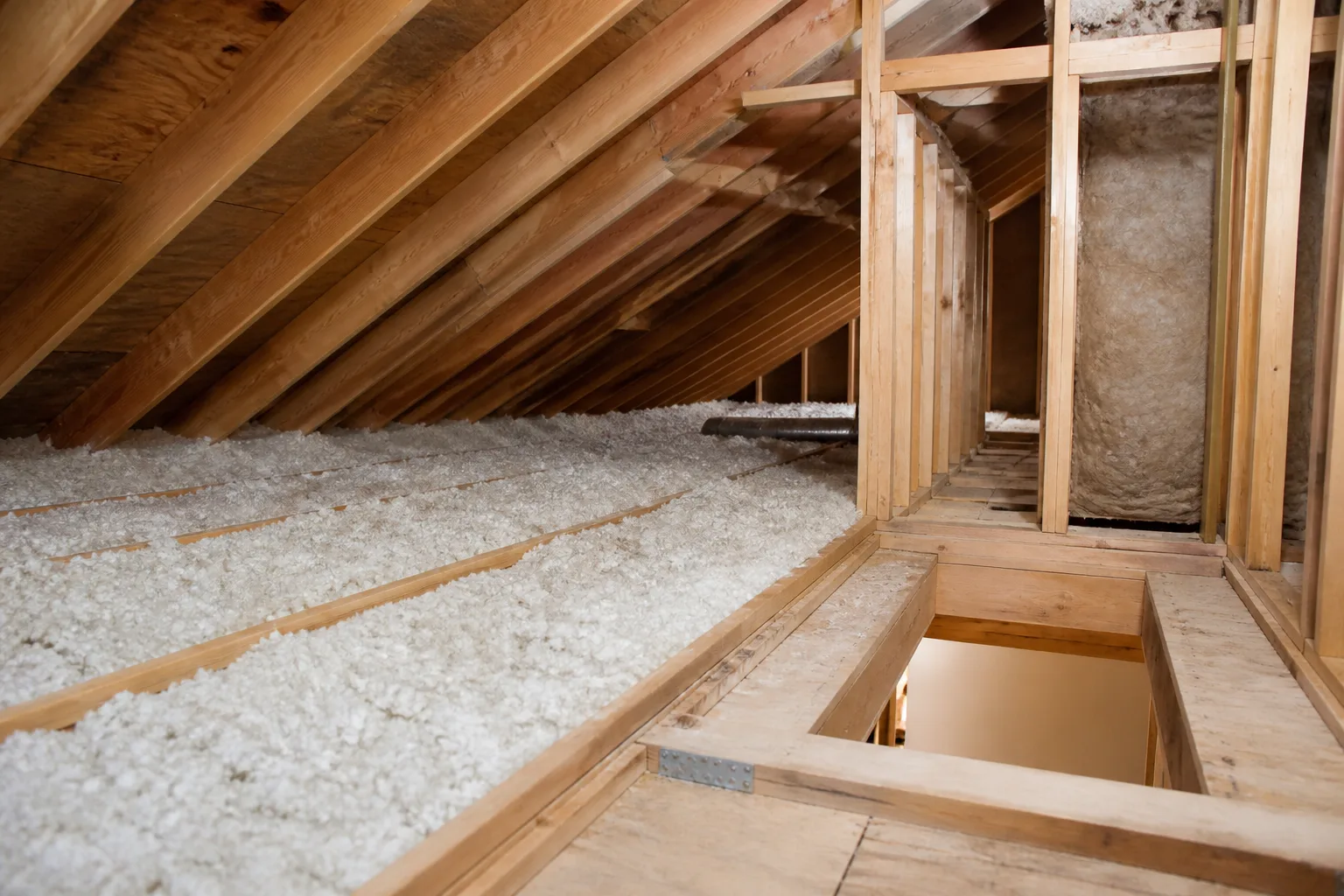
- InsulSafe SP – loose-fill fiberglass, blown in. The workhorse for open, flat-ceiling truss attics. Non-combustible, won’t settle much, and blows around obstructions well. Best fit for the 1980s – 2000s tract construction that dominates Boulder City.
- Spirit loosefill – a lower-density loose-fill option with a softer hand. Good where you need to blow over existing material without crushing it, or where the truss spacing makes a lighter fill easier to level.
- Certaspray and spray-applied options – for attics with complex geometry, knee walls, or where you need a bonded surface. Overkill for a plain flat-ceiling attic, useful for the odd additions and remodels around Boulder City where the ceiling line isn’t clean.
For most Boulder City homes built between 1980 and 2005 with standard truss construction, InsulSafe SP over a properly air-sealed attic floor is the straightforward answer. If your attic has a finished knee wall or a dormer, the calculus changes. See our Attic Insulation in Boulder City page for how we scope those layouts.
Why does air sealing come before the first bag goes in?
Blowing insulation over an unsealed attic floor is the single most common mistake we find in Boulder City attics. The reasoning is simple: insulation slows heat, it does not stop air. Every top plate, every wire penetration, every recessed can light, and every plumbing stack is a hole that lets conditioned air leave the house in summer and cold air leak in during the desert winter. Cover those holes with fiberglass and you’ve insulated the leak, not fixed it.
Clark County tract construction has a few repeat offenders. Top plates along exterior walls, where the wall meets the ceiling, are frequently unsealed. Recessed can lights in older Boulder City homes are usually open to the attic. Bathroom exhaust fans vented into the attic instead of outside are common in 1990s builds. The prerequisite scope on a CertainTeed job should include:
- Sealing top-plate penetrations along exterior and interior walls.
- Weatherstripping and insulating the attic hatch or scuttle.
- Installing covers over recessed light fixtures rated for insulation contact.
- Sealing plumbing, electrical, and HVAC penetrations at the attic floor.
- Confirming bath and kitchen exhausts vent to the exterior, not into the attic.
We won’t blow insulation over an unsealed attic floor, period. It’s the first clause in how we work under The Haven Standard, and it’s why our before-and-after blower-door readings – the pressurization test that shows how much air a home is leaking in one number – actually move after a job. Without the sealing step, the reading barely changes and you’ve spent money on a problem that wasn’t the real one.
How much CertainTeed insulation does a Boulder City attic actually need?
More than the coverage chart says, if you want the delivered performance to hold up in summer. Here’s how we think about the number.
- Start with the code-required R-value for our climate zone. That’s the target, not the ceiling.
- Account for the temperature derate. At a 110°F mean, expect roughly 10 – 15% less thermal resistance than the 75°F rating.
- Install to a nominal R-value high enough that the derated performance still meets code in August. In practice, that means a slightly deeper fill than the chart’s minimum.
- Verify depth with a depth rod at multiple points, not one. Attics don’t fill evenly.
What that costs depends on the starting R-value, the air-sealing scope, and the attic’s geometry. Most attic insulation jobs in a single-family Boulder City home run between $1,800 and $3,800 for a full air-seal-and-insulate scope, with blown fiberglass typically at the lower end and spray foam – see our Spray Foam Insulation in Boulder City page – at the higher end. We write the price down before any work starts, and a free second opinion on a competing quote is always available.
What documentation should you keep after the job?
This is the part nobody tells you about, and it’s the part that matters when you file a rebate or sell the house. NV Energy’s Home Efficiency Rebates require installed R-value certification, and the coverage chart from the bag alone doesn’t satisfy that. You need a record of what was actually put in.
At minimum, ask for:
- Depth-rod photos taken at one measurement point per 100 square feet, at least.
- Product lot numbers from every CertainTeed bag, so the installed product is traceable.
- A written description of the air-sealing scope – what was sealed, where, how.
- Before-and-after blower-door ACH50 readings if the job included air sealing. This is the delta that proves performance change.
Under The Haven Standard, every visit closes with a Documented Photo Record, not on request – it’s part of the job. We’ve pulled records out of a garage in Boulder City for a homeowner filing an NV Energy rebate and the whole file was photos and lot numbers in a folder. That’s what “have it in writing” looks like on the receiving end. If you’re also dealing with a damp or unvented floor, our Crawl Space Encapsulation & Vapor Barrier in Boulder City page covers the related work.
When should you call a pro?
If your attic already has insulation and you’re still fighting hot rooms, call before you add another layer. The problem is usually air, not depth. If the existing material is disturbed, pest-damaged, or vented exhaust has deposited moisture, removal and replacement is a different job than top-up. And if the job touches recessed lighting or you’re not certain what’s rated for insulation contact, that’s a licensed electrician’s call, not an insulation call. Our technicians have up to 10 years of experience reading exactly these situations, and we’ll tell you when something is out of our lane.
If you want a second read on a competitor’s quote, bring it. We’ll read it with you, free. Start at Envelope Insulation Boulder City home for the full service line and how a job runs from written price to documented record.
Related services in Boulder City
Attic work rarely stops at insulation. If the air-sealing scope uncovers an unvented crawl space or a moisture problem under the floor, those get handled on the same visit or scoped separately. The Boulder City attic insulation page covers the full flat-ceiling truss workflow, and spray foam is the right call when the geometry doesn’t allow a clean blow.
What happens when you call
- 1
A real person answersNo phone trees – you reach a local pro.
- 2
You get an upfront price rangeHonest numbers before anyone is dispatched.
- 3
A background-checked tech heads outLicensed & insured, dispatched right away.
- 4
You approve before work beginsNothing starts until you say go.
The Bottom Line
CertainTeed’s InsulSafe and Spirit lines are solid products, and the coverage charts that come with them are honest – at 75°F. Boulder City attics don’t run at 75°F, and the 10 – 15% R-value gap between the lab and a summer afternoon means the depth you install should account for the difference. Seal the attic floor first, blow to a nominal R-value that still delivers in summer, and keep the depth-rod photos, lot numbers, and blower-door readings. That’s the difference between an insulated attic and a documented one.
If you’re in Boulder City and want help sizing the job or reading a quote you already have, Envelope Insulation Boulder City offers free estimates and a free second opinion on any written estimate. Call (844) 320-7926.
Frequently Asked Questions
Yes, with one adjustment: install deeper than the published coverage chart recommends. CertainTeed InsulSafe SP and Spirit loosefill perform well in the flat-ceiling truss attics common in Boulder City, but the coverage charts assume a 75°F mean temperature. At Boulder City’s summer attic temps, fiberglass loses roughly 10 – 15% of its rated R-value, so you need a slightly higher nominal R-value to hit code performance in August. Call (844) 320-7926 for an exact quote – estimates are free.
Because R-value is temperature-dependent. The R-38 rating was measured at a 75°F mean per ASTM C518, and your Boulder City attic runs much hotter in summer. As mean temperature rises, fiberglass heat resistance falls, so the delivered R-value is lower than the label. The fix is depth and proper air sealing, not a different product line. Call (844) 320-7926 and we’ll measure your attic and write out the scope before any work starts.
Sometimes, but the rebate requires installed R-value certification and documentation of what was actually installed – not just the coverage chart from the bag. You’ll need depth-rod photos, product lot numbers, a written scope of the air-sealing work, and blower-door readings if applicable. CertainTeed coverage charts calibrated at 75°F may overstate delivered R-value in a Boulder City summer context, so keep the records. Call (844) 320-7926 for a free estimate and a written scope you can submit.
Always. Blowing fiberglass over an unsealed attic floor traps the leaks instead of fixing them, and the blower-door reading barely moves after the job. Top plates, recessed light covers, attic hatch weatherstripping, and every penetration get sealed first, then insulation goes in. That’s the only order we work in, and it’s why before-and-after blower-door numbers actually change. Call (844) 320-7926 for a free estimate.
Written by the team at Envelope Insulation Boulder City.
Need Insulation Help?
Call Envelope Insulation Boulder City - licensed & insured, here with fast after-hours help in Boulder City.
(844) 320-7926