
Attic Insulation: Repair or Replace? How Boulder City Homeowners Decide
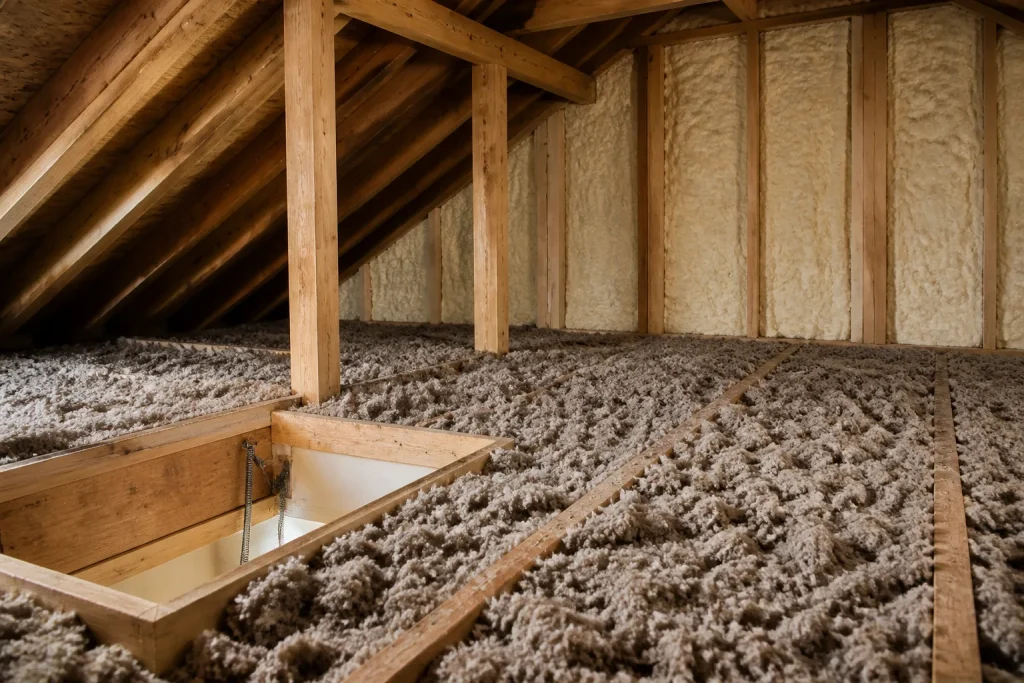
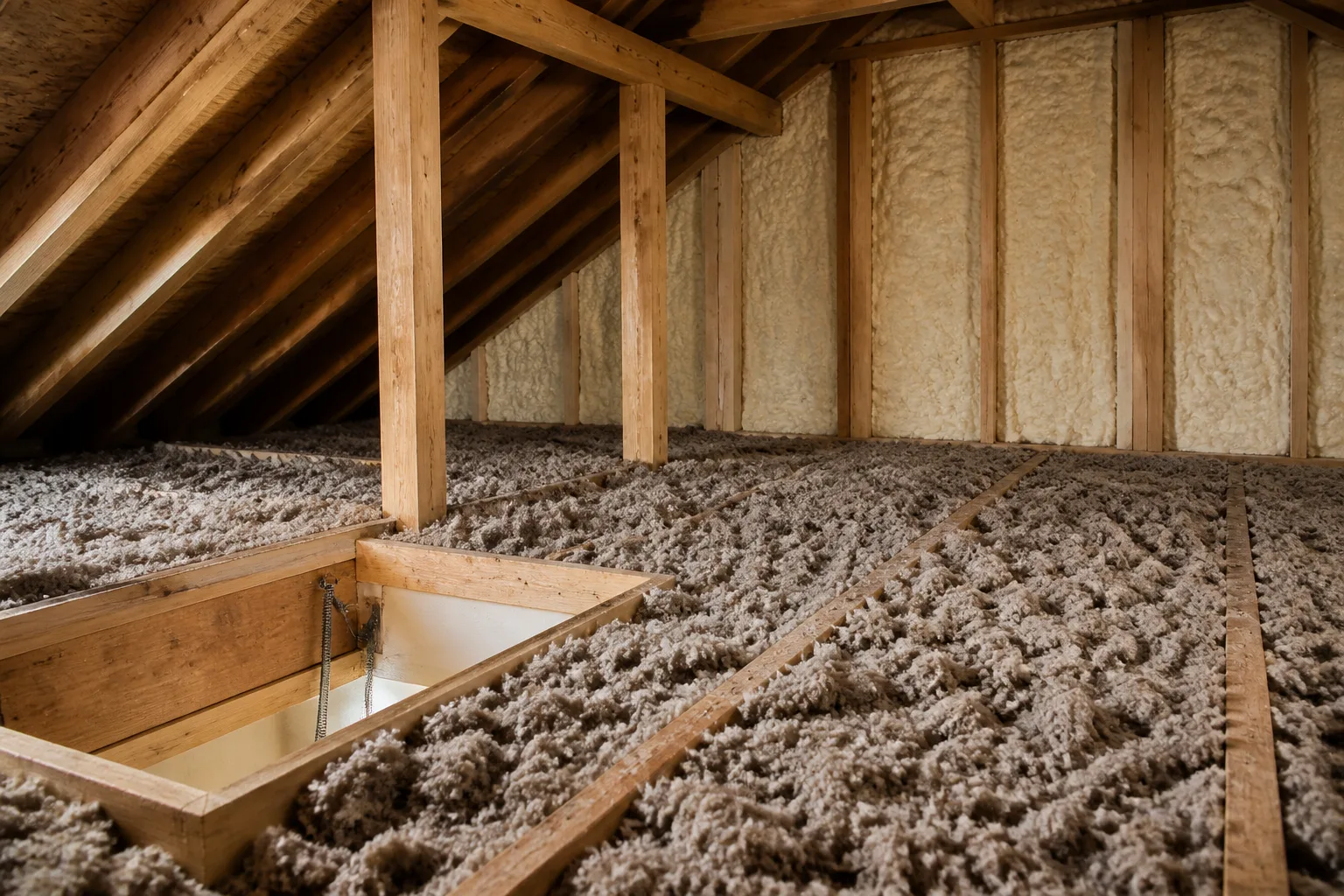
Insulation that looks intact from the attic hatch may be measuring at R-11 when it was installed at R-30. Settled, compressed, and moisture-cycled fiberglass batts lose effective R-value silently, and a visual walk-through won’t catch it. The repair-or-replace question in Boulder City isn’t really about age or appearance. It comes down to two measurable things: where your current effective R-value sits against code minimum, and whether the material underneath has been compromised by moisture or pests badly enough that it’s a substrate problem, not a coverage problem.
If you’d rather skip the crawl-around-the-attic part, call (844) 320-7926. We’ll measure it, scan it, and put the finding in writing before anyone touches a bag of insulation.
What’s the difference between effective R-value and the number on the bag?
R-value is the material’s resistance to heat flow. The number printed on a batts wrapper assumes the material stays at its manufactured density and stays dry. In a real Boulder City attic, neither holds for long. Summer attic temperatures push past 150°F, and the desert diurnal swing – hot days, cool nights – works fiberglass through thousands of expansion cycles over a decade. It settles. It compresses under stored boxes and foot traffic. Batt edges pull away from the joists and leave a gap you can’t see from the hatch.
Effective R-value is what the material is actually delivering right now, and it’s routinely 30 – 50% below the nominal rating in older attics. That gap is the whole reason a probe and a thermal scan matter. A thermal camera reads surface temperature differences across the attic floor and flags the cold spots – the settled sections, the compressed bays, the wet corner near the chimney chase. We probe the depth at multiple points and compare it to modeled performance.
- Nominal R-value: what the label claims at install.
- Effective R-value: what the material is doing today, measured on-site.
- Code minimum in Boulder City’s climate zone: typically R-38 to R-49 for an attic floor, depending on the assembly and the current energy code in force.
If the probe says you’re at R-22 and the thermal scan is clean, adding blown-in on top is a real option. If it says R-11 with wet sections and rodent runs, you’re looking at the other path. That decision is the whole game.
When is repair the right call?
Repair means topping up existing insulation rather than removing it. It’s defensible under three specific conditions, and all three need to be true at once:
- Localized damage only. The compromised area is confined – one bay near a bath fan, a strip along the eave where wind-driven rain got in, a section a raccoon nested in. The rest of the field probes at adequate depth and passes the thermal scan.
- Adequate depth in the unaffected zones. The clean sections already sit within a few inches of your target. Topping R-30 up to R-49 is a modest addition. Topping R-11 up to R-49 means a foot of new material over garbage, and you’re paying for coverage on top of a problem.
- No moisture or pest contamination in the substrate. The decking is dry, the joists are sound, and there’s no rodent harborage, no droppings matted into the batts, no mold at the eaves. If the substrate is clean, you’re fixing coverage. That’s a repair.
Here’s the caveat that trips people up: repair still requires air sealing first. Under our approach, we seal top plates, can lights, and penetrations before any insulation gets blown over the attic floor. We won’t blow new material over an unsealed floor, even on a small top-up, because you’d be paying to insulate a sieve. Certified CertainTeed and GreenFiber products go in only after the bypasses are closed.
When is full replacement the only defensible choice?
Replacement means removing the old material, air sealing the deck, and installing fresh insulation. Four conditions make it the only honest recommendation:
- Uniform settling below R-19. When the entire field probes low, the material has failed as a system. You’re not patching a bad bay – you’re reinstalling a floor.
- Evidence of rodent harborage. Droppings, urine staining, chewed vapor barrier, and travel runs mean the material is contaminated. We can’t seal and reuse a surface that’s already a health and odor problem. This is where attic cleaning and rodent proofing comes in ahead of the insulation itself.
- Confirmed moisture intrusion. Wet batts don’t dry in a sealed attic. If we find active moisture – a bath fan venting into the attic, a roof leak, condensation at a cold corner – the material has to come out and the source has to be fixed before anything new goes in.
- Vermiculite or asbestos-era material. Homes built before 1980 may hold vermiculite that could contain asbestos. That’s a removal job with disposal requirements, not a top-up. No exceptions.
In our experience in Boulder City, the split runs close to even. Plenty of homes here are good repair candidates. Plenty aren’t, and a homeowner who gets sold a top-up on a compromised floor ends up paying twice.
Why does a blower-door test before removal matter?
A blower-door test is a pressurization measurement. We seal the house, mount a calibrated fan in an exterior door, and pull a pressure difference across the building envelope. The reading – in CFM50, cubic feet per minute at 50 pascals – tells you in a single number how much conditioned air the house was losing before any work. That number is your baseline.
It matters because without it, you have no way to prove the new insulation actually improved envelope performance. Coverage looks better. The R-value on the invoice looks better. But if the air-leakage number didn’t move, you paid for batting, not performance. Running the test before removal and again after the seal-and-install lets you compare the two figures side by side: “the blower-door test read 4,200 CFM50 before sealing and 2,100 after.” That’s the number that tells you the truth.
We publish those before-and-after readings on applicable jobs. Not because it’s a marketing trick, but because you can’t audit an insulation job by eyeballing it.
Related services in Boulder City: if your decision lands on replacement or a larger envelope job, see our page on Attic Insulation in Boulder City for the full scope.
What disposal documentation should you get when old material comes out?
When material is removed from a pre-1980 attic, you should walk away with a paper trail. The vermiculite question is the big one. Vermiculite from certain historic sources can contain asbestos, and the only defensible way to handle it is to assume it might and dispose of it accordingly. That means a written record of what was removed, how it was contained, where it went, and who handled it.
Even for material without vermiculite, fiberglass with unknown binder chemistry from an older install should be documented as to quantity removed and disposal method. If a contractor hauls your old insulation out in the back of a pickup and hands you nothing, you have no record of what left your house or where it went. Ask for the disposal documentation before the crew arrives, not after. It’s one of those things a homeowner should never have to chase.
How does the cost math shake out?
Here’s the part most contractors won’t put on the page. In Boulder City, a straightforward top-up – blowing new insulation over an adequate, clean, sealed field to reach R-49 – is the lower-cost route, and it’s genuinely adequate when the conditions above hold. A full removal and reinstall costs more because you’re paying for labor on the removal, disposal, air sealing, and the new material.
But compare the two honestly:
- Top-up scenario: field probes at R-30, clean and dry, bypasses sealed. Add blown-in to reach R-49. Lower material cost, modest labor, fewer disposal fees. Adequate upgrade.
- Full replacement scenario: field probes at R-11, contaminated or wet, bypass network hidden under failed material. Removal plus disposal plus air sealing plus reinstall. Higher cost, but the only path that lets you access and seal the air bypasses buried underneath – and the bypass network is where the real leakage lives.
The trap is paying for a cheaper top-up on a floor that needed sealing, then discovering six months later that the air-leakage number barely moved. That’s the cost of skipping the diagnosis.
When to call a pro: if you’re crawling an attic in mid-July Boulder City heat, dealing with potential vermiculite, or trying to read a blower-door number, this is the point where a trained technician earns their keep. Air sealing and removal are not weekend jobs, and the risk of getting it wrong on a $4,000 decision is real. Our technicians have up to 10 years of experience, and every job starts with a written price – no work starts without one.
The Bottom Line
Repair or replace comes down to effective R-value against code minimum, plus whether moisture or pests have turned your attic floor into a substrate problem. Repair works when damage is localized, unaffected depth is adequate, and the substrate is clean. Replace when settling is uniform below R-19, rodents or moisture have compromised the material, or you’re looking at pre-1980 vermiculite. Get a blower-door baseline before anything is removed. Ask for disposal documentation when old material leaves.
If you’re in Boulder City and need help reading your attic, Envelope Insulation Boulder City offers free estimates – call (844) 320-7926. You’ll get a written price before any work starts, a free second opinion on any competing estimate you bring us, and a documented photo record when the crew leaves.
Frequently Asked Questions
Yes, if the existing material is clean, dry, and probing at adequate depth in the unaffected zones, and if the attic floor is air sealed first. Adding blown-in over an unsealed or contaminated floor is the mistake we see most often in Boulder City. Call (844) 320-7926 for a free estimate – we’ll tell you which scenario you’re in.
You can’t tell by looking. Effective R-value drops when material settles, compresses, or absorbs moisture, and those changes are invisible from the hatch. A depth probe at multiple points plus a thermal scan reveals it in an hour. That’s the only reliable read.
A blower-door test measures, in a single number (CFM50), how much conditioned air your building envelope is losing. Running it before removal gives you a baseline, so after the new installation you can compare before-and-after and see whether the job actually improved performance. Without it, you’re guessing.
Removal is required when settling is uniform below R-19, when rodent harborage or active moisture has contaminated the material, or when pre-1980 vermiculite is present. In each case you should receive disposal documentation. Call (844) 320-7926 to schedule an attic audit – estimates are free.
Written by the team at Envelope Insulation Boulder City.
Need Insulation Help?
Call Envelope Insulation Boulder City - licensed & insured, here with fast after-hours help in Boulder City.
(844) 320-7926