
GreenFiber Attic Insulation in Boulder City: A Homeowner’s Guide
GreenFiber cellulose is 85% recycled paper treated with borate fire retardant, and the same chemistry that makes it pest-resistant means bags stored in a humid job-site trailer for two weeks before installation carry measurably higher moisture content and lower settled density than the spec sheet assumes. In Boulder City’s high-desert swings, that gap between what the bag claims and what actually lands on your attic floor is the difference between an R-value you paid for and one you didn’t. This guide covers what GreenFiber does well here, where installers cut corners, and how to verify the job was done to spec.
What Is GreenFiber Cellulose and Why Does It Matter in Boulder City?
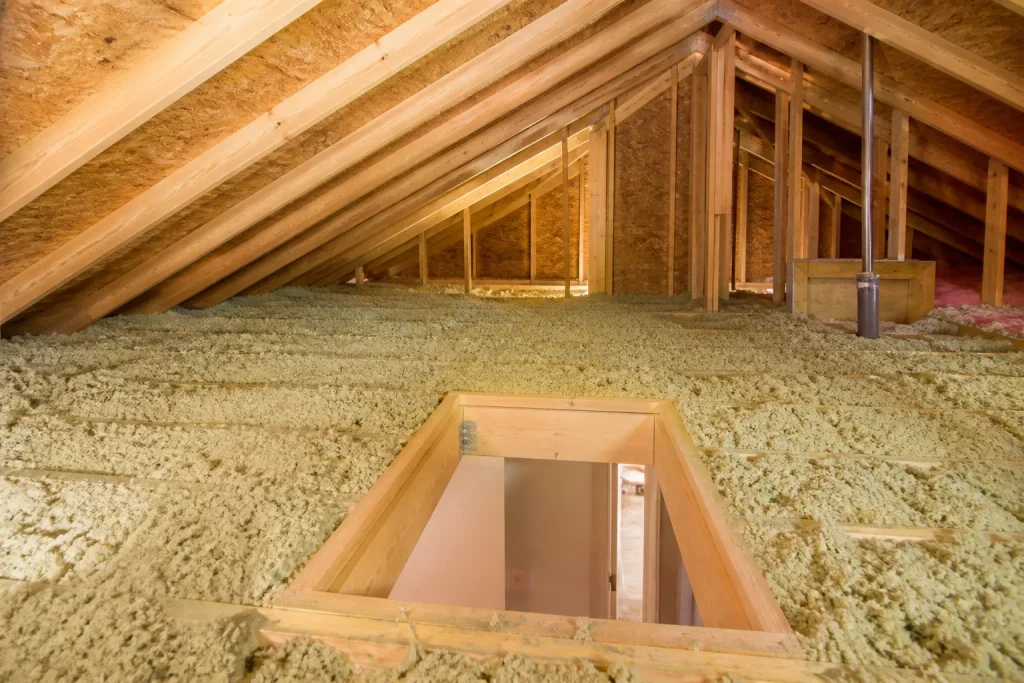
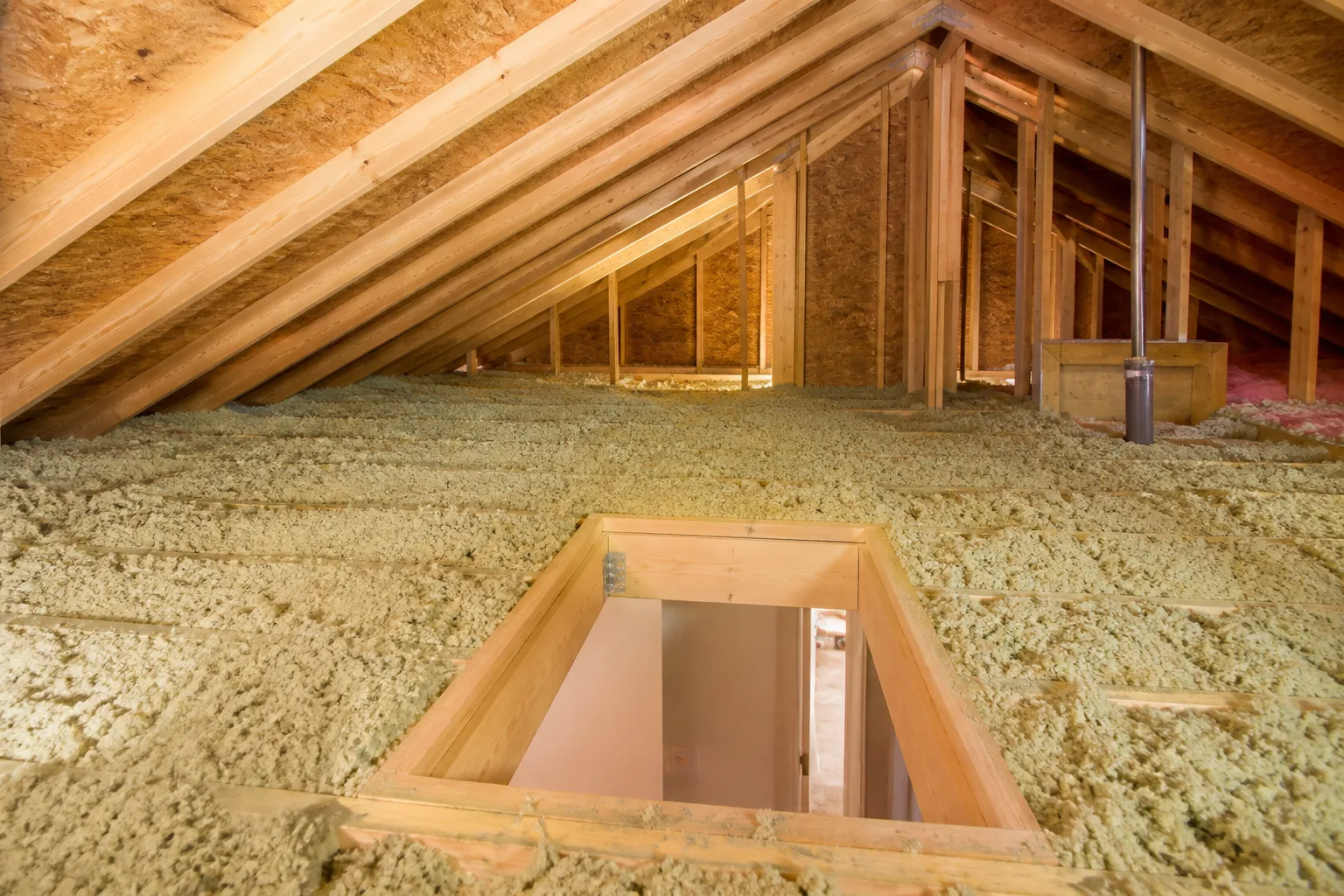
GreenFiber is a blown-in cellulose insulation made from post-consumer newsprint, treated with borate (a mineral salt) for fire and pest resistance. It’s the highest-recycled-content blown-in product commonly installed in Boulder City attics, and it’s specified by brand name because the borate treatment and density targets are consistent from batch to batch in a way that generic cellulose isn’t.
The borate does two jobs at once. It raises the material’s resistance to flame spread – GreenFiber carries an ASTM E84 Class 1 rating, meaning flame spread and smoke development both fall in the lowest tested category. For Nevada residential code compliance, that rating matters most where the insulation sits in direct contact with attic framing, wiring penetrations, and the underside of the roof deck near the eaves. Class 1 material in contact with combustible framing is what inspectors look for, and GreenFiber’s rating satisfies it without a separate fire-blocking layer in most standard attic assemblies.
What the spec sheet does not tell you is that borate is water-soluble. That single fact drives most of what follows in this guide.
What Settled Density Should GreenFiber Hit, and How Do You Verify It?
GreenFiber’s published target for horizontal attic application is an installed density of 1.5 to 1.8 pounds per cubic foot (lb/ft³). That number is not decoration – it’s what the R-value tables are calculated against. Blow the same material at 1.2 lb/ft³ and you get less R-value per inch than the bag claims, plus more settling over the first heating season.
The verification method is simple and every homeowner should ask for it: the bag-count calculation. Here’s how it works.
- Each bag of GreenFiber lists a coverage chart on the label – square feet covered at a given installed depth for a target R-value.
- Count the bags actually installed on your job.
- Measure the average settled depth in at least six spots across the attic (corners, center, near the hatch, along the eaves).
- Divide total bags by the square footage, then by the average depth in inches. The result is pounds per square foot per inch of depth, which converts directly to lb/ft³.
If the math comes in under 1.5 lb/ft³, the material was blown too light and the R-value is short. We’ve pulled apart jobs in Boulder City where the contractor’s truck log said 42 bags and the attic held enough material for 30. That’s not a rounding error – it’s a 25% shortfall on a job the homeowner paid full price for.
Cellulose vs. Blown Fiberglass in a Boulder City Hot Attic
Boulder City summers push attic temperatures past 140°F on a routine July afternoon, and the diurnal swing (the spread between the overnight low and the afternoon high) is one of the wider ones in southern Nevada. That swing is where cellulose earns its keep against blown fiberglass.
At equivalent installed depth, cellulose carries a slightly higher density – roughly 1.5 to 1.8 lb/ft³ versus 0.5 to 0.7 lb/ft³ for blown fiberglass. That mass matters in two ways. First, denser material resists convective looping, where air currents inside a loose-fill blanket ferry heat from the hot roof deck down toward the ceiling. Second, the mass acts as a thermal buffer during the swing – it releases heat more slowly in the evening, which flattens the temperature curve your air conditioner sees.
Blown fiberglass still wins on one point: it’s essentially inert to moisture. Cellulose is not. If your attic has an active bath fan venting into it or a roof leak, fiberglass will dry out; cellulose may not. Neither material is the right answer for a wet attic. Fix the moisture first. If you’re weighing spray foam against blown-in for a Boulder City home with a complicated roofline, our Spray Foam Insulation in Boulder City page covers where foam actually makes sense and where it doesn’t.
Moisture Tolerance: GreenFiber’s Real Limit in Boulder City’s Climate
GreenFiber can tolerate brief wetting during installation – a rainy delivery day, a humid trailer – and dry back out without permanent loss. Sustained moisture above 20% moisture content (MC) is a different story. Above that threshold, the borate fire retardant begins to migrate out of the cellulose fibers and into the surrounding assembly. You lose fire resistance, you lose pest resistance, and the material can clump and lose its loft permanently.
The check is a moisture meter reading taken 30 days after installation. Not the day of. Thirty days gives any brief installation moisture time to equilibrate with the attic air, so a reading at that point tells you whether you have a persistent problem or a one-time event. We take readings at multiple depths and locations – a single surface reading tells you nothing about what’s happening at the bottom of a 14-inch blanket.
Two Boulder City construction patterns put attics at elevated moisture risk:
- Bath and dryer exhaust vented into the attic instead of outdoors. Common in homes built before the 1990s code updates, and in older Boulder City neighborhoods near the historic district. This is the single most common cause of cellulose failure we see.
- Knee-wall and low-slope roof assemblies with no path for vapor to escape. A sealed-tight attic that can’t dry to either side will hold moisture. Cellulose in that assembly needs a vapor strategy, not just a bag count.
What Your Documentation Package Should Include
Here is the part of the job most homeowners never think to ask about until it’s too late to get it. A completed GreenFiber attic insulation job should leave you with three documents, and if you don’t have all three, the job isn’t documented.
- Installed depth verification photos. A tape measure against the settled depth at labeled locations in the attic, with the measurement visible in frame. Six or more locations across the attic floor.
- Bag count versus square footage calculation sheet. Total bags installed, total square footage covered, average depth, and the resulting lb/ft³. This is your proof the density target was met.
- Blower-door ACH50 reading confirming the air-sealing layer underneath. This is the one that separates a proper job from a blow-and-go. The blower-door test is a pressurization measurement that shows, in a single number, how much air your building envelope is losing. The ACH50 reading should be taken after air sealing and before the blown-in goes down. If a contractor can’t produce a reading showing the attic floor was sealed before the material went in, they blew GreenFiber over unsealed top plates, can lights, and penetrations – and your R-value is addressing the wrong problem.
This is where our approach differs, and it’s not complicated: sealed first, then insulated, in that order. We won’t blow any brand of insulation over an unsealed attic floor. Before and after blower-door numbers get published on every applicable job so you can see the performance change you actually paid for. A sample: on a Boulder City ranch home with 1,100 square feet of attic last spring, the blower door read 4,200 CFM50 before sealing and 2,100 after. The cellulose went in on top of that, not over a leaky ceiling. Our Attic Insulation in Boulder City page has more on how the sealing-before-insulation sequence works.
When to Call a Pro
If your attic already has cellulose, fiberglass, or foam and you’re not sure of the installed density, depth, or whether the floor was ever sealed, an assessment is the right starting point. DIY cellulose installation looks simple – rent the blower, buy the bags, blow the attic – but two things go wrong almost every time: the density target gets missed because the machine settings are wrong, and the air sealing gets skipped because it’s invisible work done before the fun part.
We’ve talked to Boulder City homeowners who spent a Saturday afternoon blowing 20 bags into an attic that had a six-square-foot gap around a can light and no top-plate sealing at all. The insulation wasn’t the problem. The envelope was. And the documentation package – the photos, the bag count, the blower-door reading – is what tells you which situation you’re in. Our Envelope Insulation Boulder City home page walks through the full service line if you want the broader picture.
Related Services in Boulder City
Cellulose in a wet crawl space doesn’t work either – moisture migrates up. If your Boulder City home has a vented crawl space, the vapor barrier is part of the envelope conversation: Crawl Space Encapsulation & Vapor Barrier in Boulder City.
What happens when you call
- 1
A real person answersNo phone trees – you reach a local pro.
- 2
You get an upfront price rangeHonest numbers before anyone is dispatched.
- 3
A background-checked tech heads outLicensed & insured, dispatched right away.
- 4
You approve before work beginsNothing starts until you say go.
The Bottom Line
GreenFiber cellulose is a strong choice for a Boulder City attic when it’s installed at 1.5 to 1.8 lb/ft³ on top of a sealed attic floor, and when the moisture path is controlled. The borate fire retardant carries Class 1 ASTM E84 ratings that satisfy Nevada code in contact with framing. The mass effect helps in our temperature-swing climate. The failure modes – undersettling, skipped air sealing, and moisture above 20% MC – are all things a homeowner can verify with a bag count, a blower-door reading, and a 30-day moisture meter check. Ask for all three in writing before the crew leaves.
If you’re in Boulder City and need help, Envelope Insulation Boulder City offers free estimates. We’ve sealed and insulated 9,000+ homes, every one with a written price before work started and a documented record when the crew left, all under the 365-Day Done Right Promise. Call (844) 320-7926. Calls are answered by a live person, 24/7.
Frequently Asked Questions
Most GreenFiber attic insulation jobs in Boulder City run between $1.80 and $2.60 per square foot for material and installation at R-38 to R-49, with the lower end for open, simple attic layouts and the higher end for attics that need air sealing first, baffle installation at the eaves, or debris removal. A 1,200-square-foot attic typically lands between $2,400 and $3,100. Call (844) 320-7926 for a written price before any work starts – estimates are free.
Yes. GreenFiber carries an ASTM E84 Class 1 flame spread and smoke development rating, which satisfies Nevada residential code requirements for insulation in contact with attic framing. The borate treatment is what earns that rating. Ask for the product spec sheet and confirm the lot number matches what was installed – that’s the documentation required to prove code compliance after the fact.
You check the bag-count calculation per square foot per inch of depth. GreenFiber’s target is 1.5 to 1.8 lb/ft³ for horizontal attic application. Any contractor should be able to hand you a sheet showing total bags installed, total square footage, average settled depth, and the resulting lb/ft³. If they can’t produce that sheet, the density is unverified. Call (844) 320-7926 if you want a second opinion on a density calculation a competing contractor gave you – we’ll read it with you, free.
Sometimes, but only if the air sealing is done first and the existing insulation is dry, intact, and not contaminated by rodent activity or mold. Blowing cellulose on top of wet or pest-damaged material traps the problem underneath. We assess the existing material with a moisture meter and a visual inspection before recommending a top-off versus a full removal. On any written estimate you get from anyone, the scope should state clearly which approach was chosen and why. Call (844) 320-7926 for a documented assessment – the photo record is included on every visit.
Written by the team at Envelope Insulation Boulder City.
Need Insulation Help?
Call Envelope Insulation Boulder City - licensed & insured, here with fast after-hours help in Boulder City.
(844) 320-7926