
Johns Manville Attic Insulation in Boulder City: A Homeowner’s Guide
Johns Manville publishes third-party Environmental Product Declarations on most of its insulation lines, a level of material transparency almost no competitor matches. Fewer than one in ten homeowners who ask us for a quote have ever seen one. That document tells you embodied carbon, recycled content percentage, and the exact testing conditions under which R-value was measured. In Boulder City, where attics sit above 110°F for four months, those testing conditions matter more than the marketing on the bag.
If you’d rather have someone read the spec sheet with you than sort it out alone, call (844) 320-7926.
What Is a Johns Manville EPD, and Why Should a Boulder City Homeowner Care?
An Environmental Product Declaration is a third-party-verified document that reports a product’s environmental impact across its life cycle, including embodied carbon, recycled content, and the standards used to test it. Johns Manville publishes EPDs on most of its fiberglass and mineral wool lines. Most insulation sold in Boulder City comes with nothing comparable.
Why it matters here: Nevada energy rebate programs increasingly reward low-embodied-carbon materials, and a documented EPD is the proof an auditor or program administrator will accept. Without one, you’re relying on a manufacturer’s word. With one, you’re handing over a verified number.
Three things an EPD actually tells you:
- Embodied carbon. The CO2e tied to making and shipping the product, reported per functional unit. JM’s fiberglass lines generally score well because the raw material is sand and recycled glass, not petrochemicals.
- Recycled content percentage. JM reports both pre- and post-consumer recycled glass in its fiberglass products. That figure varies by product line, so check the specific EPD for the product you’re quoted.
- Test conditions for R-value. R-value is measured at a stated mean temperature. At 75°F mean, a product performs one way. At the attic temperatures Boulder City sees in July, performance shifts. Knowing the test conditions tells you how much to trust the number on the label.
We keep EPDs on file for every material we install. Ask for one before you sign anything, from us or anyone else.
Climate Pro Blown Fiberglass vs. JM Batts in Boulder City’s Unconditioned Attics
Boulder City sits in IECC Climate Zone 3B: hot-dry, with design temperatures that push unconditioned attic air well past 130°F in summer. The choice between Johns Manville’s blown fiberglass (Climate Pro) and its batt products comes down to density, settled thickness, and how the material behaves when the attic is working against it.
Here’s the comparison that matters:
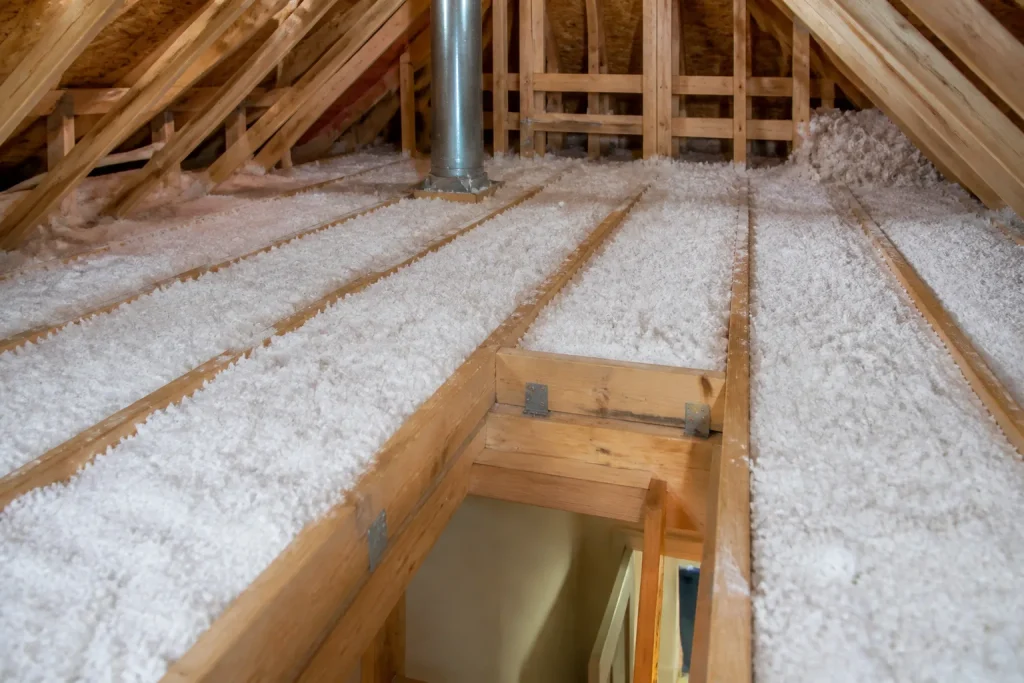
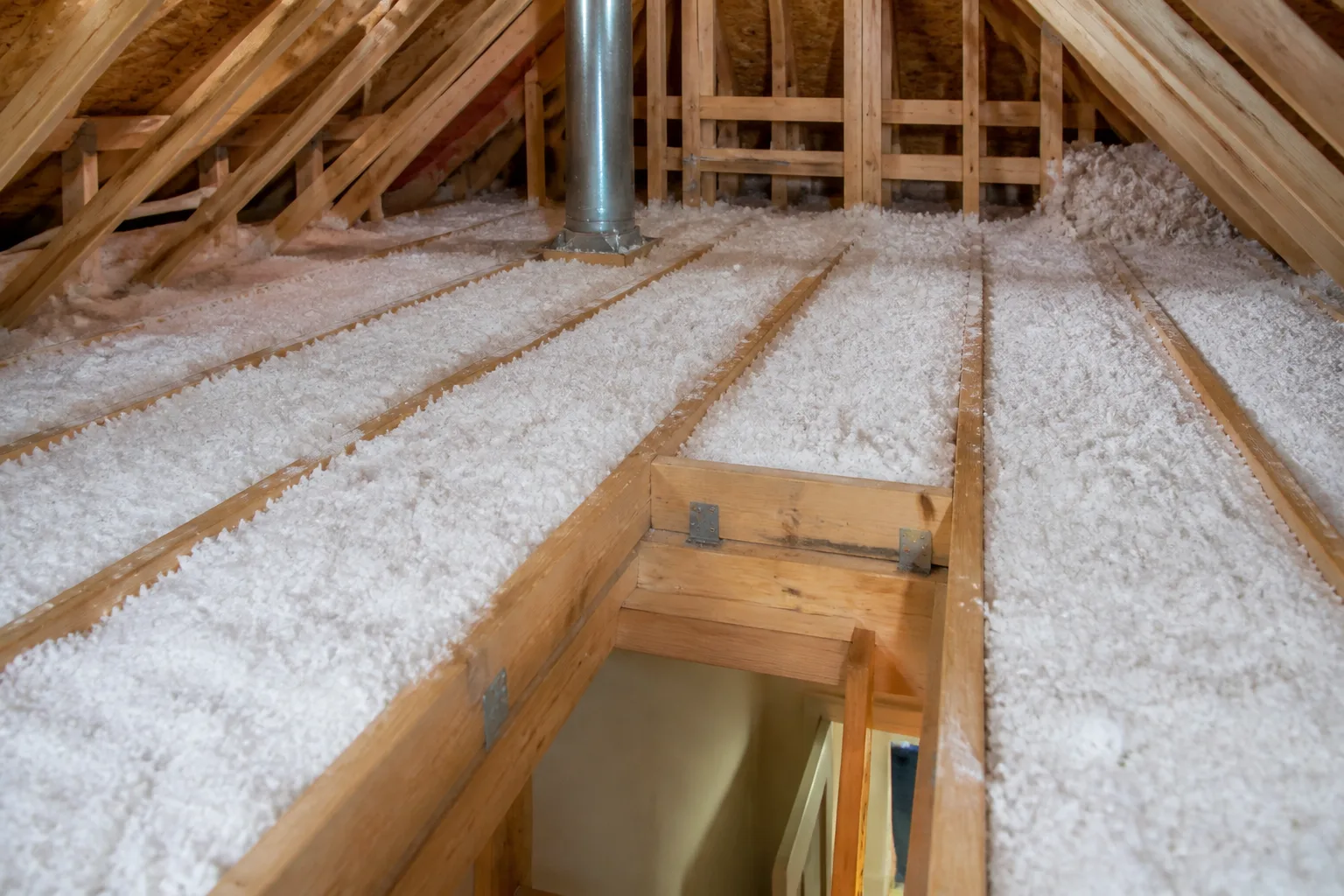
- Climate Pro blown fiberglass. Installed loose, blown to a specified settled density (typically around 1.5 to 2.0 lbs/ft³ depending on the R-value target). Fills around obstructions, truss webs, and irregular framing better than batts. Settles over time; the installed depth you measure on day one is not the depth you’ll measure in year three, which is why the settled R-value is what you should be quoted, not the bag R-value.
- JM fiberglass batts. Higher density per inch, pre-formed, and easier to verify visually. They perform well in clean, regular cavities. They leave gaps around wires, can lights, and top plates unless those areas are air-sealed first. In a Boulder City attic with a lot of penetrations, batts alone are the wrong answer.
- JM mineral wool batts. Denser still, non-combustible, and more moisture-tolerant than fiberglass. Worth considering where the attic assembly has any history of condensation or where fire performance is a priority.
Our rule, every time: seal first, then insulate. We won’t blow Climate Pro over an unsealed attic floor. If the top plates, can lights, and penetrations aren’t sealed, the insulation is just a blanket over a hole. See our Attic Insulation in Boulder City page for how that sequencing works in practice.
Vented vs. Unvented: Which JM Product Line Fits Your Boulder City Attic?
Your attic assembly determines which Johns Manville product is appropriate, not the other way around. This is the step most quotes skip.
Vented attic (the common case in Boulder City). Soffit and ridge vents move outside air through the attic to carry heat and moisture out. Here, the insulation goes on the attic floor, and the product choice is Climate Pro blown fiberglass or JM batts. Critical detail: ventilation baffles must be installed at every rafter bay before insulation goes down, or the blown material will block the soffit and choke the vent.
Unvented or conditioned attic. The insulation goes on the roof deck, not the floor, and the assembly becomes part of the building envelope. Fiberglass is the wrong material here. You need closed-cell spray foam (we install Demilec and Icynene) or a rigid board with a sealed air barrier. Blowing fiberglass against a hot roof deck in an unvented assembly traps moisture and creates a condensation problem you’ll discover two summers later.
We pulled a job out of a garage in Boulder City last spring where a prior crew had blown fiberglass into an unvented roof assembly. The deck was wet. The fix wasn’t more insulation. It was Spray Foam Insulation in Boulder City applied to the deck after the failed material came out.
If your attic is vented and the floor is the right target, Envelope Insulation Boulder City walks through how we approach the whole envelope, not just the attic.
Vapor Retarder Placement in Climate Zone 3B: Where JM’s Specs Diverge from Cold-Climate Rules
Johns Manville’s own technical data specifies vapor retarder placement differently for hot-dry climates than for cold climates. Boulder City is firmly in the hot-dry camp, and getting this wrong is one of the most common installation errors we see.
In cold climates (Zones 5 and up), a vapor retarder goes on the warm-in-winter side of the insulation, typically between the ceiling and the conditioned space. In Boulder City’s Zone 3B, the vapor drive runs the other direction for much of the year. The rules shift:
- Do not install a vapor retarder (poly or otherwise) on the attic floor in a vented assembly in Zone 3B. It traps moisture against the ceiling drywall during the cooling season, when the conditioned air is cool and the attic above is hot.
- Use a vapor-permeable air barrier instead. The job of stopping air movement belongs to air sealing (caulk, foam, gaskets), not to a sheet of poly. Sealed first, then insulated, in that order.
- In an unvented assembly, the vapor retarder question is answered by the spray foam itself. Closed-cell foam at two inches or more is a Class II vapor retarder. The roof deck assembly is designed around that.
This is where a Boulder City homeowner gets burned by a crew that learned the trade in Minnesota. The material was right; the vapor logic was wrong. Our technicians have up to 10 years of experience and we verify climate-zone specs before a single bag comes off the truck.
What Documentation Should You Hold After a Johns Manville Install?
Ask for three things in writing, and hold them. Any installer working in Boulder City should be able to hand them over on the day of completion, not two weeks later.
- Installed depth at multiple measurement points. Blown fiberglass settles, so the depth you measure in year three is lower than the depth on installation day. A proper record lists the settled depth achieved at, say, five or six points across the attic, with the corresponding R-value. That’s your baseline for any warranty claim.
- Ventilation baffle confirmation, with photos. Every rafter bay that has a soffit vent should have a baffle in place before insulation goes down. The only way to verify it after the fact is with photos taken before the blow. We include a documented record on every visit, which includes exactly this.
- Blower-door delta if air sealing was done concurrently. A blower-door test is a pressurization reading that shows, in a single number, how much air your building envelope is losing. Before-and-after readings (CFM50 before sealing, CFM50 after) tell you what the air-sealing work actually accomplished. Without them, you’re taking the installer’s word.
When to Call a Pro
Fiberglass batts and blown material aren’t intrinsically dangerous, but the work that has to happen before them is where people get hurt. Air sealing around can lights and top plates means crawling through an attic with 130°F air, exposed wiring, and no stable footing. Spray foam chemistry requires respiratory protection and ventilation. And if your home has an unvented assembly, the wrong product choice creates a moisture problem that a homeowner won’t recognize until it’s expensive.
The national brands on the market all work. Owens Corning, GreenFiber, Johns Manville, and the mineral wool lines are all legitimate products, and the EPDs and technical data are public. What separates a good Johns Manville installation in Boulder City from a bad one is the sequencing and the documentation.
Related services in Boulder City: Attic Insulation in Boulder City, Spray Foam Insulation in Boulder City, Crawl Space Encapsulation & Vapor Barrier in Boulder City, and Envelope Insulation Boulder City.
The Bottom Line
Johns Manville’s EPDs and technical data are the most useful documents most Boulder City homeowners have never read. The product line is genuinely good. The installation is where it succeeds or fails: air sealing before insulation, the right product for the right assembly (vented vs. unvented, Climate Zone 3B vapor rules), and documentation you can hold in your hand when the crew leaves.
- Climate Pro blown fiberglass for vented attic floors; JM batts or mineral wool where density and fire performance matter; spray foam for unvented assemblies.
- No vapor retarder on the attic floor in a vented Zone 3B assembly. Air sealing is the vapor strategy.
- Ask for installed settled depth, baffle photos, and a blower-door delta if sealing was part of the job.
- Under Haven Standard, every job begins with a written price and a written scope. Free second opinion on any written estimate you bring us.
If you’re in Boulder City and want a real number before anyone comes out, Envelope Insulation Boulder City offers free estimates. Call (844) 320-7926. We’ll read your quote with you, EPDs and all.
Frequently Asked Questions
Yes. Johns Manville’s Climate Pro blown fiberglass and its batt and mineral wool lines all perform well in Boulder City’s hot-dry Climate Zone 3B when installed in the right assembly. Vented attic floors are a good fit for Climate Pro. Unvented roof assemblies need spray foam instead, and cold-climate vapor retarder rules should not be applied in Boulder City.
Qualification depends on the specific program and product line, and some Nevada programs weight low-embodied-carbon materials. An EPD is the documentation an administrator will accept as proof. Ask your installer for the EPD for the exact product quoted, not the marketing sheet. If you have a quote in hand, call (844) 320-7926 and we’ll walk through it with you.
Blown Climate Pro for most vented attic floors, because it fills around trusses and penetrations and delivers uniform settled R-value. Batts make more sense in a clean, regular cavity where visual verification matters. In a Boulder City attic with lots of can lights and wiring, batts alone leave air gaps that undermine the R-value. Air sealing before either product goes in is the deciding factor.
A blower-door test measures how much air your home loses under controlled pressurization, reported in CFM50. Before and after readings, taken around the air-sealing work, tell you how much of your conditioned air was leaking out and how much the work reduced that. Without a before reading, the after number alone is a single data point with nothing to compare. Call (844) 320-7926 for a free estimate that includes both readings.
Written by the team at Envelope Insulation Boulder City.
Need Insulation Help?
Call Envelope Insulation Boulder City - licensed & insured, here with fast after-hours help in Boulder City.
(844) 320-7926