
Knauf Attic Insulation in Boulder City: A Homeowner’s Guide
At 120°F, the phenol-formaldehyde binders in standard fiberglass batts off-gas at measurably higher rates than they do at room temperature. Knauf EcoBatt uses a bio-based binder instead. Boulder City attics routinely hit 130 – 140°F in July, and for roughly 90 days a year that heat is the operative condition your insulation lives under. That makes the binder chemistry a practical question here, not a marketing footnote. This guide covers what Knauf EcoBatt actually is, how it should be installed in Boulder City homes, and what the written record should look like when the crew leaves.
If you’d rather not sort through the specs yourself, call (844) 320-7926 and we’ll walk you through it.
What Is Knauf EcoBatt, and Why Does the Binder Matter in Boulder City?
Knauf EcoBatt is fiberglass insulation made with ECOSE Technology, a bio-based binder that replaces the phenol-formaldehyde binder used in conventional fiberglass. ECOSE is derived from renewable plant materials rather than petroleum-based chemicals, and it’s what gives EcoBatt its tan color instead of the pink or yellow most homeowners recognize. The claim isn’t just environmental: the product carries UL GREENGUARD Gold certification for low chemical emissions and is verified through the asthma & allergy friendly certification program, both of which are third-party standards you can look up rather than take on faith.
Why does that matter specifically in Boulder City? Attics here are among the hottest working environments in the country. Clark County summer temperatures push attic air well past ambient, and the radiant load off a shingled roof deck keeps that heat in place from mid-morning until well after sunset. Fiberglass doesn’t burn or melt at those temperatures, but binder chemistry does respond to heat. Conventional binders release more volatile organic compounds as temperature climbs. A bio-based binder formulated to lower those emissions is worth more in a Boulder City attic than it would be in a mild coastal climate, where the same product sits at 80°F year-round.
One honest caveat: no insulation is a health product, and EcoBatt isn’t a cure for anything. The distinction is about reducing what off-gasses in the hottest, most enclosed space in your home. If you’re comparing fiberglass options for a Boulder City house, Knauf EcoBatt is the one where the binder question is actually answered.
Blown-In vs. Batt: Which Knauf Format Fits Your Boulder City Attic?
Most Boulder City homes fall into two attic shapes: flat ceilings with limited attic access, and cathedral or vaulted sections over living space. The format you choose follows from the shape, not from preference.
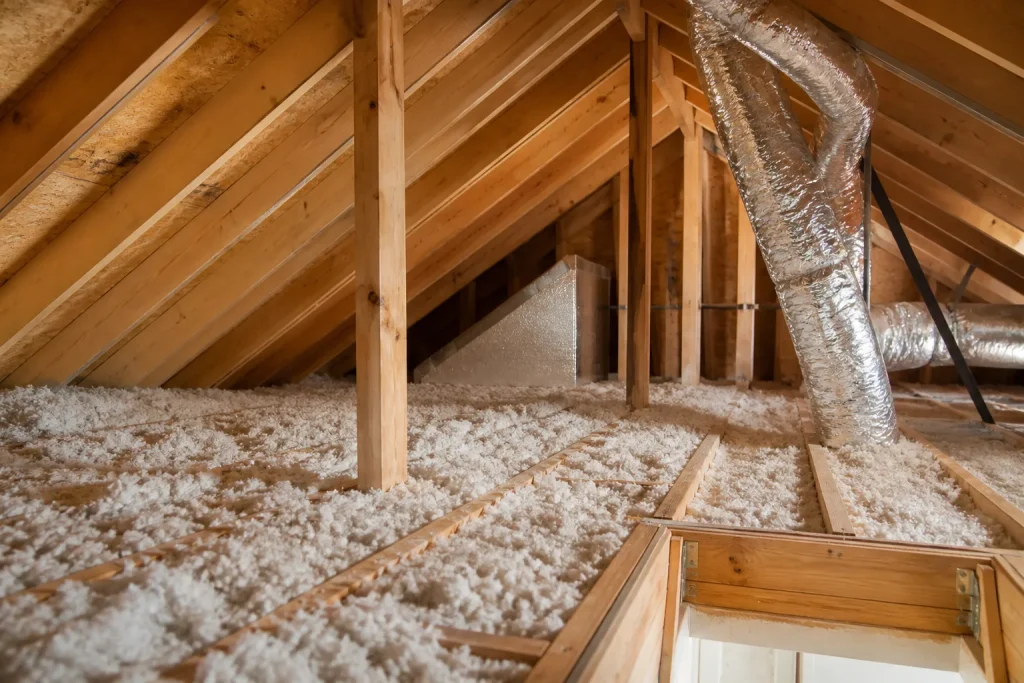
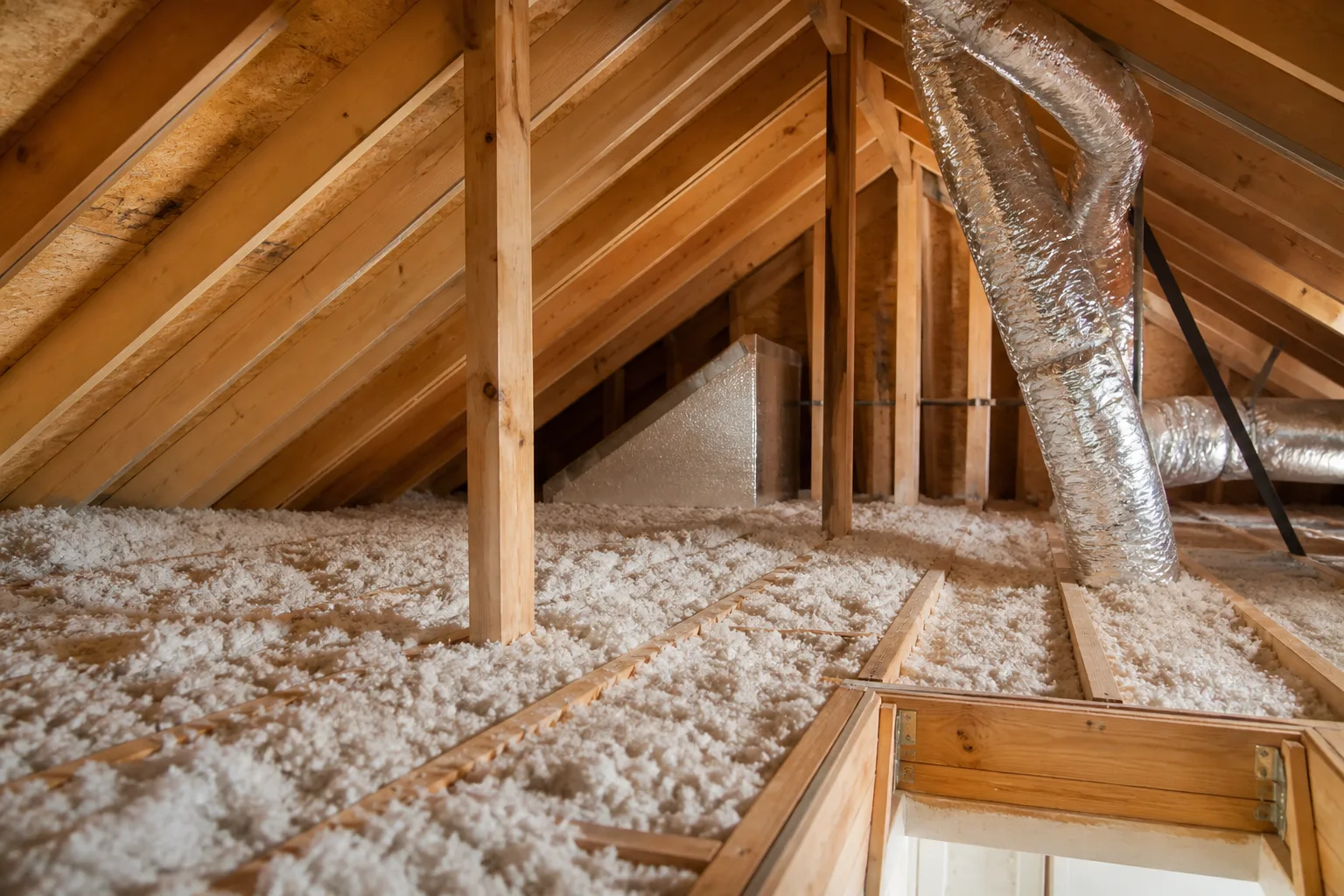
Blown-in EcoBatt (unbonded loosefill) is the right call for flat ceilings with a standard scuttle or knee-wall access. Loosefill fills around obstructions, wires, and framing that batts can’t cover without cutting and fitting, and it’s the format that lets a crew hit a target depth evenly across the whole floor. For most single-story Boulder City ranches and mid-century homes, this is the practical answer.
Batt formats make sense in cathedral sections where there’s no open attic floor to blow onto. Friction-fit batts go between rafters or behind a finished ceiling, and getting them right takes careful cutting around vents and recessed fixtures.
- Blown-in: flat ceilings, open attic floor, uneven joist spacing, lots of penetrations to work around.
- Batt: vaulted or cathedral ceilings, exposed rafter bays, tight knee-wall cavities.
- Combination: many Boulder City homes need both, with blown-in over the flat run and batt in the vaulted section.
If your house has both shapes, the two formats can be quoted and installed in the same job. The key is that each section gets the format that lets it reach spec depth, not whichever is easier to carry up the ladder.
What R-Value Does a Boulder City Attic Need?
Boulder City sits in Climate Zone 3B, and Nevada energy code currently calls for a minimum of R-38 in attics. That’s the floor, not the ceiling. Homes with ductwork running through the attic or a lot of can lights often perform better at R-49, and the right number depends on what the attic is actually doing.
Here’s where Knauf’s settled density numbers matter. Loosefill R-value is a function of installed depth times settled density, not the fluffy depth you see right after the crew leaves. Knauf EcoBatt loosefill settles over time, so the spec has to account for how much. To hit R-38 with blown-in EcoBatt, you generally need an installed depth in the range of 13 to 14 inches, depending on the exact R-value per inch at the settled density. To hit R-49, you’re looking at closer to 16 to 18 inches. Those are the numbers a written scope should state explicitly, in inches, so you know exactly what was promised.
What we’ve found in Boulder City attics is that older homes were built to R-11 or R-19 and still carry that spec decades later, sometimes topped with a few bags of whatever was on sale at the time. If your attic hasn’t been measured, you don’t know your R-value. A depth reading at five points tells you in about ten minutes.
Can You Top Off Existing Insulation With Knauf Loosefill?
Topping off aged fiberglass with Knauf loosefill is sometimes appropriate and sometimes not. The deciding factor is what’s already on the attic floor, not what product you’re adding.
Top-off usually makes sense when:
- The existing insulation is clean, dry, and still at a stable depth.
- There’s no rodent activity, water staining, or compressed batt sections.
- The attic floor has already been air sealed, or can be sealed before the new material goes down.
- The existing R-value is known and the top-off math is written out.
Full removal and restart usually makes sense when:
- The existing insulation is matted, contaminated, or holding rodent waste.
- There’s no way to air seal the top plates and penetrations without disturbing the old material.
- The attic has moisture problems that need to be fixed before anything new goes in.
Here’s the part most Boulder City homeowners don’t hear from a straight top-off quote: if the attic floor isn’t sealed first, the new insulation gets blown over unsealed top plates, can lights, and wire penetrations, and you’ve just buried the air leaks under fresh material where nobody can reach them. That’s why we won’t blow insulation over an unsealed attic floor. Air sealing comes first, then insulation. In older Boulder City homes near the historic district, we’ve pulled material that had been topped off twice and still read R-22 at the settled depth because nobody checked the depth after the fact.
What the Written Record Should Look Like After a Knauf Job
You should walk away from a Knauf attic job with documentation, not a verbal summary. Here’s what we consider the minimum for a Boulder City home:
- Installed depth grid measurements. At least five measurement points per 500 square feet, recorded in inches and written down. Depth is the only way to verify that the R-value you paid for is the R-value installed.
- Product lot numbers. Knauf EcoBatt bags carry lot codes. Those go in the record so the material is traceable.
- Before-and-after blower-door readings, if air sealing was part of the job. A blower-door test is a pressurization reading that shows, in a single number, how much air the building envelope was losing before and after the work. If your scope included air sealing, you should have two numbers: CFM50 before and CFM50 after.
- Photos of the attic floor before, during, and after. Documented photo record, not “available on request.”
- The written scope and written warranty that came before the work, not after.
Under The Haven Standard, every job we run starts with a written price before anyone lifts a tool and closes with a documented photo record and, where applicable, before-and-after blower-door numbers. That standard is Clause 1 at our company and it isn’t optional on Knauf jobs. We’ve sealed and insulated more than 9,000 homes since 2016, and every one of those has a written price and a documented record behind it.
When to Call a Pro
Some attic work is genuinely dangerous. Blowing loosefill insulation is not a task where a homeowner can safely work around live wiring, recessed can lights with unknown clearances, or a hot roof deck at 140°F in July. Attic air sealing around a flue or a chimney chase involves combustion safety. If your attic has any of the following, it belongs in the hands of a trained professional:
- Recessed can lights without IC-rated housings, or knob-and-tube wiring anywhere in sight.
- A gas furnace, water heater, or flue pipe passing through the attic.
- Rodent activity or contaminated material that needs to come out first.
- Cathedral ceilings where batt compression is a real risk if the fit isn’t exact.
We work with background-checked technicians whose experience runs up to 10 years, and we’re happy to look at what you have before you commit to anything. If you’re comparing options, our Attic Insulation in Boulder City page walks through the full service line, and if your attic shares a wall with a crawl space, our Crawl Space Encapsulation & Vapor Barrier in Boulder City page covers the other half of the envelope.
Related services in Boulder City: if your project includes sealing between the attic and a crawl space, or you’re comparing Knauf against spray foam for a vaulted section, our Spray Foam Insulation in Boulder City page lays out the trade-offs. You can also start at our Envelope Insulation Boulder City home page to see the full building-envelope service line.
The Bottom Line
Knauf EcoBatt earns its place in a Boulder City attic because the binder chemistry holds up under the heat conditions here. The product choice only pays off if it’s installed at the specified density and depth, over an attic floor that’s already been air sealed. R-38 is the Clark County code minimum for Climate Zone 3B; R-49 often makes more sense depending on your ductwork and can lights. Topping off aged fiberglass is sometimes fine and sometimes not, and the deciding factor is the condition of what’s already there, not the new bags.
What you should insist on, no matter who does the work: a written price before anyone starts, at least five depth measurements per 500 square feet, product lot numbers, and before-and-after blower-door readings if air sealing was in the scope. If a quote doesn’t include those, ask why.
If you’re in Boulder City and need help, Envelope Insulation Boulder City offers free estimates – call (844) 320-7926. If you already have a written estimate from another contractor, we’ll read it with you as a free second opinion. Same product standards, same documentation, and no pressure on the call.
Frequently Asked Questions
Yes. Knauf EcoBatt is fiberglass insulation and doesn’t burn, melt, or degrade at the attic temperatures Boulder City sees in summer. Its bio-based ECOSE binder replaces phenol-formaldehyde, which is the binder most conventional fiberglass uses. The product carries UL GREENGUARD Gold certification and asthma & allergy friendly certification, both third-party standards you can verify. Call (844) 320-7926 if you want to review the spec sheet for your specific attic before deciding.
Generally 13 to 14 inches of settled depth for R-38, and 16 to 18 inches for R-49, depending on the exact R-value per inch at Knauf’s settled density. The number that matters is the settled depth, not the fluffy depth immediately after installation. Ask for at least five depth measurements per 500 square feet recorded in inches on your paperwork. Call (844) 320-7926 for a free depth check on your Boulder City attic.
Top-off is usually cheaper when the existing insulation is clean, dry, and still at a stable depth, and the attic floor can be air sealed before the new material goes in. Removal and restart usually costs more but produces a better documented outcome when the old material is matted, contaminated, or sitting over unsealed penetrations that need to be reachable. Call (844) 320-7926 and we’ll look at both options with you before you commit.
Yes. We source from Knauf, Johns Manville, CertainTeed, Owens Corning, Rockwool, and other manufacturers, so we’re not locked into one product line. If Knauf EcoBatt fits your attic and your ceiling configuration, we’ll quote it; if another brand makes more sense for your specific build, we’ll say so. Call (844) 320-7926 for a written price before any work starts – that’s the standard on every job.
Written by the team at Envelope Insulation Boulder City.
Need Insulation Help?
Call Envelope Insulation Boulder City - licensed & insured, here with fast after-hours help in Boulder City.
(844) 320-7926