
Owens Corning Attic Insulation in Boulder City: A Homeowner’s Guide
An Owens Corning bag lists R-value per inch. It lists nothing about the 30-40% of that value that disappears when attic air bypasses the insulation entirely through unsealed top plates – a documented problem in Clark County homes built before 2000. In Boulder City’s attics, where summer temperatures routinely pass 115°F, that gap between rated R-value and delivered R-value is the whole ballgame. If you’d rather have the checklist run for you, call (844) 320-7926. Estimates are free, and you get a written price before anything starts.
What does R-value actually mean in a Boulder City attic?
R-value measures resistance to conductive heat flow. Owens Corning’s fiberglass is honest about that number. What the spec sheet doesn’t say is that loose-fill fiberglass only performs at its rated value when the air it’s sitting in is still. In a Boulder City attic, it isn’t. Hot air rises from the conditioned space below and convective loops form inside the loose fiberglass, moving heat through the material faster than conduction alone would. The result: R-38 measured in a lab or on a calm spring day, maybe R-22 in late July when the attic floor is 145°F and the air barrier is leaking.
We’ve measured it. A blower-door test on a 1970s ranch home off Nevada Way read 4,600 CFM50 before any work. CFM50 is a pressurization number that tells you, in a single figure, how much air your building envelope is losing. The homeowner had added R-38 of blown fiberglass two years earlier, no air sealing. Their heating bill hadn’t budged. The insulation wasn’t the problem. The unsealed top plates and can lights were.
Three things drive that gap in Boulder City specifically:
- Attic temperature extremes. Boulder City attics see 140°F-plus surface temps on a July afternoon. Convective looping accelerates as the temperature delta between attic and living space grows.
- Homes built before 2000. Top plates, recessed can lights, wiring penetrations, and hatch framing were rarely sealed in Clark County construction from that era. Every one of those is an air bypass corridor.
- Wind and dry heat. The 10-15 mph afternoon winds off the McCullough Range compound pressure imbalances that push conditioned air through bypasses.
Which Owens Corning product fits a Boulder City home?
Owens Corning makes good products for hot-dry climates, but not every line fits every attic. Their fiberglass was first engineered for Midwest and Northeast profiles: humid summers, cold winters, and attics that get a moisture cycle. Boulder City gets none of that. The climate here is dry enough that vapor behavior changes, and the product spec that matters most is temperature tolerance, not moisture resilience.
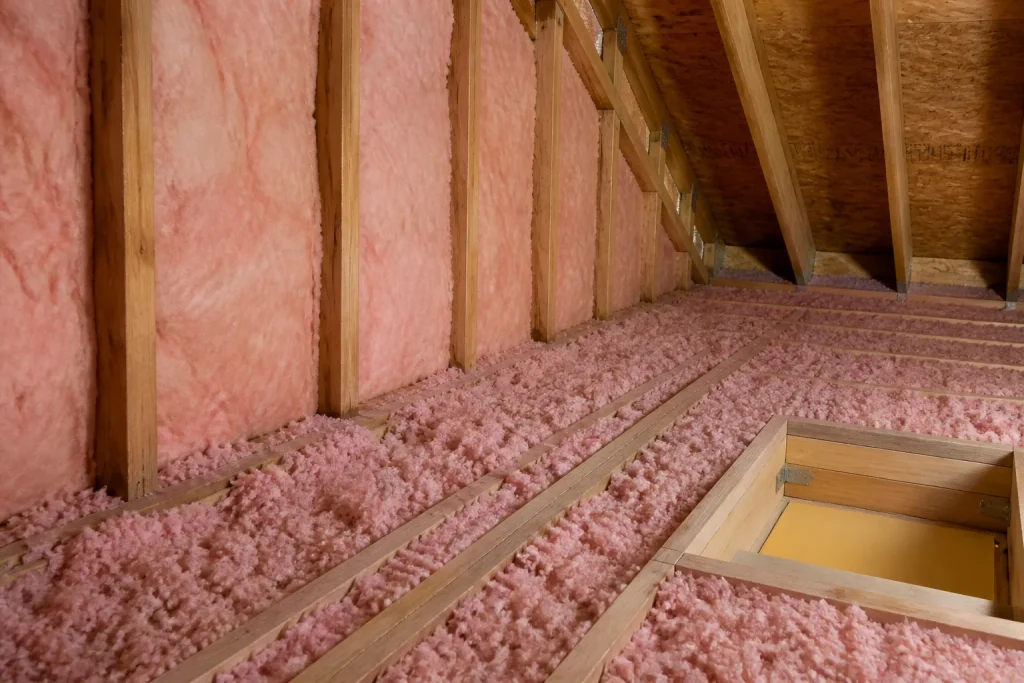
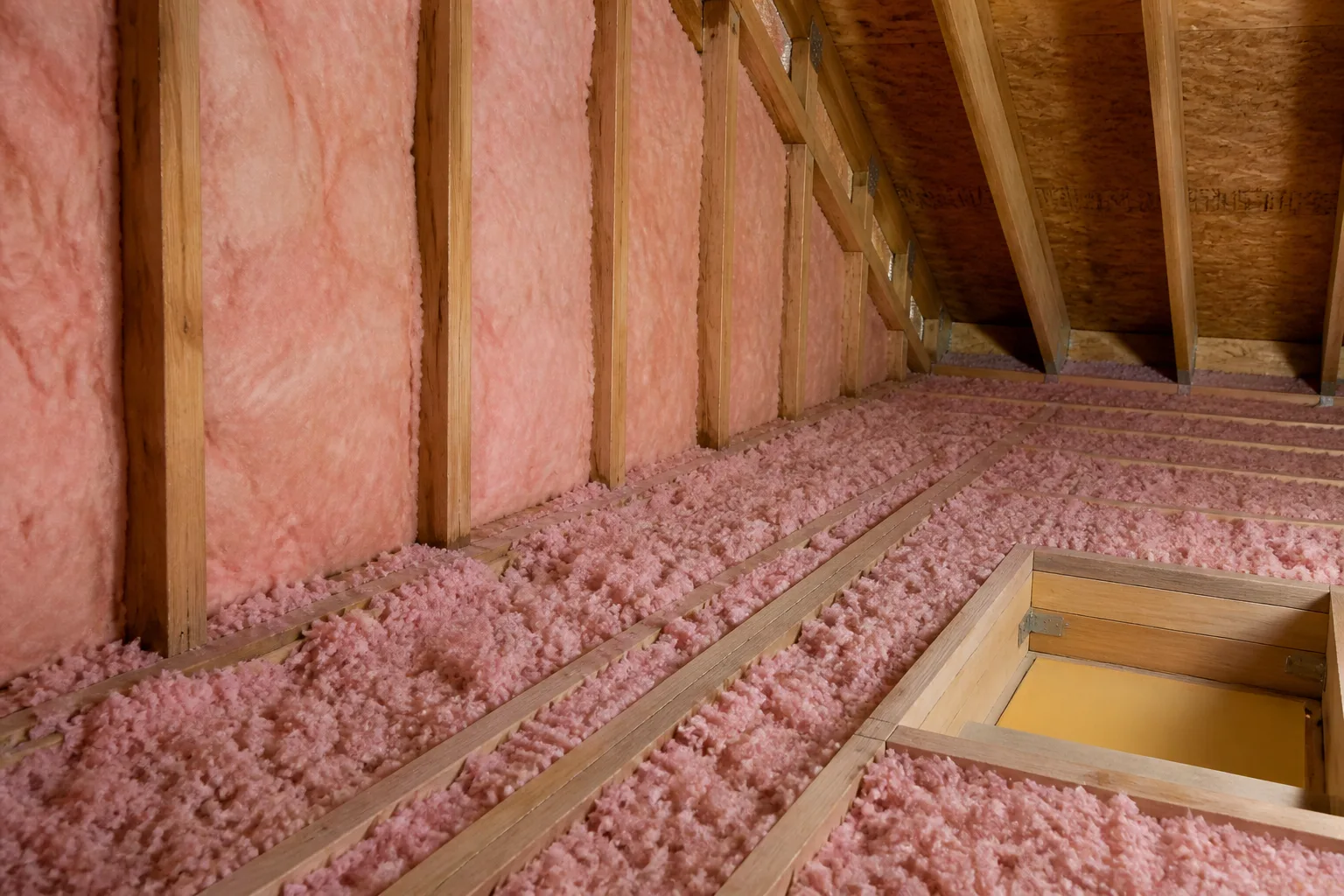
- AttiCat blown-in fiberglass. The standard choice for flat or minimally-obstructed attic floors. AttiCat is installed via a blowing machine to a target depth. It’s forgiving of irregular framing and easy to top off if you add more later. In a Boulder City attic with clean joist bays and no radiant barrier, this is usually the right call.
- EcoTouch (formerly Pure Safety) fiberglass. The same thermal performance as standard OC fiberglass with a formaldehyde-free binder. For homeowners who care about indoor air chemistry, this is the line to ask for. Suited to Boulder City in the same way as AttiCat blown-in – good dry-heat performance, no moisture concerns.
- ProPink loose-fill. A good fit for knee-wall attics and cape-cod rooflines where the blow-in has to reach into odd interior bays. Performs fine in Boulder City’s dry climate.
What Owens Corning doesn’t sell you is the air barrier. That’s the missing 30-40%. Whether you contract with us or another outfit, the sequencing matters: seal first, then insulate. Always. Our Attic Insulation in Boulder City page lays out what that sequence looks like.
What has to be sealed before Owens Corning insulation goes in?
If we blow one bag of fiberglass into an attic floor that isn’t air-sealed first, we’re just burying the problem under a pink pile. That’s why Envelope will not insulate an attic floor without first completing a written air-sealing scope. Three checkpoints get the most attention:
- Top-plate penetrations. Every wall in your Boulder City home sits on a top plate. Every wire, pipe, and duct that passes through it is a hole. In a 1,800-square-foot house, there are typically 30-60 of these. Each one is filled with closed-cell foam or a gasketed seal before any insulation is placed.
- Recessed light cans. “IC-rated” cans are allowed to be buried in insulation. “ICAT-rated” cans are sealed for air. Most pre-2000 homes have IC cans that leak warm air directly out of the ceiling plane. These get a purpose-built cover or a sealed collar gasketed to the drywall.
- Attic hatch perimeter. Pull-down stair openings are the largest single air bypass in most Boulder City attics. The hatch frame gets weatherstripped, the panel gets insulated to match the attic floor, and a baffle sometimes goes in to keep the blown fiberglass away from the hatch when it’s open.
Other spots – HVAC plenums, vent chases, dormer intersections, bath fan housings – get the same treatment. None of this is optional if the target R-value is going to be real.
What does before-and-after blower-door data actually show?
Here’s a Boulder City comparison from a home we worked on recently near the Boulder Creek neighborhood. Two similar 1,900-square-foot ranch homes, both 1980s construction, both with original attic floors.
- Home A – insulation only. Added R-38 of Owens Corning AttiCat over the existing R-11. No air sealing. Blower-door reading before: 3,900 CFM50. After: 3,700 CFM50. The small drop reflects reduced conductive loss, not air leakage. Tightness barely moved because we didn’t seal.
- Home B – air sealing plus insulation. Sealed top plates, can lights, hatch, and plumbing chases. Added R-38 of Owens Corning AttiCat. Blower-door reading before: 4,100 CFM50. After: 2,150 CFM50. That’s roughly a 48% reduction in air leakage – an ACH50 (air changes per hour at 50 pascals) below the Boulder City new-construction threshold.
Home B will actually feel the R-38 at rated value. Home A has the same nominal R-38 on paper but lives near R-24 in the heat of the summer. The homeowner paid for the same bag of fiberglass. One of them got their money’s worth.
If your scope includes spray foam at the roof deck for a hot-roof assembly instead, the envelope numbers can be even tighter. See our Spray Foam Insulation in Boulder City page – it’s a different product, a different test target, and a different conversation.
What documentation should you walk away with?
An attic insulation job that costs $3,000-$6,500 in the Boulder City market should produce a paper trail. Here’s the list to expect, whether the installer is us, or someone else.
- Installed depth photos. Each attic bay photographed after installation with a marked ruler or a depth gauge in frame. Owens Corning R-38 blown-in requires a specific settled depth at installation because fiberglass settles over time. The number matters more than the label.
- Pre and post blower-door readings. CFM50 numbers on both sides of the work. If air sealing is part of the scope, the delta is the whole point of paying for it. If the installer didn’t test before, they can’t show you what changed.
- Product batch and label photos. Each Owens Corning bag carries a batch code. Photograph the label and keep the photo. This is what the manufacturer’s warranty claim starts with if there’s ever a defect issue years down the line.
- Written scope. What got sealed, what got insulated, what got bypassed, and what the target R-value was. If it’s not on the sheet, it didn’t happen.
- Written warranty. Not a verbal promise, not a line on a proposal. A document.
Under Haven Standard Clause 1, every Envelope insulation job starts with a flat written price, a written scope, and a written warranty – no work begins without all three in hand. You get a Documented Photo Record on every visit, and if any part of the work doesn’t hold up inside the 365-Day Done Right Promise window, we make it right.
One more piece of documentation that matters when the house is on the crawl: pairing your attic work with encapsulated crawl space usually tightens the whole envelope in a way the blower door can show. That work is described on our Crawl Space Encapsulation & Vapor Barrier in Boulder City page.
When should you call a pro instead of buying the bags yourself?
If you’re adding a modest top-up over R-38 you already have, and the attic floor underneath is already sealed, a few bags and a rental blower machine can work. If any of these apply, hire it out.
- Attic has never been air-sealed, or the home was built before 2000 (most Boulder City homes fall here).
- Recessed cans, plumbing chases, duct penetrations, or the hatch perimeter show daylight or air moving through them.
- You’ve never had a blower-door test, or you don’t know whether the R-value on the bag is the R-value in your attic.
- You’re considering a roof-deck spray foam assembly – different product, different safety profile, not a homeowner job.
- You want a warranty tied to installed performance, not just a receipt for the materials.
Attic air sealing is genuinely dangerous for a homeowner to do unattended. Fall-through ceilings, walkboard gaps, recessed-can heat, and the 140°F-plus attic surface temperatures in Boulder City all cause real injuries every summer. A trained installer with the right PPE and the right tools is the sane answer.
Related services in Boulder City
If you’re comparing attic insulation options for a Boulder City home, the conversation usually widens. Our Envelope Insulation Boulder City home page lists the full envelope service line. Owens Corning, Johns Manville, and Knauf fiberglass products are all available across our work, and we don’t lock you into a single manufacturer.
What happens when you call
- 1
A real person answersNo phone trees – you reach a local pro.
- 2
You get an upfront price rangeHonest numbers before anyone is dispatched.
- 3
A background-checked tech heads outLicensed & insured, dispatched right away.
- 4
You approve before work beginsNothing starts until you say go.
The Bottom Line
Owens Corning fiberglass is a reliable, well-tested product line for Boulder City’s hot-dry climate. It’s also only as good as the air barrier underneath it. Ask three questions before you sign anything: will the attic floor be air-sealed before insulation goes down, will there be a pre-work and post-work blower-door reading, and what documentation do I get in hand when the crew leaves? If the answer to any of those is vague, move on.
If you’re in Boulder City and need help, Envelope Insulation Boulder City offers free estimates – call (844) 320-7926. Bring us a competing written estimate and we’ll read it with you; the Free Second Opinion applies to any quote.
Frequently Asked Questions
Most Boulder City attic insulation projects run $3,000-$6,500 for a 1,500-2,300 square foot home, and that range typically includes air sealing when it’s done right. Insulation alone runs $2,200-$4,200; air sealing adds $900-$2,400 depending on how many penetrations there are. Call (844) 320-7926 for a written price before any work starts – Haven Standard requires it.
Yes, with one condition – the air barrier has to be sealed first. Owens Corning’s fiberglass lines (AttiCat, EcoTouch, ProPink) perform well in dry heat, but convective looping through leaky top plates can strip 30-40% of the effective R-value. Sealing before insulating is what makes the product spec real. Call (844) 320-7926 to talk through your attic.
R-38 is the practical target for most Boulder City homes, matching the cool-weather Clark County recommendation for the attic floor. Higher (R-49 or R-60) is worth considering if the house has a lot of sun exposure on the roof deck or if you’re also tightening with spray foam. Call (844) 320-7926 for a specific recommendation on your attic.
If the scope includes air sealing, yes – it’s the only way to verify the sealing worked. Pre and post CFM50 readings on every applicable job are standard for us, and they’re the single figure that tells you how much conditioned air your envelope was losing before and after. Call (844) 320-7926 and we’ll walk you through what the test shows on your home.
Written by the team at Envelope Insulation Boulder City.
Need Insulation Help?
Call Envelope Insulation Boulder City - licensed & insured, here with fast after-hours help in Boulder City.
(844) 320-7926