
Last updated November 17, 2026
DIY vs Professional Insulation: The Boulder City Homeowner’s Decision Guide
Renting a blown-insulation machine from a Boulder City home improvement store runs about $150 per day, and most rentals require you to buy a minimum amount of material before the machine leaves the yard. Here’s what that $150 doesn’t get you: any way to measure whether the depth you installed matches the R-value printed on the bag, and any blower-door result to prove the work actually cut your air loss. This guide draws a hard line between the insulation tasks that genuinely belong in the DIY column and the ones where self-installation quietly underperforms in desert conditions – so you can decide with numbers instead of guesswork.
Quick Answer
Three insulation tasks are reasonable DIY projects for a careful Boulder City homeowner: replacing an attic hatch cover, fitting batt insulation into accessible crawlspace rim joists, and installing weatherstripping at the transitions between conditioned and unconditioned space. Everything else – blown attic insulation, spray foam, air sealing of the attic floor – either needs calibrated equipment, has a measurable performance threshold you can’t verify without a blower-door test, or carries permit and resale-disclosure consequences under Clark County rules. When the installed depth has to land within spec and the result has to be provable, that’s professional work.
Table of Contents
- The Three DIY-Appropriate Insulation Tasks in Boulder City
- Why Spray Foam Is Not a DIY Task in the Desert
- The Blower-Door Dependency Problem
- The Real Math on DIY Blown Attic Insulation
- Nevada Permits, Licensing, and Resale Disclosure
- Common Mistakes to Avoid
- When to Call a Professional
- Frequently Asked Questions
The Three DIY-Appropriate Insulation Tasks in Boulder City
We’ve walked plenty of Boulder City attics and crawlspaces, and there’s a pattern in what homeowners successfully handle themselves. It isn’t about how handy you are. It’s about whether the task has a measurable threshold that requires equipment. These three tasks do not.
- Attic hatch cover replacement. The hatch is the single most common thermal bypass in a Boulder City attic – a bare piece of drywall or thin plywood leaking conditioned air straight into the attic. Build a rigid cover from 2-inch extruded polystyrene foam board (R-10 at that thickness), glue it to a plywood backer, and add a foam gasket around the opening. The whole job costs $40 to $80 in material and takes an afternoon.
- Batt insulation in accessible crawlspace rim joists. Where the rim joist between floor joists is reachable and dry, cut unfaced mineral wool batts (Rockwool is a common choice here because it resists moisture and doesn’t support mold) to a friction fit. This is not the same as a full rim-joist air seal, which we cover below – it’s the insulation layer only. If your crawlspace is damp or has standing moisture, stop and fix the moisture first; batts against a wet rim joist will fail.
- Weatherstripping at conditioned-to-unconditioned transitions. The door from the house to the garage, the attic access trim, and any exterior door with visible daylight are all fair game. Use a closed-cell foam or bulb-seal gasket rated for the gap, check the seal with a dollar bill (it should drag when you pull it), and re-check every season. Boulder City’s temperature swings between summer highs over 100°F and winter nights in the 30s work weatherstripping hard, so closed-cell beats open-cell every time.
Notice what all three have in common: low material cost, no calibration, and no way to get them dangerously wrong. The moment a task involves blowing loose material or mixing two-part chemistry, that changes. If you want to see how a full, sealed-then-insulated attic job is scoped by a professional, our page on Attic Insulation in Boulder City lays out the sequence.
Why Spray Foam Is Not a DIY Task in the Desert
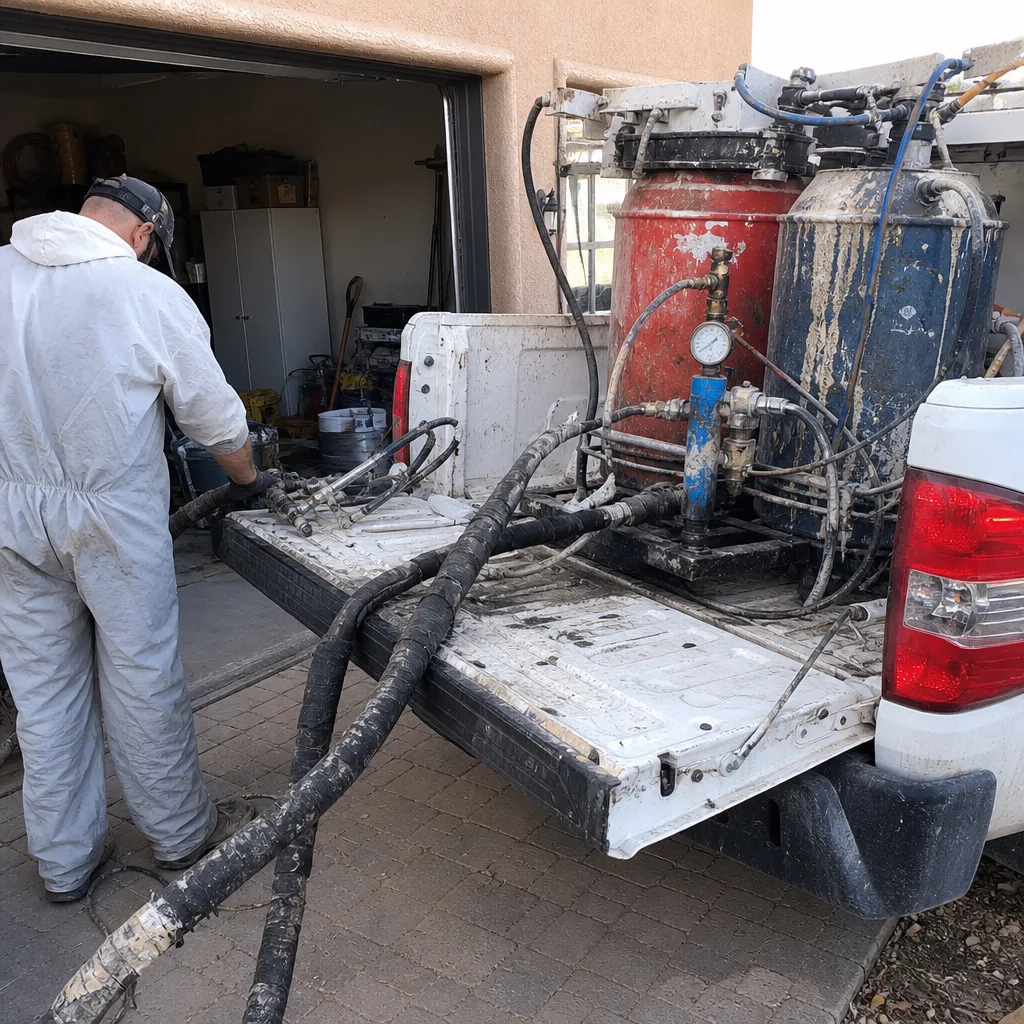
The kits sold to homeowners look forgiving. The chemistry isn’t. Two-component spray foam – a resin and an isocyanate that must be mixed at a specific ratio – is sensitive to temperature. In a Boulder City garage sitting at 90°F in July, that ratio shifts. And off-ratio foam doesn’t announce itself.
What happens with off-ratio foam in the desert: it cures with internal voids, soft spots, and poor adhesion to the substrate. From the outside it looks installed. You can’t see the problem by eye. An infrared scan or a physical probe is what finds it, and by then the foam is bonded in place and expensive to remove. In our experience, the failure shows up as a perimeter that looks sealed but still reads as a leak on a blower-door test.
There’s a second reason. Professional foam – Icynene and Demilec both make closed-cell products we install – is applied with heated proportioners and calibrated guns that hold the mix ratio at the specified temperature. Landfill-bound DIY foam kits lose pressure as they empty, and the last third of a canister often sprays inconsistently. You end up with a patched, uneven layer across a ceiling that was supposed to be uniform.
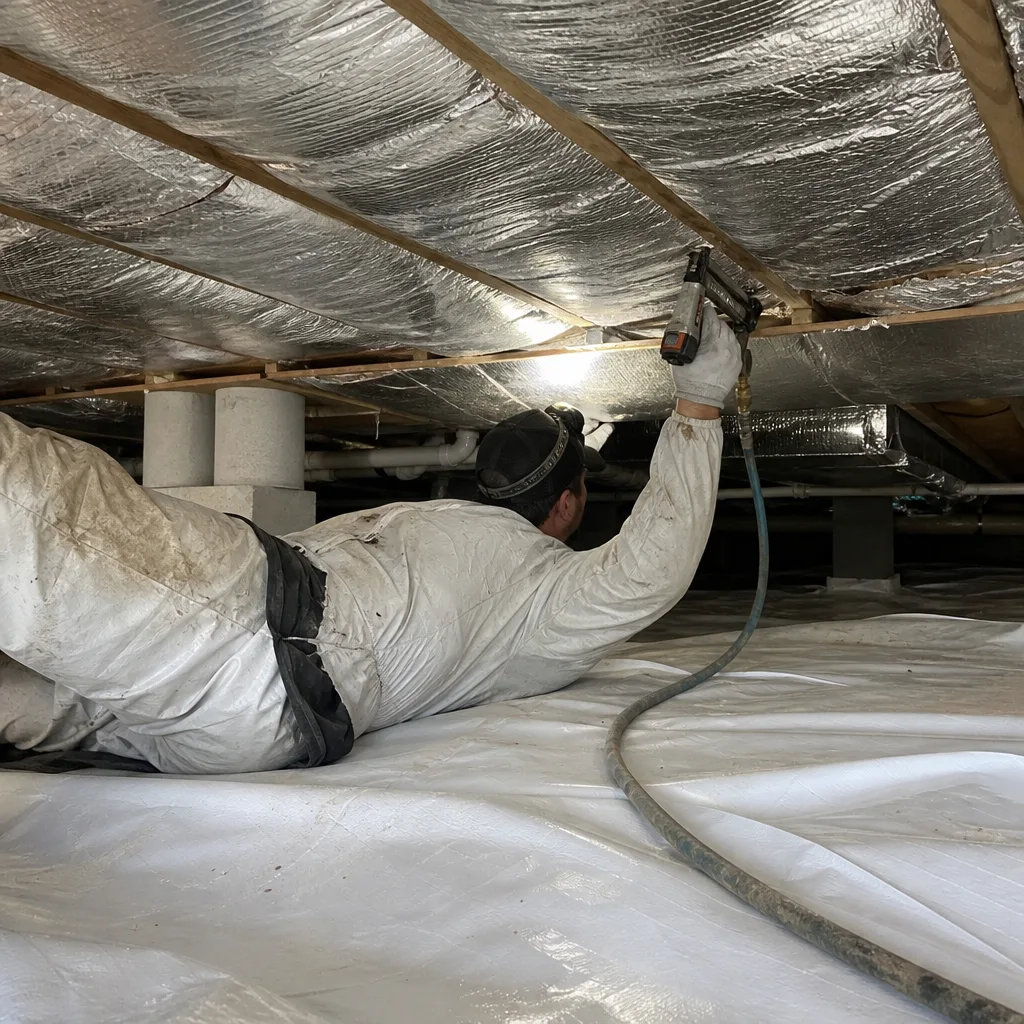
That’s why spray foam in our work is never a do-it-yourself product. It’s also why we don’t sell spray foam as a standalone fix: it’s part of a sealed envelope, sequenced after air sealing so it isn’t covering leaks. If your project is in a garage ceiling, a rim joist cavity, or a bonus room over a garage, that’s the definition of professional application. Our Spray Foam Insulation in Boulder City page covers the setup and the ratio controls. For crawlspace-specific spray foam, the moisture sequence matters even more, which is why our Crawl Space Encapsulation & Vapor Barrier in Boulder City guide is the place to start.
The Blower-Door Dependency Problem
A Boulder City homeowner who seals their attic floor by hand – foam in the top plates, caulk around the can lights, gaskets on the penetrations – has done real work. What they don’t have is any way to know whether the leakage rate actually improved to code-compliant levels.
A blower-door test is a pressurization measurement. A fan pulls the house to a set pressure difference (usually 50 pascals), and the machine reports how much air the building envelope is losing in cubic feet per minute at that pressure – a figure called CFM50. The homeowner gets one number before and one after. That’s the proof. Without a blower door, you’re sealing blind.
Here’s why blind matters in the desert. Air leakage into an attic isn’t just an energy problem in Boulder City – pulling 110°F attic air into your return path means your air conditioner works harder on every cycle. The difference between a leakage rate of 4,200 CFM50 and 2,100 CFM50 is the difference between a home your AC fights every afternoon and one it can keep up with. But you can’t feel CFM50. You can feel the humidity or the cool spots, and those signals are noisy.
In our work, that number is the deliverable. We publish before-and-after blower-door readings – a before-and-after figure the homeowner walks away with, not a promise. That’s part of operating under The Haven Standard: Have it in writing, and have the number that proves it. The result on a typical sealed-then-insulated attic job is roughly a 40 to 55 percent reduction in leakage, depending on how much bypass area the house started with. Every applicable job closes with a Documented Photo Record and the two readings sitting side by side.
DIY air sealing isn’t wrong. It’s unverifiable, and an unverified envelope is only as good as the guess that went into it.
The Real Math on DIY Blown Attic Insulation
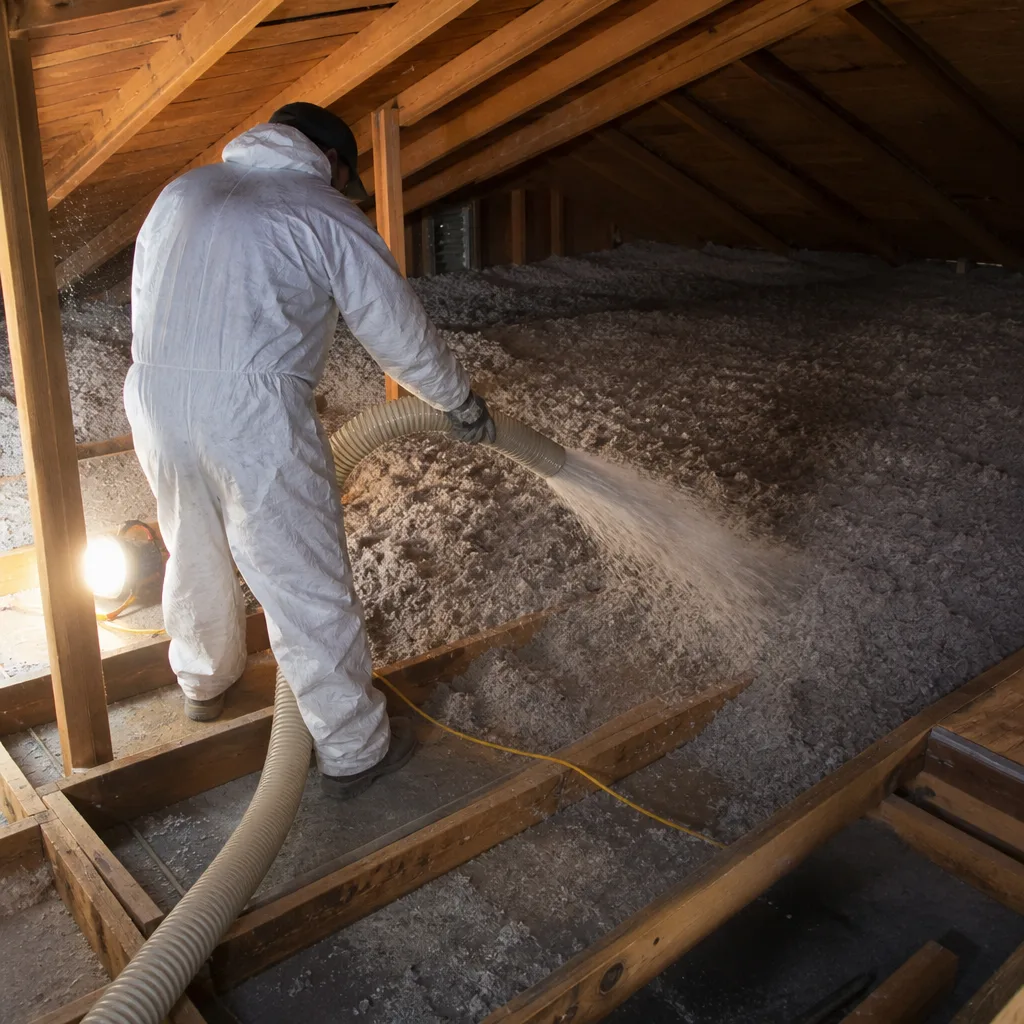
Here’s what people imagine the DIY blown-insulation project costs: a bag of cellulose and an afternoon. Here’s what it actually costs, using the trade’s real numbers.
- Material. Loose-fill cellulose runs $12 to $20 per bag at retail. To hit R-49 in a 1,200-square-foot Boulder City attic – the depth you’d want in this climate – you need roughly 25 to 35 bags. Call it $400 to $700.
- Machine rental. $150 for the day at a Boulder City home improvement store, plus a minimum material purchase that often tops $200.
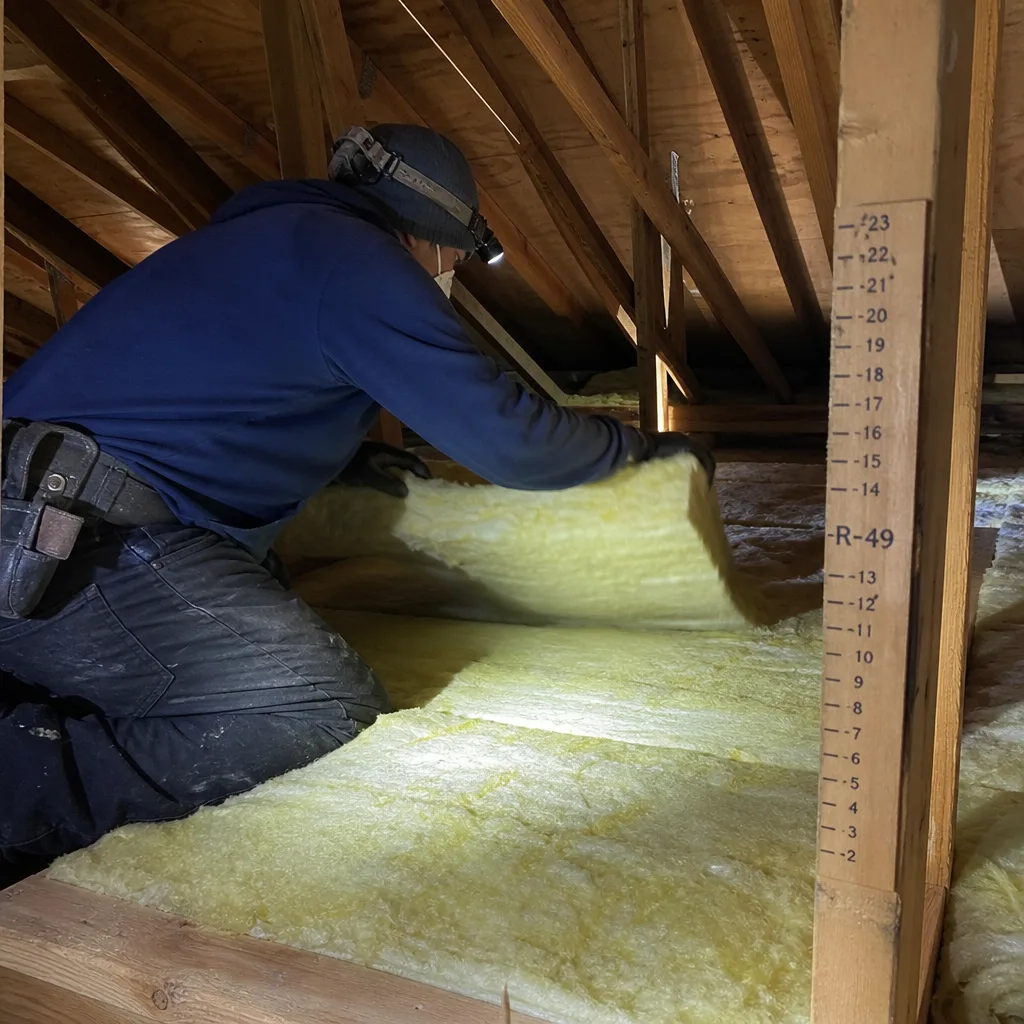
- Depth gauges. $20 to $60 for a box of rulers, and you need them installed at the correct interval – IECC guidance calls for a gauge at least every 300 square feet.
- Time. Two people, most of a day. A single person doing it for the first time should plan for longer. Add a trip to the store for the propane torch, mask, and kneepads.
- Depth variance. Here’s the number that matters. Without gauges at the right interval, installed depth drifts by ±15 to 20 percent across a sloped, obstructed attic. That means an R-49 target becomes an average of R-40 with thin spots at R-35 or below.
Run the totals: $600 to $900 in material and rental for a two-person job, with a real chance the installed R-value is 15 percent under what you paid for. The same work done professionally – with the depth checked against gauges and the result verified by a blower door – typically runs $1,100 to $1,900 for that same 1,200 square feet in Boulder City, depending on existing access, whether removal is needed, and how much air sealing is required first. The gap is real. The performance difference is what you’re deciding about.
Nevada Permits, Licensing, and Resale Disclosure
Harrison? No – this is Clark County, and there are three places where DIY insulation work can cost you later.
Permits. New insulation over existing conditioned space in Boulder City generally doesn’t require a building permit. But if you’re converting a garage, finishing a bonus room, or installing spray foam as a fire-rated thermal barrier, that work triggers a permit review. Doing that work unpermitted can’t pass inspection later, and an unpermitted enclosed assembly is a resale red flag.
Resale disclosure. Nevada sellers owe a written disclosure statement. Unpermitted or unverified insulation work that touches the thermal envelope can become a line item in that disclosure, and Clark County-adjacent buyers in this market are thorough. The days when an “improvement” could be sold without documentation are behind us. A written scope, a photo record, and a blower-door reading are the documentation that holds the value in the transaction.
Insurance claims. Here’s the one that surprises people. If a homeowner self-installs spray foam or attic insulation and a subsequent moisture or fire event touches that assembly, the insurer will look at whether the work met code. Unpermitted, uncalibrated, or undocumented work can complicate a claim even when the work isn’t the technical cause. That’s not a scare tactic – it’s a common claims-review pattern. Insulation installed by a licensed contractor with documentation doesn’t carry that ambiguity.
To put the record in place on your Boulder City home, start with Envelope Insulation Boulder City home and see how the full service line – energy audits, attic air sealing, and removal and replacement – fits together.
Common Mistakes to Avoid
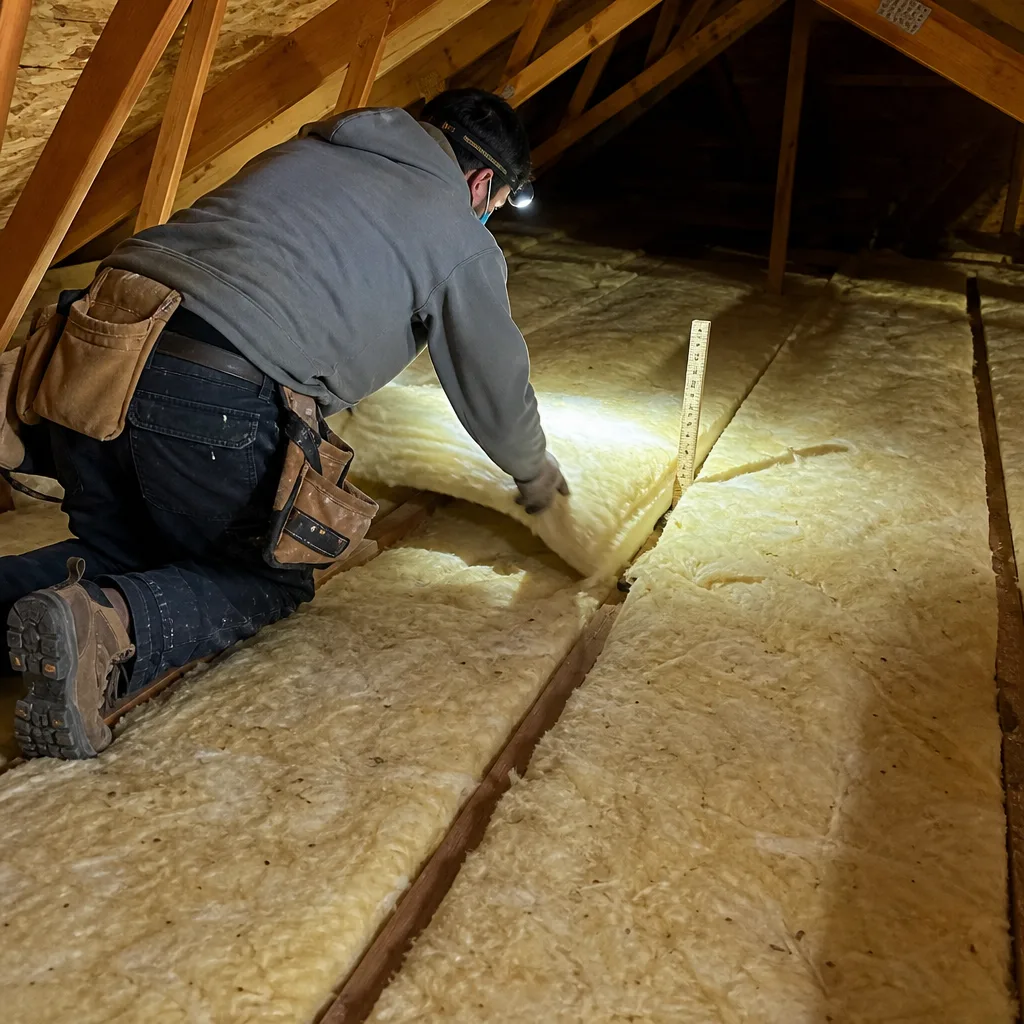
- Blowing new insulation over an unsealed attic floor. This is the single biggest mistake we see in Boulder City attics. The loose fill covers the bypasses, you never find out they were there, and the R-value on paper is doing nothing useful. Seal first, insulate second, always.
- Buying the rental machine without buying the depth gauge box too. The rental staff sells you the machine; the gauge box is often an afterthought on the shelf. Without gauges every 300 square feet, depth drift of ±15 to 20 percent is guaranteed. If you don’t have the gauges, you don’t have the R-value.
- Relying on paper-faced batt for a crawlspace rim joist. Face-stapled batts against a rim joist with a warm-moisture interface are a common DIY failure in this climate. Use unfaced mineral wool and deal with the moisture first.
- Mixing spray foam in a garage that’s already hot. 90°F garage air shifts the two-component mix ratio, and off-ratio foam cures with voids you can’t see. By the time an infrared scan finds it, removal is expensive.
- Treating an attic hatch as “just a cover.” A bare plywood hatch is a thermal short-circuit. A $50 foam-and-gasket cover often cuts measurable leakage on its own, but only if the gasket actually compresses on the trim.
- Leaving can lights and top plates unsealed while chasing a bigger R-value. Upgrading from R-30 to R-49 is a modest gain. Sealing the top plate, the can lights, and the wire and plumbing penetrations is where a Boulder City home’s leakage rate actually moves.
- Skipping the documentation. A photo record, a written scope, and before-and-after readings are what protect the value of your work at resale. Without them, a buyer’s inspector treats the whole job as “unknown.”
When to Call a Professional
Call a licensed insulation contractor when the project involves any of the following in Boulder City: blowing loose-fill into an attic where the existing depth is inconsistent or unknown; applying spray foam in a garage ceiling, rim joist, or bonus room; air sealing can lights, top plates, or plumbing penetrations; encapsulating a crawlspace; removing existing insulation that’s been contaminated by rodents or moisture; or any work where the result has to be verified with a before-and-after blower-door reading before you can trust the number.
Envelope Insulation Boulder City offers free estimates – with a written price before any work starts. Call (844) 320-7926 to schedule a visit, and we’ll bring the documentation that tells you what the job will look like and what the result will read on the exit test.
Frequently Asked Questions
DIY is cheaper on paper – a 1,200-square-foot blown attic job runs $600 to $900 in material and machine rental, compared with $1,100 to $1,900 installed by a professional. But the DIY version carries depth variance of ±15 to 20 percent and no blower-door result, so part of what you paid for isn’t verifiable. The more accurate comparison is cost-per-verified-R-value, and that often tilts toward hiring it out. Call (844) 320-7926 for a free written price on your Boulder City home – no cost, no obligation, and a number to compare.
We don’t recommend it, and the reason isn’t skill. Two-component spray foam requires a specific mix ratio that shifts with temperature. In a Boulder City garage sitting at 90°F, the ratio drifts, and off-ratio foam cures with internal voids and poor adhesion you can’t see by eye. The failure only shows up on an infrared scan or a blower-door probe. Professional application uses heated proportioners and calibrated guns for exactly this reason. Call (844) 320-7926 with your project to get a written price and a clear scope.
Standalone blower-door testing in the Boulder City market typically runs $250 to $450, and consumer rental of a calibrated blower door isn’t generally available to homeowners. The reason is that the reading only means something when it’s set up correctly – pressure reference, house preparation, and calibration all affect the CFM50 number. When we perform the work, before-and-after readings are published as part of the job; the home’s CFM50 result becomes the proof the job performed. Call (844) 320-7926 to ask how the test fits your project.
Straight re-insulation over existing conditioned space in Boulder City generally doesn’t require a permit, but garage conversions, bonus-room finishing, and spray foam used as a thermal barrier do trigger permit review under Clark County requirements. Unpermitted work on the thermal envelope can create a resale disclosure issue and complicate an insurance claim after a moisture or fire event. The fix is documentation: a written scope and photo record. Call (844) 320-7926 to talk through your specific scope with a licensed professional.
Insulating before air sealing. In Boulder City, that means blowing loose fill over an unsealed attic floor where top plates, can lights, and plumbing penetrations were never sealed. The insulation looks installed, the R-value is printed on the bag, and the envelope is still leaking – you just covered the evidence. Seal first, insulate second, and verify with a blower door. Call (844) 320-7926 for a free second opinion on any written estimate, including a DIY plan you’re considering.
Most sealed-then-insulated attic jobs on a Boulder City home are completed in a single day, start to finish, with the blower-door test done at the end and the before-and-after readings handed to you before the crew leaves. Larger crawlspace encapsulations or full removal-and-replace work can take two days, depending on access and condition. Every job we do starts with a written price and ends with a Documented Photo Record. Call (844) 320-7926 to get your visit scheduled.
The Bottom Line
Three tasks belong in the DIY column for a careful Boulder City homeowner: attic hatch covers, accessible crawlspace rim joist batts, and weatherstripping at conditioned-to-unconditioned transitions. Everything past those involves either equipment you can’t rent, chemistry that shifts in the desert heat, or a measurable threshold you can’t verify without a blower door. When depth has to land within spec and the performance has to be provable, that’s professional work – and the number the blower door reports is the number you paid for. If you’d like that number on your own home, call (844) 320-7926 for a free estimate. Under The Haven Standard, we’ll have the price and the scope in writing before anyone lifts a tool.
Written by the team at Envelope Insulation Boulder City.