
Last updated November 17, 2026
The Complete Attic Insulation Guide for Boulder City Homeowners
Here’s a number that surprises most Boulder City homeowners: an attic running R-38 with an unsealed top plate can lose more conditioned air than one running R-19 with a fully sealed assembly. The insulation label tells you what was installed. It does not tell you what the assembly performs at. In a desert climate where attic temperatures climb past 110°F for much of the summer, that gap between label and performance gets expensive fast. This guide walks you through the decision sequence a blower-door technician actually uses before a single bag of insulation opens, so you can tell a real scope of work from a bag count.
Quick Answer
Attic insulation in Boulder City should be sized against a measured air-leakage number, not chosen by R-value alone. The sequence is: run a blower-door test to get your ACH50, seal the top plates, recessed lights, hatch, and penetrations, then choose insulation depth and material to hit your target. Skipping the sealing step means the R-value you paid for performs well below its label in Boulder City’s heat.
Table of Contents
- Why Boulder City’s Climate Rewrites the Insulation Playbook
- What 110°F Attic Temperatures Do to Insulation R-Value
- Blower-Door Testing and ACH50: The Number That Comes First
- The Air-Sealing Targets Boulder City Inspectors Flag
- Nevada Energy Code Minimums vs. What Actually Moves Your Bill
- How to Read Your Post-Job Blower-Door Report
- Choosing Materials: Blown, Batt, or Spray Foam
- Common Mistakes to Avoid
Why Boulder City’s Climate Rewrites the Insulation Playbook
Boulder City doesn’t get a mild desert. It gets the Mojave at full strength: summer highs that regularly push past 105°F, cooling degree days that dwarf the national average, and an attic that acts as a solar oven from May through September. That environment changes what insulation is actually doing for you. In a cold climate, insulation mostly holds heat in. In Boulder City, it mostly keeps heat out, and it has to do that job while the attic above it is far hotter than the outdoor air.
Homes here were built in distinct waves. The historic district has older, tighter structures with varied framing. Neighborhoods developed through the 1990s and 2000s tend toward larger attics with recessed lighting and generous HVAC chases. Newer builds in and around Boulder City tend to be tighter but often carry builder-grade blown insulation with no documented air-sealing step. That last point matters: a tighter house leaks less in absolute terms, but the leaks it does have are often concentrated in exactly the places installers skip.
We’ve seen this pattern repeat in Boulder City: a homeowner gets a quote for R-49 blown insulation, installs it, and their summer bill barely moves. When we open the attic, the recessed can lights are still open to the conditioned space, the top plate is unsealed, and the new insulation is sitting on top of a ceiling that’s still leaking like it was before. The insulation isn’t wrong. The sequence was.
What 110°F Attic Temperatures Do to Insulation R-Value
R-value is measured in a lab at a standard temperature differential. Real attics don’t run a standard differential. When the ceiling below is at 75°F and the attic air is at 115°F, the assembly is doing something closer to a summer heat-gain test than a lab test, and some materials handle that better than others.
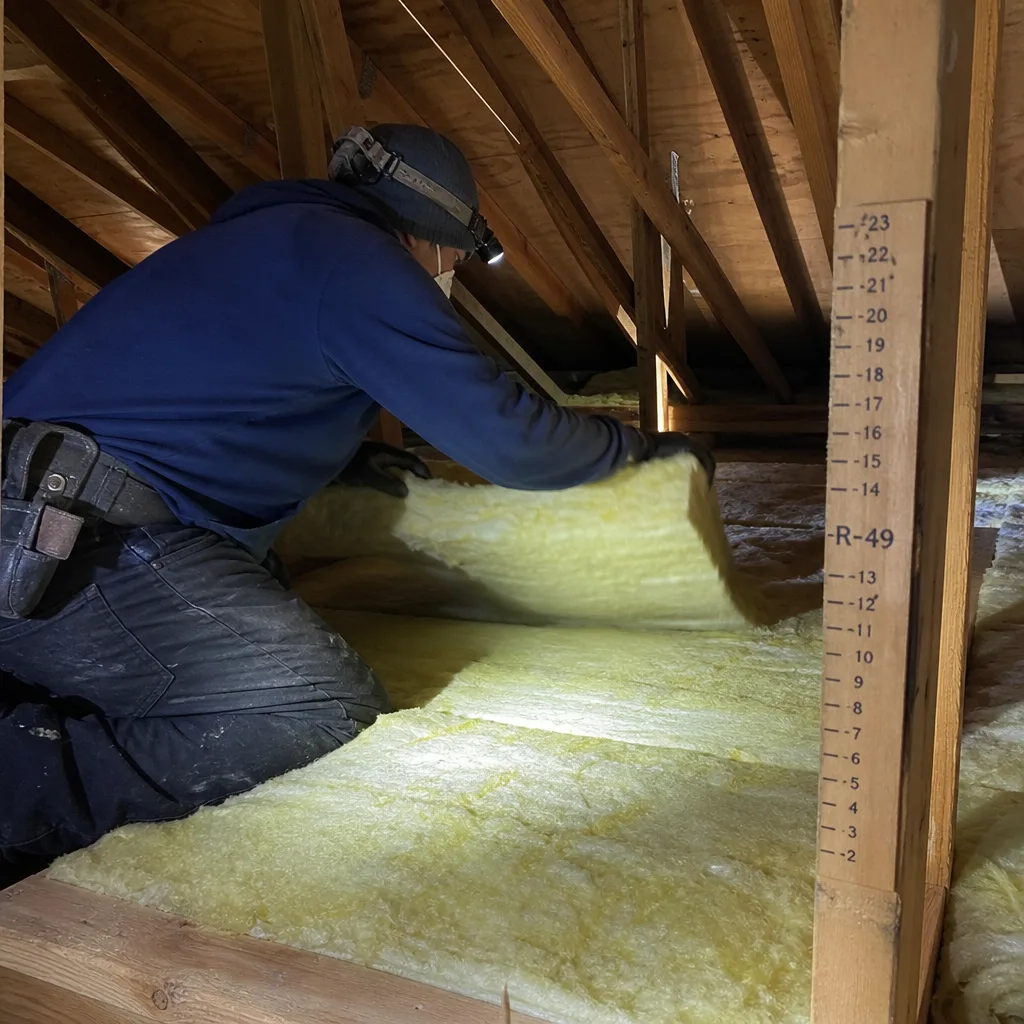
Blown fiberglass and mineral wool like Knauf and Rockwool hold up well across temperature swings, but they’re sensitive to air movement. If the attic floor leaks, air channels form through the loose fibers and the effective R-value drops well below the label. Blown cellulose has slightly better air resistance but can settle over time. Batt insulation is the most vulnerable to installation gaps: a batt with a visible gap at the edge or around a penetration loses a meaningful share of its rated value, and thermal bridging through exposed framing runs straight past the insulation.
The honest summary: in Boulder City, tested R-value after thermal bridging and air leakage commonly lands 15 to 25 percent below the label number on an unsealed assembly. On a sealed assembly it lands much closer to the label. The insulation material is only half the story. The other half is whether air is moving through it.
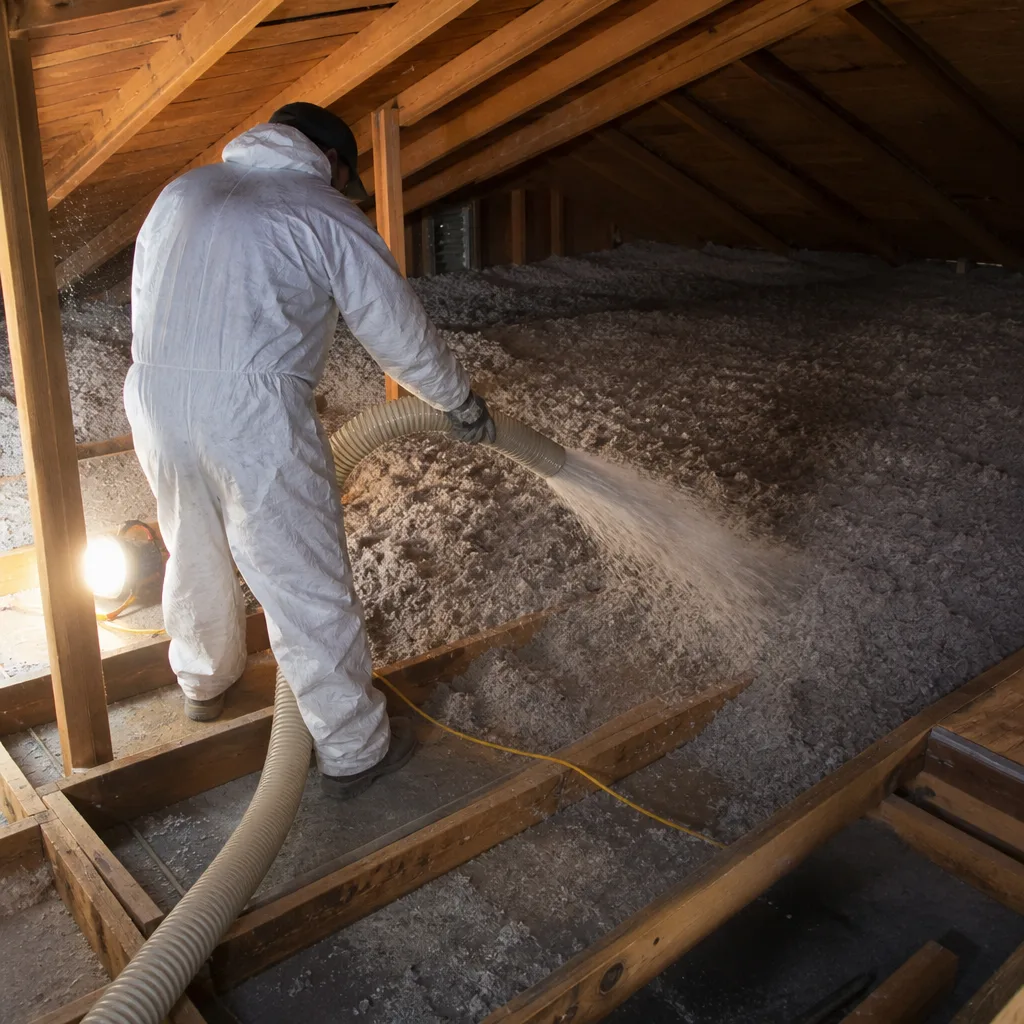
- Blown fiberglass or mineral wool: Cost-effective, handles heat well, loses performance fast if the attic floor isn’t sealed.
- Blown cellulose: Better air resistance, slightly heavier, can settle and lose loft over years.
- Batt: Cheapest on paper, most sensitive to installation gaps and thermal bridging.
- Spray foam: Highest performance in a hot attic, works as both insulation and air barrier, highest cost.
Blower-Door Testing and ACH50: The Number That Comes First
ACH50 – air changes per hour at 50 pascals – is the single number that tells you how leaky your Boulder City home actually is. A blower-door test pressurizes the house to a controlled 50 pascals and measures how much air escapes through every gap, crack, and penetration in the envelope. It’s the same test energy auditors use, and it’s the test a competent insulation scope should start with.
Why it has to come first: if you choose insulation depth before you know the leakage rate, you’re guessing. A home at 8 ACH50 needs sealing work before anything else makes sense. A home at 3 ACH50 might need only modest sealing and can go straight to insulation. A home at 12 ACH50 (common in older Boulder City stock) needs a serious sealing scope and probably a plan for the HVAC chases and recessed lights before any bag opens.
The sequence we use on every applicable job:
- Run the pre-test and record the ACH50 baseline.
- Walk the attic and map every air-sealing target: top plates, recessed lights, hatch, plumbing and wiring penetrations, HVAC chases, and the wall-to-floor junction.
- Seal the entire list to a documented spec.
- Choose insulation material and depth based on the sealed envelope, not the pre-sealed one.
- Run the post-test and publish both numbers.
That’s the whole point of the before-and-after reading: it turns “did we improve things” into a figure you can see in a report.
The Air-Sealing Targets Boulder City Inspectors Flag
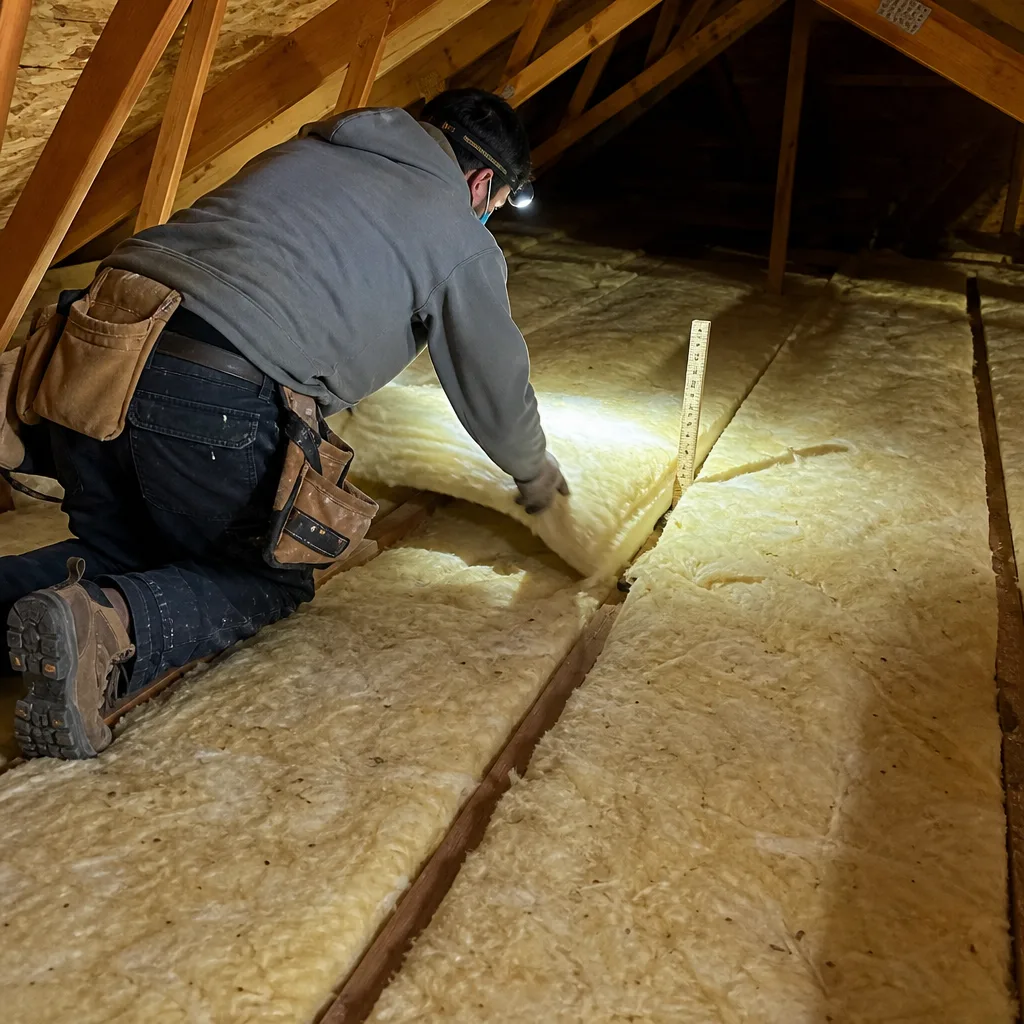
Boulder City code inspectors, like most of Clark County, look for the same handful of air-sealing items on the final walk. When the scope misses these, the insulation still passes inspection, but the performance doesn’t land. Every sealing scope on our jobs covers the full list below: it’s the hard prerequisite.
- Top plates: The joint where the wall frame meets the ceiling frame. Unsealed, this gap runs around the entire perimeter of the attic and is one of the largest single leak paths in a home.
- Recessed can lights: A non-IC-rated can light is effectively a hole in your ceiling. Seal or replace; ic-rated cans still need a gasketed seal at the housing.
- Attic hatch and pull-down stairs: These are typically the biggest single leak in the assembly. A gasketed, insulated hatch cover is the fix.
- Plumbing and wiring penetrations: Every pipe, conduit, and wire that passes through the ceiling plate is a hole. Seal each one with the appropriate material: fire-rated sealant where required, foam otherwise.
- HVAC chases and duct boots: These often leak at the ceiling plane even when the ductwork itself is well-sealed. Seal the chase, then check the boot.
- Wall-to-floor junction and stud bays: The band area where the ceiling framing meets the exterior wall is a common gap that gets passed over when a crew is working from the middle of the attic outward.
Sealing is not an upsell. It’s the difference between insulation that performs and insulation that just looks like it does. Under our attic insulation service in Boulder City, sealing comes first, then insulation: every time, no exception.
Nevada Energy Code Minimums vs. What Actually Moves Your Bill
Nevada energy code sets minimum attic R-values for new construction and major renovations. It’s a floor, not a target. The number that actually moves your summer bill in Boulder City is higher than the code minimum, because the code is written for a statewide average and Boulder City sits far on the hot side of it.
The practical guidance:
- Meet code: The minimum for your build type. Do not undershoot it.
- Meet performance: Aim for the R-value that pairs with a sealed envelope to hit a low ACH50 (typically 3-5 for an existing home after sealing, lower for newer builds).
- Meet reality: In our experience, going above the code minimum by a meaningful step (roughly R-38 to R-49 or R-49 to R-60, depending on the starting point and assembly) is where the bill actually changes, not a small bump.
The delta between “meets code” and “moves the needle” is usually a few hundred dollars in material. The delta in summer bill is what the homeowner is actually shopping for. That’s why we size against the sealed envelope and the target ACH50, not against the code table.
How to Read Your Post-Job Blower-Door Report
A blower-door report is short and specific. Here’s what to look for and what each figure means.
- The pre-test ACH50. Your baseline leak rate before any work. Higher means more air was escaping through the envelope.
- The post-test ACH50. The same measurement after sealing and insulation. This is the number that reflects what you paid for.
- The delta. Subtract post from pre. A reduction from 8 ACH50 to 4 ACH50 is a 50 percent air-leakage reduction; that’s a meaningful envelope change. A reduction from 8.1 to 7.8 means the sealing step didn’t work.
- The CFM50 figure. Blower-door software typically reports the raw airflow number (cubic feet per minute at 50 pascals) alongside ACH50. Same story, different unit: the delta between pre and post tells you how much air stopped moving through the envelope.
- The test conditions. Outdoor temperature, wind, and stack pressure affect the reading. A good report records them. If they’re missing, ask.
What a good result looks like for a Boulder City home is a delta of 30 percent or better on an older property and 20 percent or better on a tighter newer build. Anything smaller means the sealing scope missed something. That’s why we publish the before and after on every applicable job: a report you can read yourself is a report you can trust.
Choosing Materials: Blown, Batt, or Spray Foam
The right material depends on the assembly and what you’re trying to do. In most Boulder City homes, the answer is blown insulation over a fully sealed floor. In a few specific situations it’s spray foam, and we’ll say so.
For a standard vented attic with an air-sealed floor and a target depth of 12 to 16 inches, blown fiberglass or mineral wool (we source Knauf, Rockwool, and CertainTeed depending on the assembly) is the workhorse. Cheap per installed R, holds up to heat, and pairs well with a sealed floor. Blown cellulose has slightly better air resistance and is a good choice when the floor has irregular penetrations; it settles some over time, so plan for that in the depth.
Spray foam is the right call in a few specific cases: an unvented attic where the insulation plane moves to the roof deck, a home with HVAC equipment inside the attic, or an assembly where hitting a low ACH50 with sealing alone isn’t realistic. It’s higher cost, and it’s the highest-performance path when the climate load is real. For a deeper look at when spray foam makes sense, see our spray foam insulation in Boulder City page.
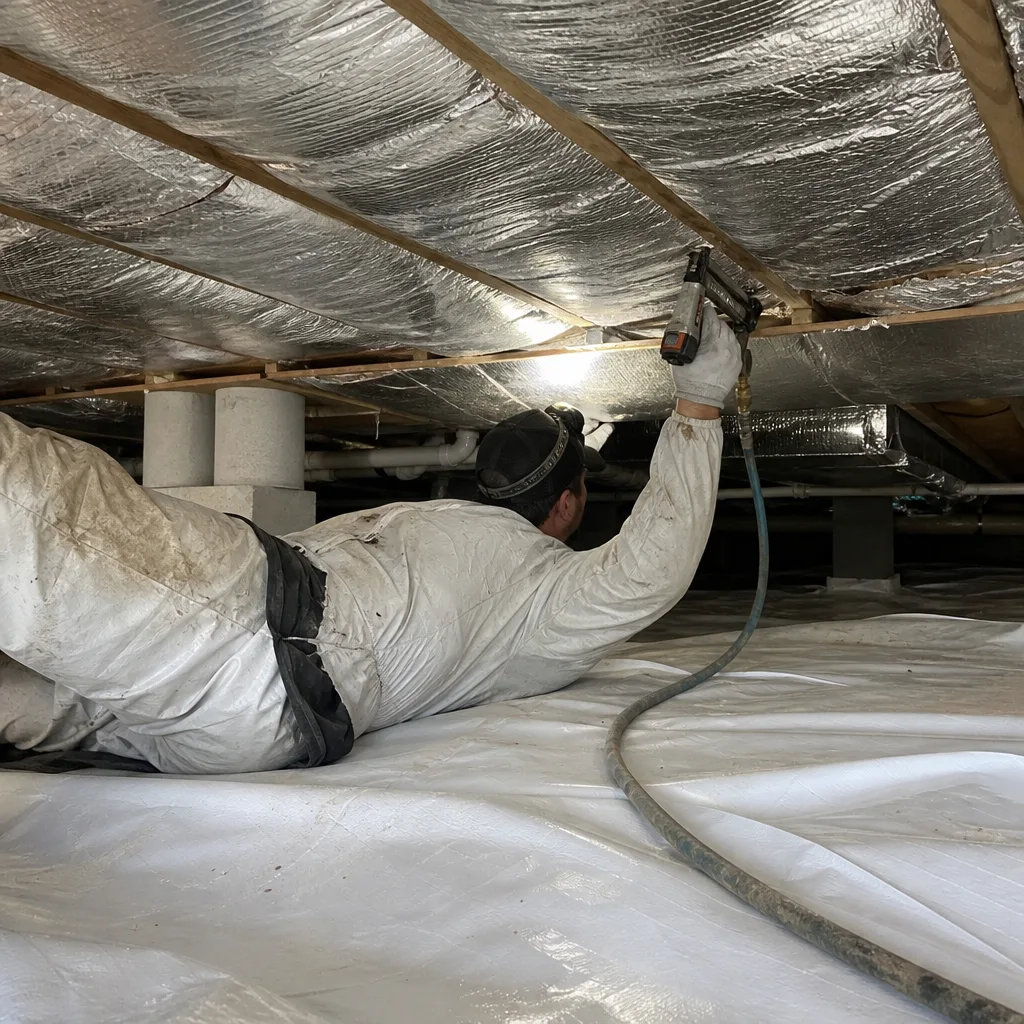
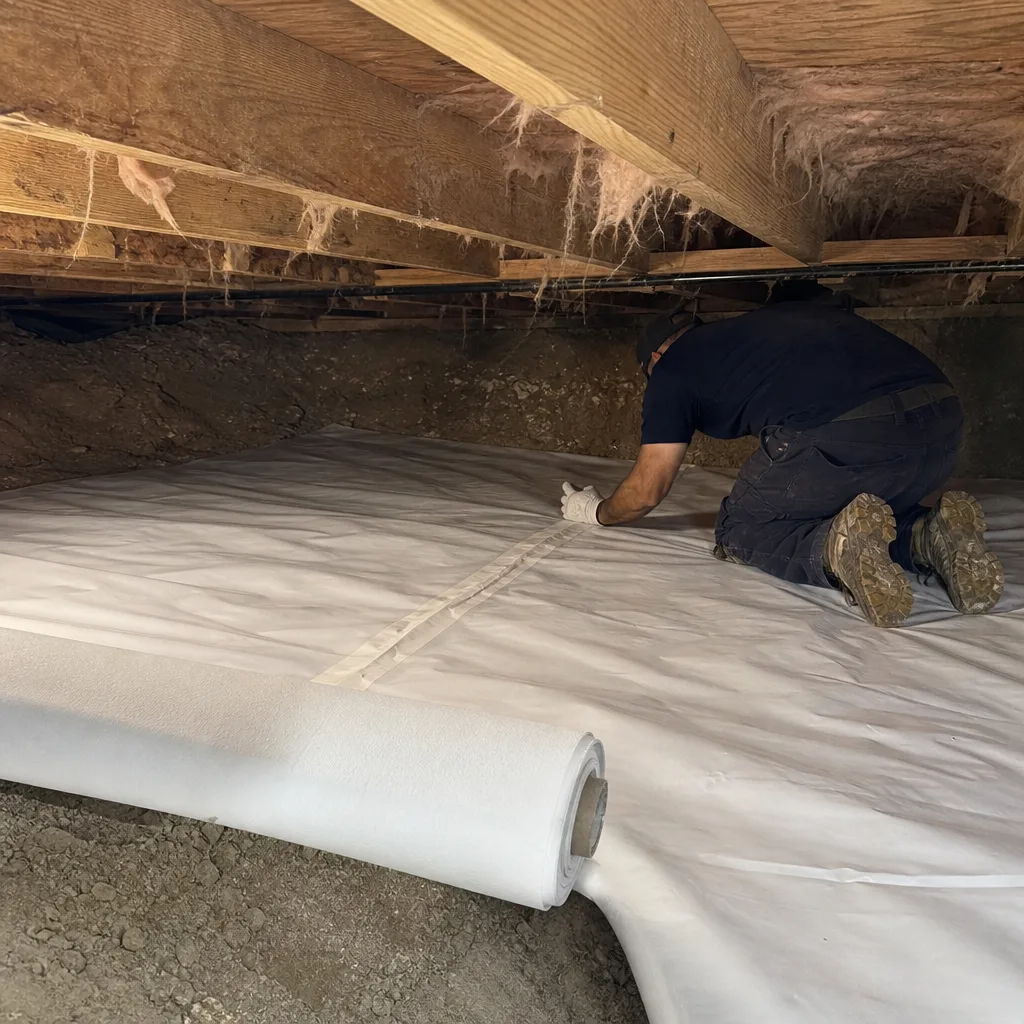
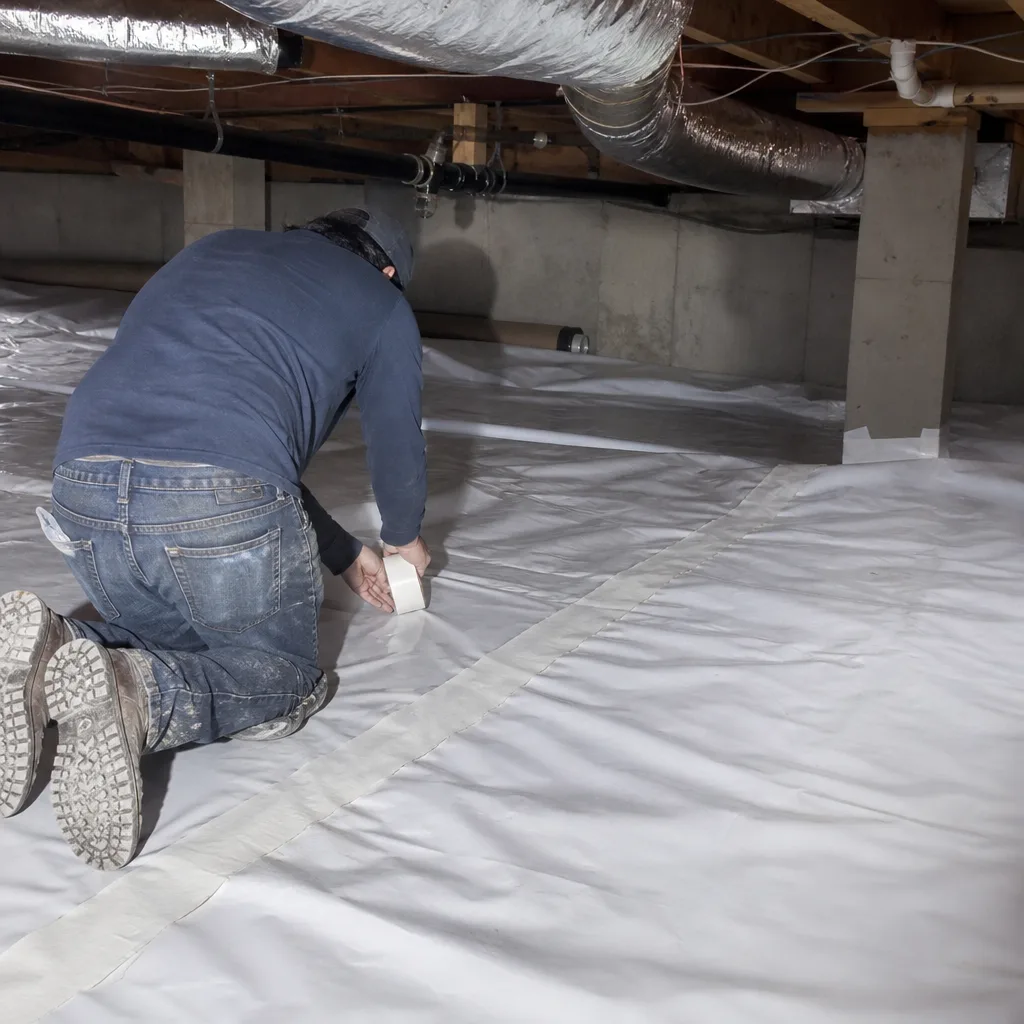
Radiant barriers are a different tool and worth mentioning because they get confused with insulation. A radiant barrier (a reflective sheet stapled to the underside of the roof deck) reduces radiant heat gain into the attic. It helps. It does not replace insulation and it does not seal air leaks. If you’re considering one, do the sealing and insulation first, then evaluate whether a radiant barrier adds enough on top to justify the cost. Same for the crawl space side of the envelope: if your Boulder City home has a vented crawl space, that’s a leak path too, and crawl space encapsulation and vapor barrier service in Boulder City is often the parallel work that finishes the envelope.
Common Mistakes to Avoid
- Choosing insulation depth before the blower-door reading. This is the single most expensive mistake Boulder City homeowners make. The depth needs to fit the sealed assembly, not the unsealed one.
- Blowing insulation over an unsealed attic floor. It looks finished. It performs like the floor wasn’t sealed. Insulation is a thermal layer; the sealing is the air layer, and the air layer has to come first.
- Skipping the recessed can lights. A non-IC can light in an unsealed ceiling is a hole. If the scope doesn’t mention can lights, ask specifically. Every time.
- Using a batt product in an irregular attic. Batts are fine when the framing is clean and uncompromised. In older Boulder City properties with added plumbing and HVAC chases, batts leave gaps that cost real performance.
- Treating the post-job reading as optional. If nobody can show you a before and after ACH50, you have no evidence the money did what it was supposed to do. That is the whole point of the test.
- Paying for a “code minimum” upgrade and expecting a bill reduction. Code minimum is the floor. It isn’t the performance target you’re actually shopping for.
- Letting a crawl space leak go unaddressed alongside attic work. The envelope has two halves. Sealing one and ignoring the other leaves the pressure imbalance driving the problem you just paid to fix.
When to Call a Professional
Attic work involves climbing into a confined space in extreme heat, sealing penetrations around live wiring, and measuring with an instrument most homeowners don’t own. Some cases clearly warrant a professional: any attic with recessed lighting on a shared circuit, any home with a history of moisture or pest activity, any assembly where you can see daylight through the ceiling, and any situation where the pre-existing insulation has been disturbed by plumbing or electrical work.
There’s also a safety reason. Attic work in a Boulder City summer means operating in a space where temperatures routinely exceed 110°F – heat illness is a real risk. Spray foam involves respiratory hazards during application and requires proper PPE and ventilation. And anything involving the electrical system – especially can lights, junctions, or wiring penetrations – should be handled by someone trained and equipped for it. We don’t recommend DIY sealing anywhere near the electrical panel or the wiring itself: the risk of shock or fire is not worth the savings.
If you want a scope that starts with a written price and a blower-door baseline, Envelope Insulation Co. provides free estimates in Boulder City. Call (844) 320-7926 to schedule one, and bring any competing written quote if you have one: we’ll read it with you.
Frequently Asked Questions
Most attic insulation jobs in Boulder City run between $2,400 and $5,800 depending on attic size, the sealing scope, and whether the work is blown insulation, batt, or spray foam – with the sealing step included in the price rather than added after. Homes that need substantial air-sealing work (older properties, unsealed can lights, unsealed HVAC chases) land at the higher end. Call (844) 320-7926 for an exact quote; the written price is provided before any work starts, and the estimate is free.
ACH50 is air changes per hour at 50 pascals – a measure of how much air a home leaks under a standardized pressure test. It matters because it’s the number that tells you whether the sealing and insulation did their job. A pre-test ACH50 tells you where you’re starting; a post-test ACH50 tells you what you paid for. Both numbers should be on the report.
Sometimes yes, but only after the existing attic floor is air-sealed, and only after you’ve verified the existing insulation isn’t wet, compressed, or contaminated. Adding insulation over an unsealed floor traps the leaks below the new thermal layer, and adding over damaged or pest-affected insulation compounds the problem. We inspect the existing condition first, then write the scope.
Yes. Boulder City’s summer attic temperatures routinely exceed 110°F, and the effective R-value of a poorly-sealed assembly can land 15 to 25 percent below the label. That means the performance gap is larger here than in a mild climate, and the sealing step matters more, not less. In a hot climate, the air barrier is doing as much work as the thermal layer.
Most Boulder City attic jobs run one to two days, including the blower-door pre-test, the full sealing scope, the insulation install, and the post-test. Larger attics, spray-foam roof-deck work, or jobs with significant existing-insulation removal run longer. The written scope lists the schedule before anyone starts, and the technician texts you when they’re on the way.
Insulation is a thermal layer; air sealing is an air barrier. They do different jobs, and in Boulder City’s climate you need both. Air sealing closes the gaps at top plates, recessed lights, the attic hatch, and every penetration through the ceiling – the actual leak paths. Insulation then slows heat transfer through the sealed assembly. Insulation without sealing performs well below its label.
The Bottom Line
Attic insulation in Boulder City is a sequence, not a product. Measure the leakage first (ACH50), seal the top plates, can lights, hatch, and penetrations, then size the insulation to the sealed assembly. Skip the sequence and the R-value you paid for performs well below its label. Follow it and the report at the end of the job shows you exactly what changed. Behind all of this is Envelope Insulation Co.’s Boulder City home envelope work: sealed first, insulated second, measured before and after, with the numbers published on every applicable job. That’s the standard we’ve worked to since 2016, and the one you should be shopping for.
If you want a written price and a documented scope before anyone opens a bag, call (844) 320-7926. Calls are answered by a live person, and a free estimate in Boulder City is one phone call away.
Written by the team at Envelope Insulation Co.