
Last updated November 17, 2026
The Complete Blown-In Insulation Guide for Boulder City Homeowners
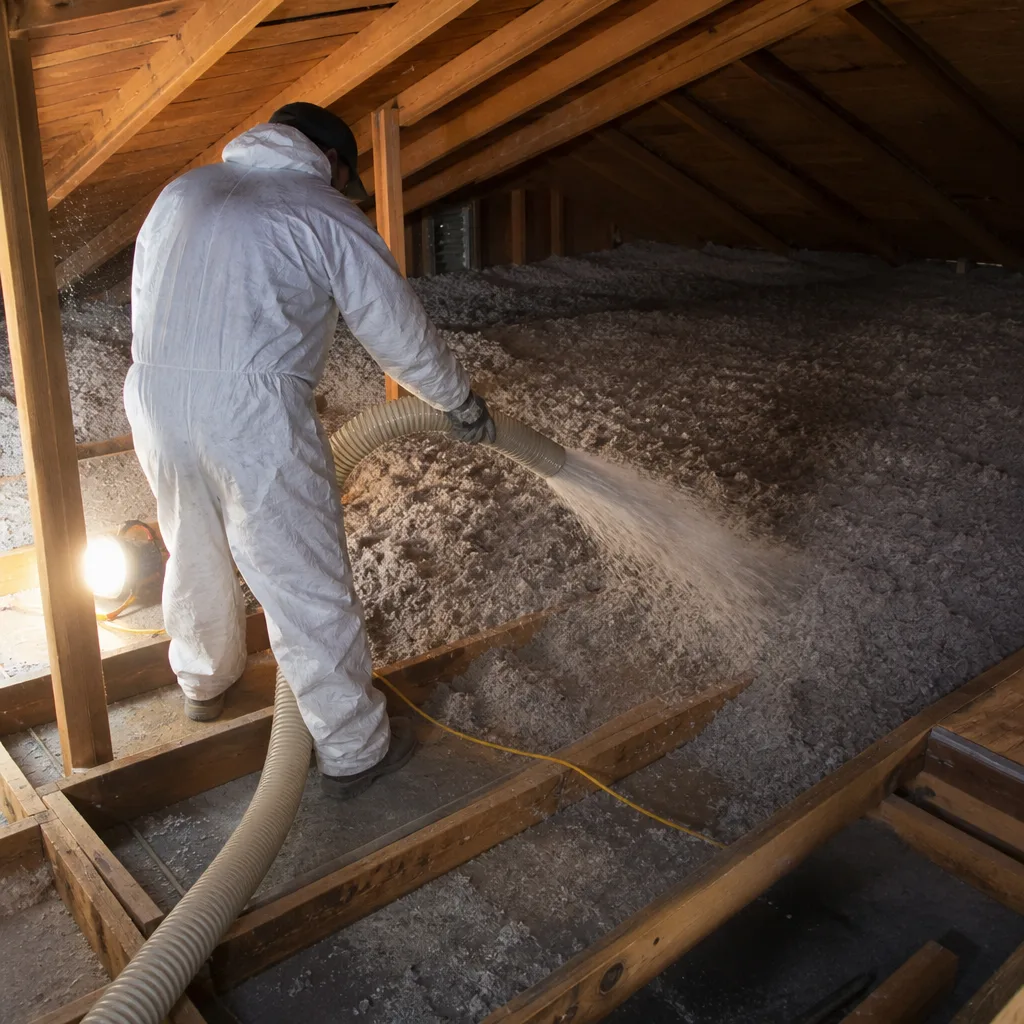
Blown-in cellulose is installed to an initial depth that settles 15 – 20% within the first year. That single fact reshapes everything about how insulation should be specified, installed, and inspected. A contractor who fills an attic to the depth that reads R-38 on day one has installed roughly R-30 by the following summer, and most homeowners are never told to expect it. In Boulder City, where attics push past 150°F in July, that gap between rated and delivered R-value is the difference between a comfortable house and an air conditioner that never shuts off. This guide shows you how to verify settled depth, top-plate sealing, and blower-door results before and after a blown-in job.
Quick Answer
Blown-in insulation is a loose-fill product, cellulose or fiberglass, machine-blown across an attic floor to a target depth that corresponds to a target R-value. Done right in Boulder City, it means sealing the air leaks first, then blowing to a depth that accounts for settling, and documenting the result with a blower-door reading. Done wrong, it means loose material over open bypasses and a number on a receipt that was never true.
Table of Contents
- Why a Boulder City attic is hard on loose-fill insulation
- Cellulose vs. fiberglass loose-fill in sustained heat
- Settled-depth math: what to blow, what to expect
- Top-plate air sealing as a hard prerequisite
- What a blower-door test actually tells you
- What a complete job record looks like
- What blown-in insulation costs in Boulder City
- Common mistakes to avoid
Why a Boulder City Attic Is Hard on Loose-Fill Insulation
Boulder City sits in the Mojave at roughly 2,500 feet, and summer attic temperatures routinely cross 150°F. That’s not a footnote. It’s the operating environment the insulation has to survive for 20 years. Insulation doesn’t stop heat by blocking it; it slows the rate at which heat moves. Every gap, every compressed batt, every convective loop through loose-fill reduces the rate at which it slows heat, and the result shows up as a hotter ceiling in the afternoons and a longer cooling run at night. Local homes built in the 1970s and 1980s frequently have R-11 or R-19 in the attic, thin by today’s targets. Homes in the Boulder City Historic District often have original plaster ceilings and older framing bays, which makes depth measurement and bypass detection more work than in a newer build.
The desert adds a wrinkle most national guides miss. Attic ventilation matters here in a way it doesn’t in humid climates. Stagnant hot air at the ridge line, blocked soffit vents from a careless blow, and missing baffles at the eaves all push more heat into the living space regardless of how deep the insulation is. If a crew doesn’t protect the soffit channels with baffles before blowing, you’ll have an attic full of material and a section of ceiling that still runs 5-8°F warmer than the rest.
Boulder City also has a specific wind pattern through the Eldorado Valley corridor that pushes fine dust into attics. Cellulose handles this reasonably well because of its density, but fiberglass loose-fill can become dusty over time and lose effective performance in the top two inches. If you’re looking at attic insulation in Boulder City, ask the contractor how they handle the soffit baffles and how they measure finished depth. Those two answers tell you more than any brochure.
Cellulose vs. Fiberglass Loose-Fill in Sustained Heat
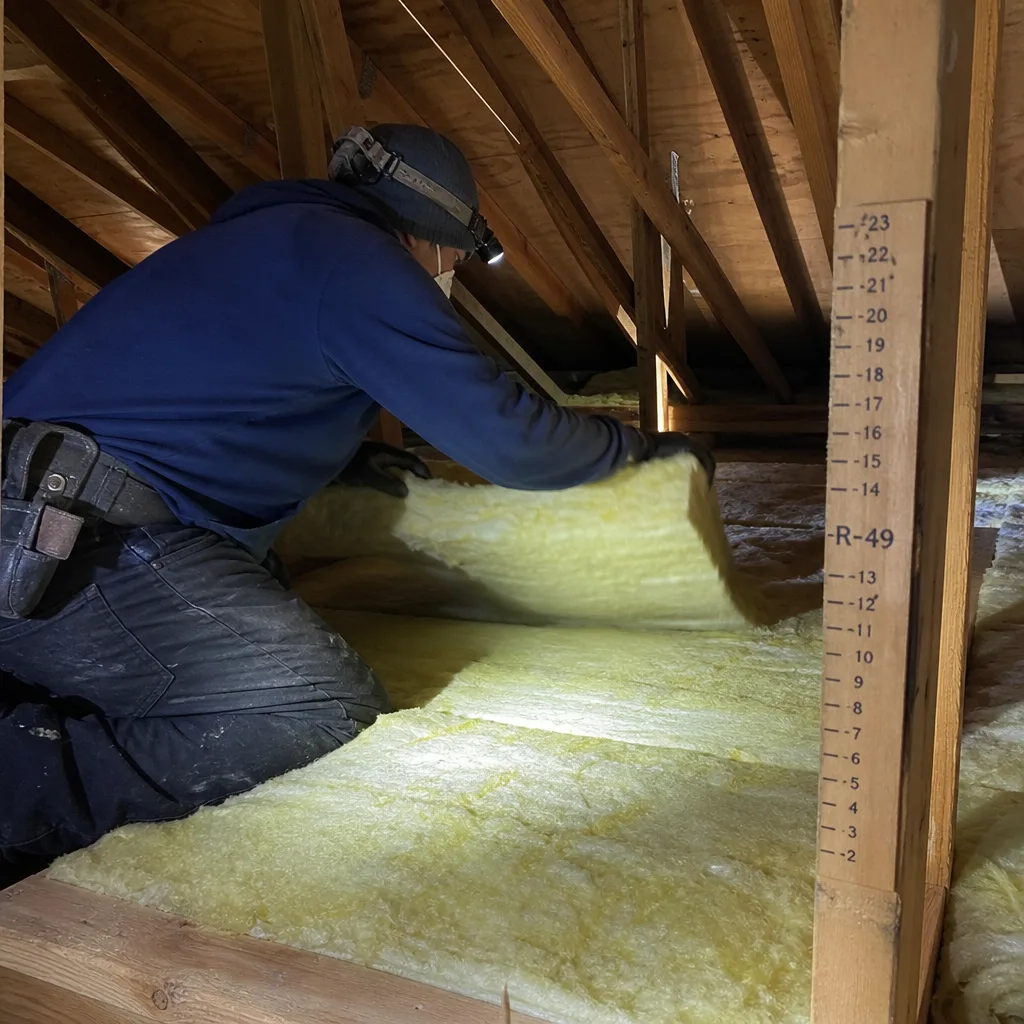
Both products work. They work differently, and in a Boulder City attic that difference shows up in year three, not year one.
Cellulose is ground newsprint treated with borate for fire and pest resistance. It’s denser than fiberglass, which means it resists convective air movement within the layer better, and it doesn’t lose R-value as quickly when attic air gets turbulent. Its published R-value is about R-3.2 to R-3.8 per inch depending on manufacturer, and it settles more than fiberglass, typically 15-20% versus 5-10% for fiberglass. That settling matters, and we’ll get to the math in the next section.
Fiberglass loose-fill is spun glass, lighter, and typically rated R-2.2 to R-4.3 per inch depending on density. In a hot attic, the lighter the material, the more susceptible it is to internal air movement, which can reduce effective R-value below published numbers. Fiberglass doesn’t settle as much, and it doesn’t hold moisture the way cellulose does, which matters if you have any roof leak history.
- Hot-attic performance: Cellulose holds its rated R-value closer to spec under sustained high heat because of its density.
- Settling: Cellulose settles more (15-20%); fiberglass settles less (5-10%). Both need depth planning.
- Fire and pest: Borate-treated cellulose is naturally fire and pest resistant. Fiberglass doesn’t burn and resists pests but doesn’t provide borate protection.
- Moisture: Fiberglass tolerates minor roof leaks better. Cellulose can clump and lose performance if it gets wet.
- Weight: Cellulose is heavier per bag. On a ceiling with older framing, that’s worth checking.
Brands like Rockwool and CertainTeed make well-documented loose-fill products. We source from them and from others because no single product is right for every attic, and a contractor locked into one manufacturer will sell you that one regardless of your home. If you want to compare your attic’s options directly, our spray foam insulation in Boulder City page covers the alternative approach where open-cell foam gives a combined seal-and-insulate in one pass.
Settled-Depth Math: What to Blow, What to Expect
Here’s the fact that separates a real insulation job from a bag count on a receipt. The R-value on the manufacturer’s chart assumes settled depth, not fresh-blown depth. If the contractor reads the chart, fills to that depth, and walks away, you’re under-insulated by the settling percentage from the first cold night.
Here’s how to calculate the initial blow depth for a target finished R-value. This same math appears on the depth card of any reputable crew.
- Pick your target finished R-value. For Boulder City attics, R-49 to R-60 is the modern target; older homes with a hot roof deck may need R-49 as a practical ceiling.
- Find the product’s settled R-value per inch. On the bag: cellulose is typically around R-3.5 per inch settled; fiberglass loose-fill varies more by density, often around R-2.5 to R-3.0 per inch settled.
- Divide target R by settled R per inch. R-49 ÷ R-3.5/in = 14 inches settled depth for cellulose. R-49 ÷ R-3.0/in = 16.3 inches for lighter fiberglass.
- Add the settling allowance to get initial blow depth. If cellulose settles 18%, initial depth is settled depth ÷ (1 – 0.18). For 14 inches settled, that’s 14 ÷ 0.82 = 17.1 inches initial blow depth.
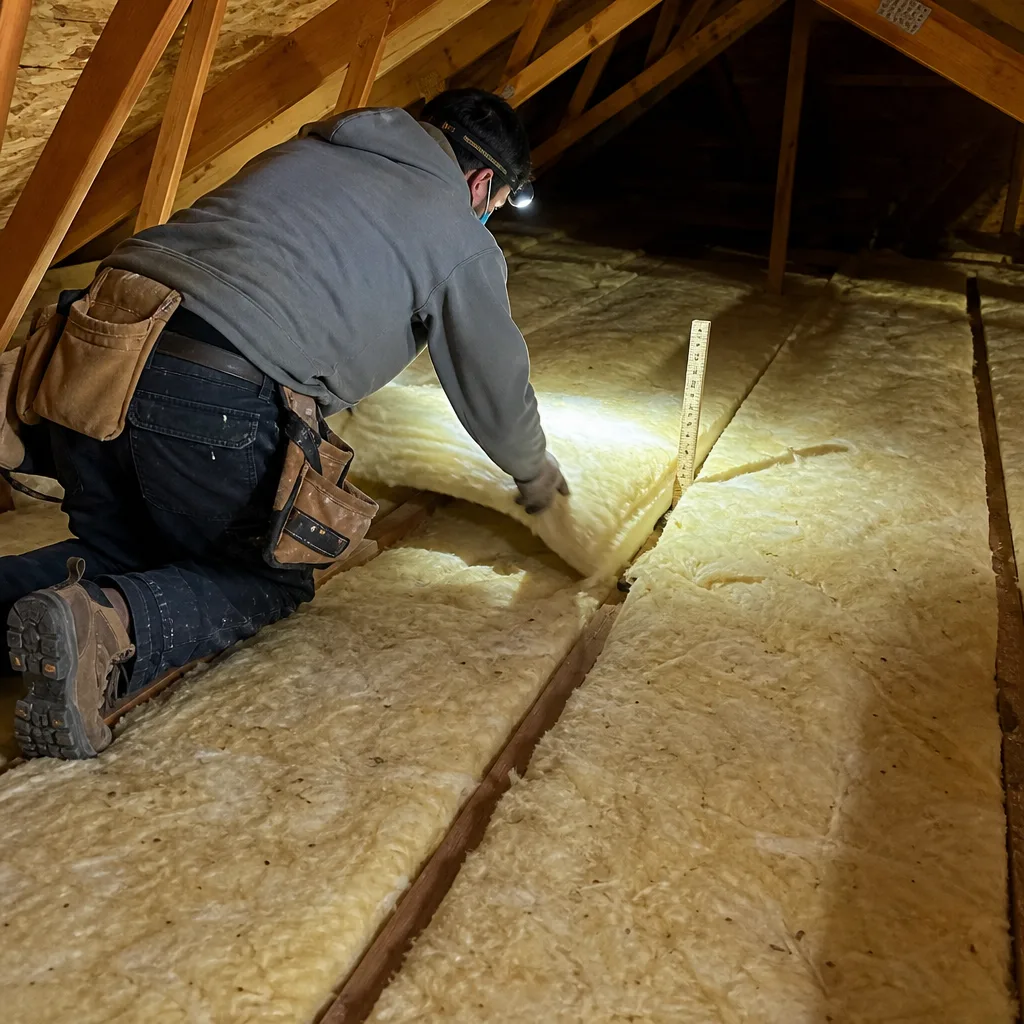
- Verify with a depth ruler. A depth ruler, sometimes called a depth tab or depth marker, is a labeled stick placed at the attic access and at two or three other points. After the blow, it should read the target initial depth. On a re-inspection a year later, it should read the settled depth.
This is why a photo of the depth rulers immediately after the blow is worth more than a receipt that says “12 inches installed.” The photo proves the depth exists. A year later, a second photo proves the settling math was right. Any Boulder City contractor who doesn’t leave depth rulers in place is hiding the one number you can actually verify.
Top-Plate Air Sealing as a Hard Prerequisite
Here’s the sentence that costs contractors the most work and saves homeowners the most money: blown-in insulation installed over unsealed top-plate bypasses gives you a fraction of the R-value you paid for. Not because the insulation is defective. Because convective loops run through it.
A top plate is the horizontal board at the top of a wall where the studs meet the ceiling joists. The gap between the drywall and the top plate is a chimney. Every can light in your ceiling is a chimney. Every wire penetration, every plumbing stack, every recessed fixture housing that isn’t rated for insulation contact is a bypass. When hot attic air can move through the insulation layer, it recharges the layer above the ceiling from the attic side and moves the effective R-value down, sometimes by 30-40%.
Sealing those bypasses first, with expanding foam and caulk on the top plates, around can lights, and at every penetration, changes the physics. The insulation then performs as designed because the air that would have moved through it can’t.
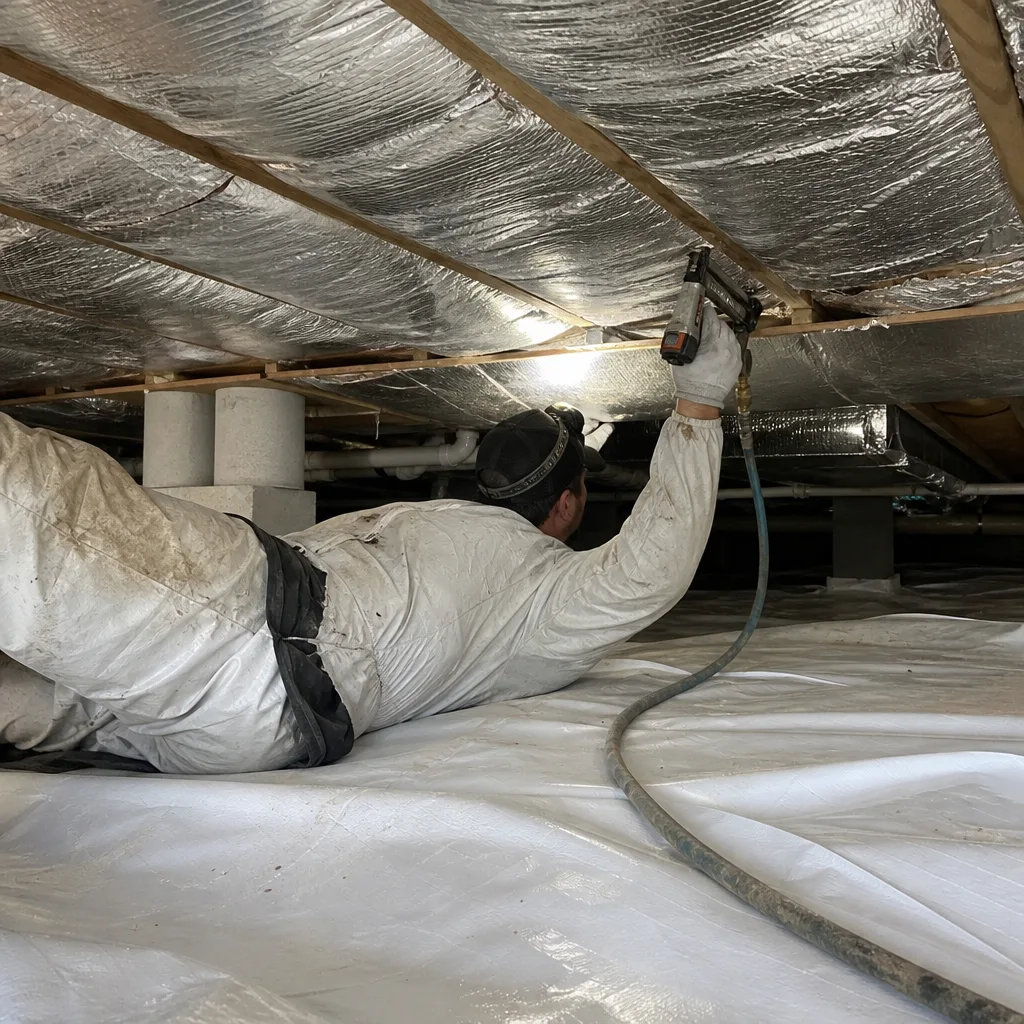
Under the Haven Standard, we don’t blow a single bag until the sealing pass is done. That’s not branding. It’s the difference between a job you can measure and a job you can only hope did something. If you’re working on the whole envelope, the crawl space encapsulation and vapor barrier in Boulder City side of the house matters too: vapor barrier and air sealing work the same way on the floor system that insulation does on the ceiling.
What a Blower-Door Test Actually Tells You
A blower-door test is a pressurization reading. A calibrated fan mounts in an exterior door frame and pulls the house to a set pressure difference, usually 50 pascals, and reports the airflow required to hold it. That number, in CFM50 (cubic feet per minute at 50 pascals), tells you in one figure how much air your building envelope is losing. Some reports normalize it to ACH50, air changes per hour at 50 pascals, which lets you compare homes of different size.
Here’s the part most homeowners don’t get told. A before-and-after blower-door test after a blown-in job can show improvement from two different causes: better air sealing, or more insulation. Those are different improvements with different physics, and the blower-door reading distinguishes them. Insulation doesn’t stop air from leaking; it slows heat. So if your ACH50 dropped, it’s because air sealing was done. If it didn’t drop and only the R-value changed, you got a thermal improvement without an air-sealing improvement. Both are real. Only one means the bypasses were actually addressed.
This is why we publish before-and-after blower-door numbers on every applicable job. A reading like “4,200 CFM50 before sealing, 2,100 after” tells you the air-sealing work moved the number by half. A reading that doesn’t move is either a job without air sealing or a job without leaks, and those are very different houses.
What a Complete Job Record Looks Like
Leaving a job well is different from leaving it clean. What you should be able to hold in your hand, or open in a text, when the crew pulls out of your driveway in Boulder City:
- A written scope and price, signed before work starts. Not a verbal range. A flat dollar figure with the R-value target and square footage.
- A bag count. The number of bags actually installed, and the manufacturer and product name. If the manufacturer lists 30 bags as the minimum for your square footage and target R, you should see 30 or more.
- Depth-ruler photos. At least one at the access, at least one mid-attic, with visible markings. These are the ground truth of the job.
- Air-sealing documentation. Photos of sealed top plates, sealed can lights, and sealed penetrations, taken before the insulation goes in.
- A blower-door reading, before and after. In CFM50 and ideally ACH50, with the date and time on the report.
- A written warranty. The 365-Day Done Right Promise is the standard we operate under: if it’s not done right, we make it right. The warranty should say that in writing, with the covered scope.
That’s the package. It’s what separates a documented job from a hopeful one, and it’s what Envelope Insulation in Boulder City delivers on every visit as part of the Documented Photo Record.
What Blown-In Insulation Costs in Boulder City
Blown-in attic insulation in Boulder City typically runs $1,600 to $3,800 for a standard 1,200 to 2,000 square foot attic, installed with air sealing included. Pricing depends on access, existing insulation, air-sealing complexity, and target R-value. Here’s the line-item range we see most often.
- Air sealing (top plates, can lights, penetrations): $450 – $1,200
- Blown-in cellulose, R-49 target: $1,100 – $2,200
- Blown-in fiberglass loose-fill, R-49 target: $950 – $1,900
- Existing insulation removal (if rodent or moisture contamination): $700 – $2,400
- Radiant barrier addition (separate scope): $1,200 – $2,600
- Blower-door test, before and after: typically included
We quote all of it as a written price before any work starts. Under Haven Standard Clause 1, you get a flat price, written scope, and written warranty before anyone lifts a tool. If you have a competing written estimate, we’ll read it with you through our Free Second Opinion before you decide. That’s not a sales tactic; it’s how a homeowner makes an informed decision.
Common Mistakes to Avoid
- Blowing over open bypasses and calling it a job. If the crew shows up with bags and no caulk gun, the job is thermal only. Insist on air sealing first.
- Filling to settled R-value on day one. A depth chart read literally under-delivers by the settling percentage. Ask what initial depth they’re blowing to and whether it accounts for settling.
- No depth rulers. Without them, there’s no way to verify the install. Ask the contractor where they place them and confirm you’ll get a photo.
- Skipping soffit baffles. A blocked soffit vent in Boulder City’s heat is a ceiling that runs 5-8°F hotter. Ask how baffles are protected before the blow.
- Can lights without IC-rated housings left unsealed. Non-IC cans are a fire hazard under insulation. They must be sealed at the ceiling plane or the housing replaced before any material goes in.
- No blower-door documentation. A contractor who doesn’t test before and after can’t tell you which improvement (air sealing or thermal) drove your savings. A written before-and-after is the only honest record.
- Handshake pricing. If the price isn’t on a page before work starts, the scope walks. Haven Standard Clause 1 exists because verbal scopes drift.
When to Call a Professional
Call a professional if your attic shows any of the following: visible settled material below R-30 depth on a cold-morning check, compressed insulation around can lights or HVAC equipment, rodent activity or droppings in the loose-fill, a ceiling that runs more than 4°F hotter than the walls in summer, a blower-door test you can’t get a copy of, or an attic where the existing material was installed without air sealing. Those aren’t cosmetic issues. They each mean the R-value you bought isn’t the R-value doing the work.
Also call if the job involves any of the following: cross-trade coordination with a roofer or HVAC contractor replacing duct runs, removing contaminated material, working around knob-and-tube wiring in an older Boulder City home, or a target R-value above R-49 in a low-slope attic. These are beyond a homeowner’s safe scope, and blown-in material over active bypasses is a fire and mold risk that isn’t visible from the access hatch. Envelope Insulation Boulder City offers free estimates in Boulder City. Call (844) 320-7926.
Frequently Asked Questions
Blown-in attic insulation in Boulder City typically runs $1,600 to $3,800 for a 1,200 to 2,000 square foot attic with air sealing included. That breaks down to roughly $450 – $1,200 for air sealing, $950 – $2,200 for the blown-in material depending on cellulose versus fiberglass, and any removal or radiant barrier as separate scopes. Call (844) 320-7926 for a written price before any work starts; estimates are free.
For a target of R-49 settled, celluose typically needs about 14 inches settled, which means blowing to roughly 17 inches initial depth to account for 15-20% first-year settling. Fiberglass loose-fill needs a bit more depth depending on density. The depth rulers placed at installation should read the initial blow depth and, one year later, the settled depth. Call (844) 320-7926 for a written quote tailored to your attic’s measured depth and target R-value.
Yes. Blown-in insulation installed over open top plates, unsealed can lights, and unsealed penetrations allows convective loops through the insulation layer that reduce the effective R-value well below the rated number. Under the Haven Standard, we don’t blow a single bag until the sealing pass is documented with photographs. Call (844) 320-7926 with your attic photos and we’ll tell you what’s likely to be found.
A blower-door test measures air leakage, in CFM50 or ACH50, and R-value measures thermal resistance. Those are different properties. A blower-door before-and-after a blown-in job distinguishes whether your energy savings came from better air sealing or better insulation, and only one of those stops the air. We publish both readings on every applicable job. Call (844) 320-7926 for a written price that includes the test.
Cellulose typically holds its rated R-value closer to published specs under sustained high heat because its density resists internal air movement. Fiberglass settles less and tolerates minor moisture better. Both work when installed to the correct initial depth with air sealing underneath. Call (844) 320-7926 and we’ll walk through your attic’s specific situation.
Yes, and you should. A complete job record includes a written scope and price signed before work, a bag count matching the manufacturer’s minimum for your square footage, depth-ruler photos, air-sealing photos, and before-and-after blower-door readings. Under the 365-Day Done Right Promise, if any of it isn’t right, we make it right. Call (844) 320-7926 with the record in hand if you have questions.
The Bottom Line
Blown-in insulation works when three things happen in the right order: the air leaks are sealed first, the material is blown to an initial depth that accounts for 15-20% first-year settling, and the job is documented with depth-ruler photos, bag count, and blower-door readings before and after. Those three variables are what determine whether a Boulder City homeowner gets the R-value they paid for or a number on a receipt that was never true. If a contractor can’t show you the before-and-after CFM50, they can’t show you the improvement you paid for. Ask for it in writing.
Contact Us for a Free Estimate
If you’re considering blown-in insulation in your Boulder City home, we’d like to give you a written price before any work starts. That’s Haven Standard Clause 1, and it applies to every estimate we deliver. Call Envelope Insulation Boulder City at (844) 320-7926. Bring us any competing written estimate and we’ll read it with you through our Free Second Opinion. The estimate is free, the documentation is thorough, and the price is on the page.
Written by the team at Envelope Insulation Boulder City.