
Last updated November 17, 2026
Attic Insulation Maintenance Schedule: What to Do and When
The single most common reason Boulder City attics lose R-value between jobs is an HVAC technician walking across the insulation to reach the air handler. One service visit can compress blown insulation enough to drop effective R-value by 20% – and nobody sends a reminder about it. That’s the problem with calendar-based maintenance advice: attics don’t decay on a schedule. They decay on events. This guide is a trigger-based maintenance schedule built around the five events that actually flatten insulation in a desert-climate home, how to read your depth markers without climbing into the attic, and when a real re-inspection with a blower-door test is worth the money.
Quick Answer
Attic insulation maintenance in Boulder City should be trigger-based, not calendar-based. Do a quick visual depth check after any reroof, HVAC service call, pest treatment, attic storage change, or major monsoon storm, and schedule a professional re-inspection with a blower-door test every 5 to 7 years or whenever you notice sagging, moisture staining, or pest trails. Keep a written record of install date, material type, installed R-value, and the last blower-door reading – it matters at resale and for utility rebate eligibility.
Table of Contents
- Why Boulder City Attics Fail on Events, Not Calendars
- The Five Events That Trigger a Check
- How to Read Insulation Depth Markers Without Entering the Attic
- Moisture Inspection for a Desert-Climate Attic
- The Documented Record Every Homeowner Should Keep
- Visual Check vs. Professional Re-Inspection With a Blower-Door Test
- A Simple Seasonal Walk-Through for Boulder City Homes
- When to Patch Insulation vs. Replace It Entirely
Why Boulder City Attics Fail on Events, Not Calendars
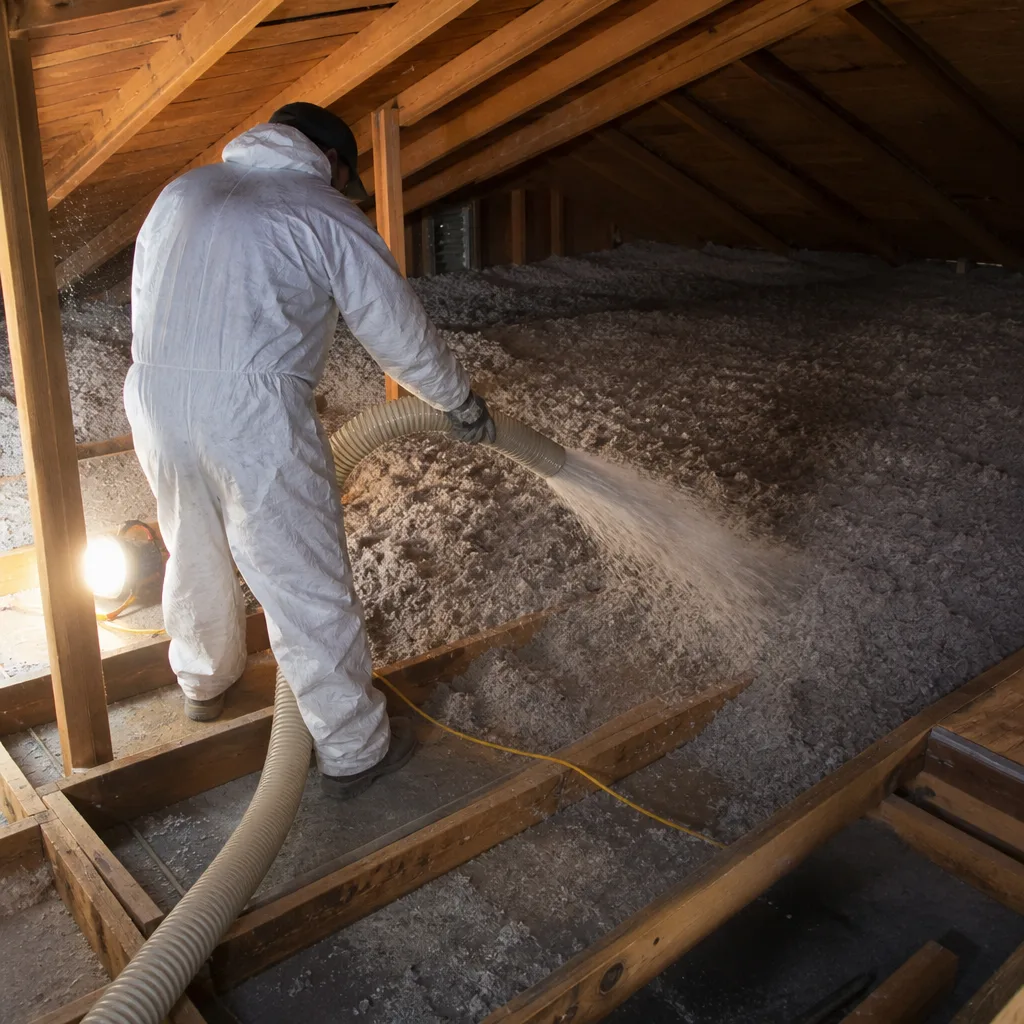
The calendar theory says insulation wears out slowly and evenly. That’s not what we see in Boulder City. Blown fiberglass and cellulose sit at a designed depth and a designed density, and both of those numbers have to stay put for the R-value on the sticker to be real. The moment someone walks across the attic floor, the material compresses. Density goes up, thickness goes down, R-value drops. A single HVAC service call to replace a blower motor can compress 3 to 4 inches of settled Knauf fiberglass along the entire path to the air handler.
Compression isn’t the only failure mode in Boulder City. This is a high-desert climate (about 2,800 feet of elevation, 4 to 5 inches of annual rain arriving mostly in July and August monsoons, and summer attic temperatures that routinely cross 140°F). That combination drives three things at once:
- Wind-driven monsoon moisture enters through ridge and soffit vents during fast-moving summer storms, and insulation that stays damp loses R-value and can grow mold.
- UV and thermal cycling dry out and crack the poly vapor barriers and the faces of rigid board products over years of 80°F-to-140°F swings.
- Pest pressure – desert pack rats, roof rats, and mice tunnel through fluffed insulation, and their trails hollow out voids that read as “cold spots” on a thermal scan.
None of those things happen on a 12-month cycle. They happen when the roof gets replaced, when the AC gets serviced, when a rat gets in, when a homeowner hauls Christmas boxes across the attic floor in November, and when a monsoon pushes water under a ridge vent. A maintenance schedule that ignores those triggers and just says “check your attic every fall” is not useful. If you want the broader picture of how a proper install should look from the start, our attic insulation in Boulder City guide covers the full assembly.
The Five Events That Trigger a Check
Treat each of these as a mandatory depth check. Each one takes under five minutes if your insulation was installed with depth markers (more on that below). If it wasn’t, you’ll need to look through the attic hatch with a light at minimum.
- Reroofing. Roofers remove the old shingles, tear off underlayment, install new felt or synthetic, and drive hundreds of new fasteners. Material and debris fall into the attic, and roofers often step on the top plate area to reach flashing. Check depth within a week of completion and check for displaced batts near the eaves.
- HVAC service. Any service call that touches the air handler, the plenum, or the ductwork requires a walk path across the insulation. Ask the technician to use a board (or lay one down yourself before they arrive) and check the walk path immediately after.
- Pest treatment. A pest control tech will disturb insulation looking for entry points and nesting sites. In our experience, rodent activity is the most common single cause of R-value loss in older Boulder City homes near the wash corridors and desert-edge neighborhoods.
- Adding attic storage. Homeowners add plywood decking in the attic to store holiday boxes, and the decking compresses the insulation underneath. Every square foot of plywood laid directly over fluffed insulation flattens that area to near zero R-value. If storage is being added, plan for raised decking on standoffs.
- Major storms. A serious monsoon event – wind-driven rain, hail, or a microburst – can drive water under ridge vents, displace loose-fill near the eaves, and lift batts. Check within 48 hours of any storm with wind gusts over 40 mph or measurable rain in a short window.
For spray foam areas, the trigger list is shorter but the stakes are higher – closed-cell foam can hide a roof leak behind a rigid shell, so a UV-and-moisture check after every reroof is non-negotiable. Our spray foam insulation in Boulder City page walks through what foam covers and where hidden leaks show up.
How to Read Insulation Depth Markers Without Entering the Attic
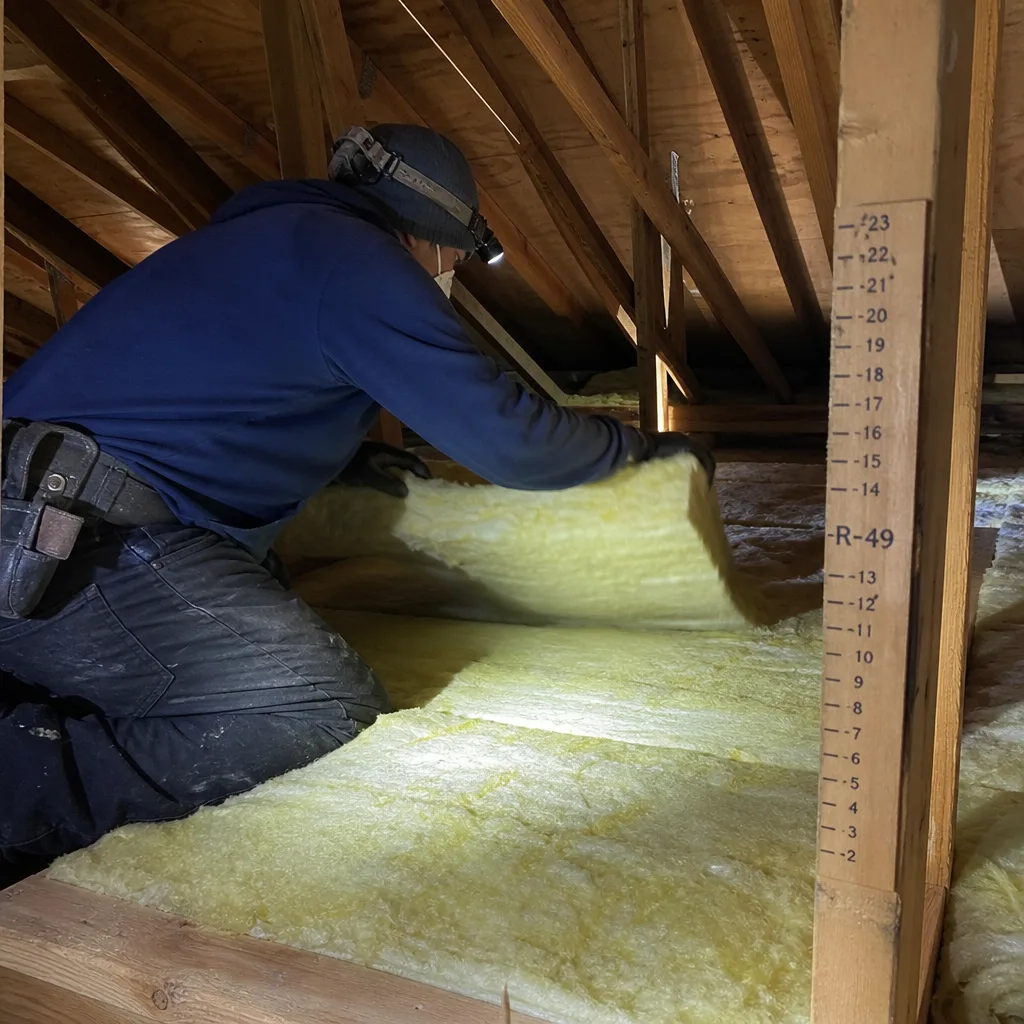
Depth markers are the single most useful thing a good insulation crew leaves behind. They’re simple: a lightweight ruler tab – usually a printed cardboard or plastic strip with R-value markings at the correct depth for the target insulation level – stapled to a joist top or pushed into the blown material at the job’s end. On a proper install, tabs are placed every 15 to 20 feet, near the attic hatch, and at each corner of the attic.
Here’s how to read them without climbing in:
- Open the attic hatch and stand on a step stool so your eyes clear the access point.
- Use a bright LED flashlight, not a phone light – the attic is dark and phone lights throw too little throw distance.
- Look for the marker tabs closest to the hatch. Most installs place one within 4 feet of the opening for exactly this reason.
- Read the R-value line that lines up with the settled surface of the insulation. If the marker says “R-49” at that line and the material covers it, you’re at spec. If material sits below the line, you’ve lost depth.
- If you see multiple markers, check at least three. A 1-inch loss across the attic is a different problem than a 4-inch loss in one walk path.
If your attic has no markers – common on homes built or insulated before 2015, when many local crews didn’t install them – you can’t read current R-value from the hatch. In that case, a professional depth check with a physical ruler plus a material sample check is the way to establish a baseline. It’s a small job that costs little and gives you a number to compare against for the next decade. Under The Haven Standard, our crews install markers on every attic job specifically so homeowners have a self-check that doesn’t require a call.
Moisture Inspection for a Desert-Climate Attic
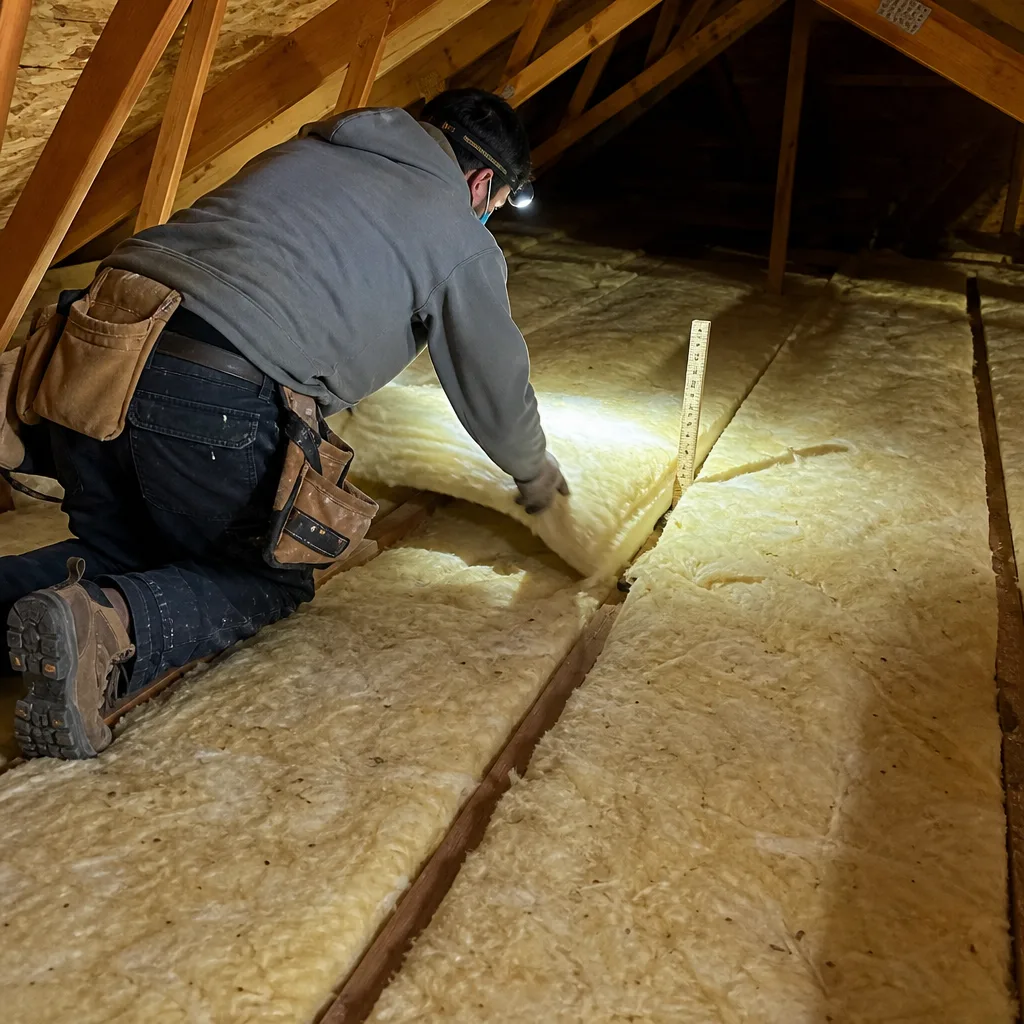
Desert-climate attics still get wet. Not from heavy rainfall, but from wind-driven summer monsoon water pushed under ridge vents and through soffit vents, and from HVAC condensate line failures that spill into the pan and then into the insulation. A proper moisture walk-through in Boulder City looks for specific things:
- Ridge vent staining. Dark water tracks on the underside of the roof sheathing directly below the ridge vent. Faint is normal. Dark and wide means water is entering during storm events and finding its way into the insulation below.
- Soffit vent wet-damming. Loose-fill that was blown too close to the soffit blocks intake airflow, which traps moisture in the cooler air under the roof deck. Check for darkened insulation along the eaves and for baffles that have been pushed out of position.
- Condensate pan overflow. The HVAC pan sits below the air handler and – when the drain line clogs – overflows into the surrounding insulation. Look for a ring of damp material within a few feet of the handler.
- Ridge-to-eave delamination. On batt installs, look for batts that have pulled away from the roof deck or fallen out of the joist bays. That’s a sign of wind-driven moisture cycling the material.
- Mold or mildew odor. If it smells musty when you open the hatch, that’s not “attic smell” – it’s an active moisture problem. Stop and call a professional before blowing new material over it.
Fixing the source comes before patching the insulation. If a ridge vent is leaking, adding material doesn’t fix the leak – it just soaks the new material too. Our Envelope Insulation Boulder City home page lists the full envelope service line, and the crawl space side of moisture control is covered in our crawl space encapsulation and vapor barrier guide.
The Documented Record Every Homeowner Should Keep
This is the section most homeowners skip and later wish they hadn’t. The record you keep from your insulation job has three downstream uses: resale disclosure, utility rebate eligibility, and the maintenance schedule itself. Here’s what belongs in it:
- Install date – the month and year the insulation was installed or upgraded.
- Material type – blown fiberglass vs. cellulose vs. spray foam vs. mineral wool. Each has a different expected lifespan and different compression behavior. CertainTeed fiberglass, Rockwool mineral wool, and Icynene spray foam all age differently.
- Installed R-value and depth – the number on the contract, and the physical depth in inches that was verified.
- Blower-door reading – the CFM50 figure before and after. CFM50 stands for cubic feet per minute at 50 pascals of pressure, and it’s the single number that tells you how tight your building envelope is. A pre-job reading of 4,200 dropping to 2,100 after air sealing is a documented result; a claim of “much tighter” is not.
- Photos – at minimum the attic floor before, the sealed penetrations, the post-install depth, and the depth markers. On a professional job, a Documented Photo Record is included on every visit, not available on request.
- Warranty and written scope – the paperwork covering what was done and what’s covered.
Why does this matter at resale? Two reasons. First, Nevada’s seller disclosure requires homeowners to disclose known defects, and a documented insulation record is the single cleanest way to demonstrate that the attic was installed to spec and maintained. Second, NV Energy rebate programs and federal energy credits require documentation – not just the receipt. A blower-door reading and a written scope are typically the difference between a rebate that goes through and one that gets kicked back.
Visual Check vs. Professional Re-Inspection With a Blower-Door Test
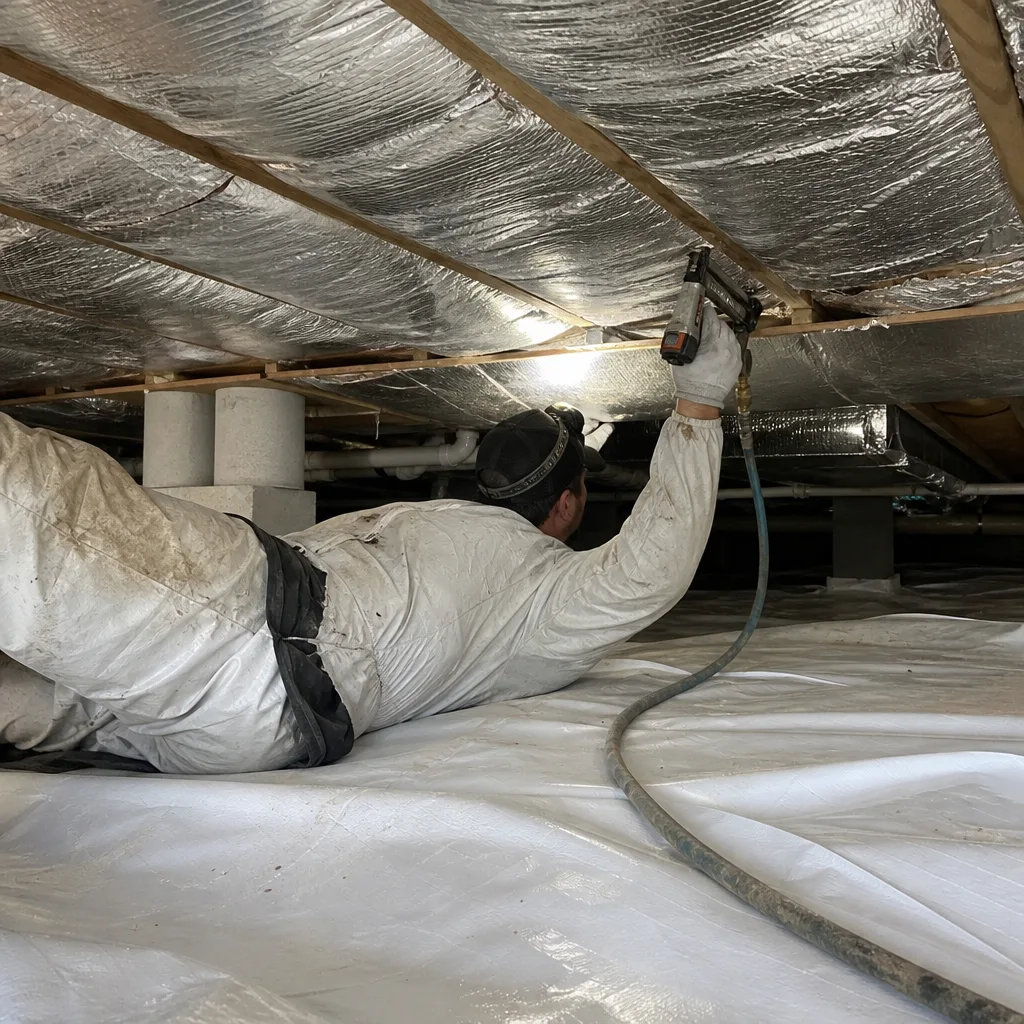
A visual check answers one question: is the insulation still at the depth it was installed to? A professional re-inspection with a blower-door test answers a different question: is the building envelope still performing the way it did when the job closed out?
Here’s the practical split:
- A visual check is sufficient after any single trigger event – one HVAC service, one reroof, one pest treatment – if the depth markers read clean and there’s no moisture staining or pest activity.
- A professional re-inspection is warranted if you’ve had two or more trigger events in a 12-month window, if you find depth loss of more than an inch anywhere, if you see moisture staining, if you’re planning a sale within 24 months, or if your last blower-door reading is 5 or more years old.
- A blower-door test specifically is warranted when your heating and cooling bills have shifted by more than 15% without a rate change, or when you’re applying for a utility rebate that requires a current measurement.
In our experience, the homes that lose the most performance between jobs aren’t the ones with the worst original install – they’re the ones with a good install and no documentation, so nobody knows what changed. A blower-door test is a pressurization measurement that shows, in one number, how much conditioned air your building envelope is losing. Reading it against a baseline makes every future decision easier.
A Simple Seasonal Walk-Through for Boulder City Homes
A light annual routine on top of the trigger-based schedule keeps things honest. This isn’t a substitute for the event-based checks – it’s an add-on. The Boulder City seasonal rhythm works best because summer attic heat and monsoon timing line up naturally:
- Early spring (March). Open the hatch, read the depth markers, look for pest droppings and trails, check that baffles at the soffits are still in place.
- Before monsoon season (June). Photograph the underside of the roof sheathing at the ridge vent and save the image with a date stamp. It gives you a reference for next year.
- After the last monsoon (September). Re-check ridge vent area for new staining, check soffit area for damp insulation, confirm no condensate overflow near the HVAC pan.
- Before the cold snaps (November). Check depth markers again – this is when homes in Boulder City lose heat fast if the insulation was disturbed over the summer. Also check that the attic hatch itself seals.
This is a 20-minute routine four times a year. It catches the small stuff before it becomes a re-install.
When to Patch Insulation vs. Replace It Entirely
Most insulation troubles in Boulder City are patch problems, not replace problems. The line between them comes down to three questions:
- Is the problem localized? A compressed walk path or one damaged section from a reroof is a patch. Material that’s lost depth across more than 25% of the attic floor is a replace.
- Is there contamination? Rodent feces, mold growth, or soaked insulation that’s held moisture for more than a few days can’t be patched – it has to come out. Air sealing and re-install follow. Our team handles attic insulation replacement as a full removal-and-reinstall job so nothing is blown over a contaminated floor.
- Is the original material at the wrong R-value? Boulder City’s climate zone recommends R-49 to R-60 for attic floors. An older install at R-30 with no air sealing isn’t a maintenance question – it’s an upgrade question, and patching to R-49 usually costs more than doing it once, correctly.
One rule of thumb: if a patch requires disturbing more than 100 square feet of existing material, get a written estimate for both patch and full re-install before deciding. A flat written price usually makes the math obvious.
Common Mistakes to Avoid
- Skipping air sealing before patching insulation. If you’re going to disturb the attic floor, seal the top plates, can lights, and penetrations first. Blowing material over an unsealed floor just re-buries the same leaks – and under The Haven Standard, we won’t do it the other way.
- Walking across the attic to check the depth marker at the far corner. Every step compresses the material underfoot. Stand at the hatch and use a flashlight with reach – that’s why markers are installed near the access point.
- Laying plywood storage decking directly on fluffed insulation. It compresses every square foot it covers to near zero effectiveness. Use raised standoffs or a storage platform if you must add decking in Boulder City homes with R-49 blown fiberglass.
- Blowing new insulation over moisture-stained material. If the ridge vent or condensate pan has been leaking, fix the leak and remove the wet material first. New insulation over wet material becomes wet material.
- Skipping the documented record after a patch or service call. Every trigger event that touches the attic should update the file – date, what was done, who did it, photo. The record is more valuable than the material.
- Trusting “attic smell” as a benign quirk. In a desert climate, a musty odor in the attic points to active moisture, not desert dust. It merits a professional inspection before any further work.
- Assuming the blower-door reading from a prior owner is still accurate. Five years of trigger events, a reroof, and one HVAC replacement can move a CFM50 number by several hundred. Re-test when the record gets old.
When to Call a Professional
Some maintenance is a homeowner flashlight check. Some isn’t. Call us when you’ve had two or more trigger events in a year, when a depth marker reads 2 inches or more below the installed R-value, when you see any moisture staining around the ridge or soffit vents, when you smell a musty odor at the attic hatch, or when pest activity has disturbed more than a small patch of material. Also call when you’re within 24 months of listing the home and your last blower-door reading is more than 5 years old – a current reading and a photo-documented record go a long way at resale. Envelope Insulation Boulder City offers free estimates in Boulder City – call (844) 320-7926.
Frequently Asked Questions
A visual depth check after every trigger event (reroof, HVAC service, pest treatment, storage change, major storm), and a professional re-inspection with a blower-door test every 5 to 7 years. Calendar-based annual checks miss the events that actually cause loss – compressed walk paths and monsoon-driven moisture are event-driven, not age-driven.
Yes, if your attic was installed with depth markers. Stand at the attic hatch with a bright LED flashlight and read which R-value line on the marker tab matches the settled surface of the insulation. If you don’t have markers, you can’t read current R-value from the hatch and a professional depth check is the way to establish a baseline.
Yes – R-49 is at the low end of the recommended range for our climate zone, and R-60 is often worth the small incremental cost. The number that matters more than the R-value on the sticker is whether the attic floor was air sealed first. Insulation at R-60 over an unsealed floor still loses significant conditioned air; R-49 over a properly sealed floor performs closer to spec.
HVAC service walk paths are the leading cause by a wide margin. A single service visit can compress 3 to 4 inches of blown fiberglass along the entire path to the air handler, dropping effective R-value by up to 20% in that corridor. Pest activity and reroof debris are second and third.
Not every year, but it’s the only way to measure envelope performance directly. A depth check tells you whether the insulation is at spec thickness; a blower-door test tells you how much conditioned air the home is actually losing. If your utility bills have shifted more than 15% with no rate change, a blower-door test is worth the money.
Install date, material type, installed R-value and depth, before-and-after blower-door readings if applicable, the written scope, the written warranty, and the Documented Photo Record. That file matters for resale disclosure and for NV Energy rebate and federal energy credit eligibility – the receipt alone is usually not enough.
The Bottom Line
Attic insulation in Boulder City doesn’t wear out on a calendar. It wears out when someone walks across it, when a rat tunnels through it, when a monsoon pushes water under a ridge vent, and when a homeowner lays plywood storage decking directly on top of it. Build your maintenance schedule around those five triggers – reroof, HVAC service, pest treatment, storage change, major storm – and add a light four-times-a-year visual check for depth and moisture. Install depth markers you can read from the hatch, keep a written record of install date, material, R-value, and the last blower-door reading, and re-test professionally every 5 to 7 years. That’s the entire schedule, and it will outlast any annual reminder you can set on your phone.
If you’d like a second opinion on an existing written estimate, we’ll read it with you for free. If you’re not sure whether your insulation is at spec, a documented depth check with a baseline reading is straightforward. Call (844) 320-7926 for a free estimate in Boulder City.
Written by the team at Envelope Insulation Boulder City.