
Last updated November 17, 2026
Attic Insulation Warning Signs Every Homeowner Should Know
Most attic insulation problems are diagnosed from the mailbox and the thermostat, not from inside the attic. The insulation itself rarely announces that it has failed. What fails first is performance: the electric bill climbs through the summer, the upstairs HVAC zone starts running longer than the downstairs zone, and one or two rooms stop holding temperature while the rest of the house stays comfortable. In Boulder City, where summer afternoons routinely cross 105°F and the attic can hit 150°F or more, that performance loss shows up fast. This guide teaches you to read those signals correctly, so you can gather real evidence before you make a single call to anyone. Knowing the warning signs saves you from paying for insulated space that isn’t actually sealed – a costly and common mistake. Here’s what to look for, area by area, and what each signal tells you about the state of your attic assembly.
Quick Answer
The warning signs of failing attic insulation are usually not visible from inside the attic. They show up on your NV Energy bill as a rising summer baseline, in HVAC runtime patterns where your upstairs zone runs more than 20% longer than the downstairs zone, in room-to-room temperature gaps, in musty smells from supply registers, and in a handful of visual clues at the attic hatch. Reading these signals correctly is what a trained technician does first, and what a responsible homeowner can also learn to spot before scheduling any work.
Table of Contents
- 1. Reading your NV Energy Bill: The Summer kWh Signal
- 2. The Room-by-Room Temperature Map (A $12 Infrared Thermometer Test)
- 3. Musty or Earthy Smells at Supply Registers: A Faster Diagnostic
- 4. Visual Warning Signs You Can See from the Attic Hatch
- 5. HVAC Runtime Patterns That Point to the Attic
- 6. Why Boulder City’s Climate Makes These Signals Arrive Faster
- 7. How to Document Warning Signs So Any Contractor Can Give You a Scoped Estimate
- Common Mistakes to Avoid
1. Reading your NV Energy Bill: The Summer kWh Signal
Your monthly kilowatt-hour figures are the single most reliable external indicator of attic thermal performance. Pull up the last 24 months of NV Energy usage – either your paper statements or the online account history – and write the kWh figure for each month onto a simple grid by month and year. You’re looking for the summer spike pattern, not the total bill. A home that was performing well two summers ago will typically show a June-to-September kWh total that’s stable or even declining. A home with a failing attic assembly will typically show the summer peak climbing year over year, even when the square footage and equipment haven’t changed.
Two patterns matter most:
- A widening summer baseline. If your July 2022 total was 1,800 kWh and your July 2024 total is 2,300 kWh, with no new equipment or added square footage, the attic is a strong suspect. The insulation may not be the culprit alone – air leakage through top plates and recessed ceiling lights is often larger than the insulation deficit – but the pattern points to attic assembly performance.
- A shift in the shoulder months. In Boulder City, May and September are transition months where the attic contributes less to load. If those months are starting to show spikes you didn’t see before, that means the attic is failing to buffer the transition itself, which points to thermal bridging or air leakage rather than a straight R-value problem.
Note your daily high temperatures too. It’s easy to confuse a hot summer with a failing attic. The test is whether the same month at the same average high temperature is costing you more kWh than it did two years ago. If it is, you have your baseline. Write the numbers down before you forget them. That baseline is the value any insulation contractor will ask for – and the first piece of evidence a scoped estimate should be measured against.
2. The Room-by-Room Temperature Map (A $12 Infrared Thermometer Test)
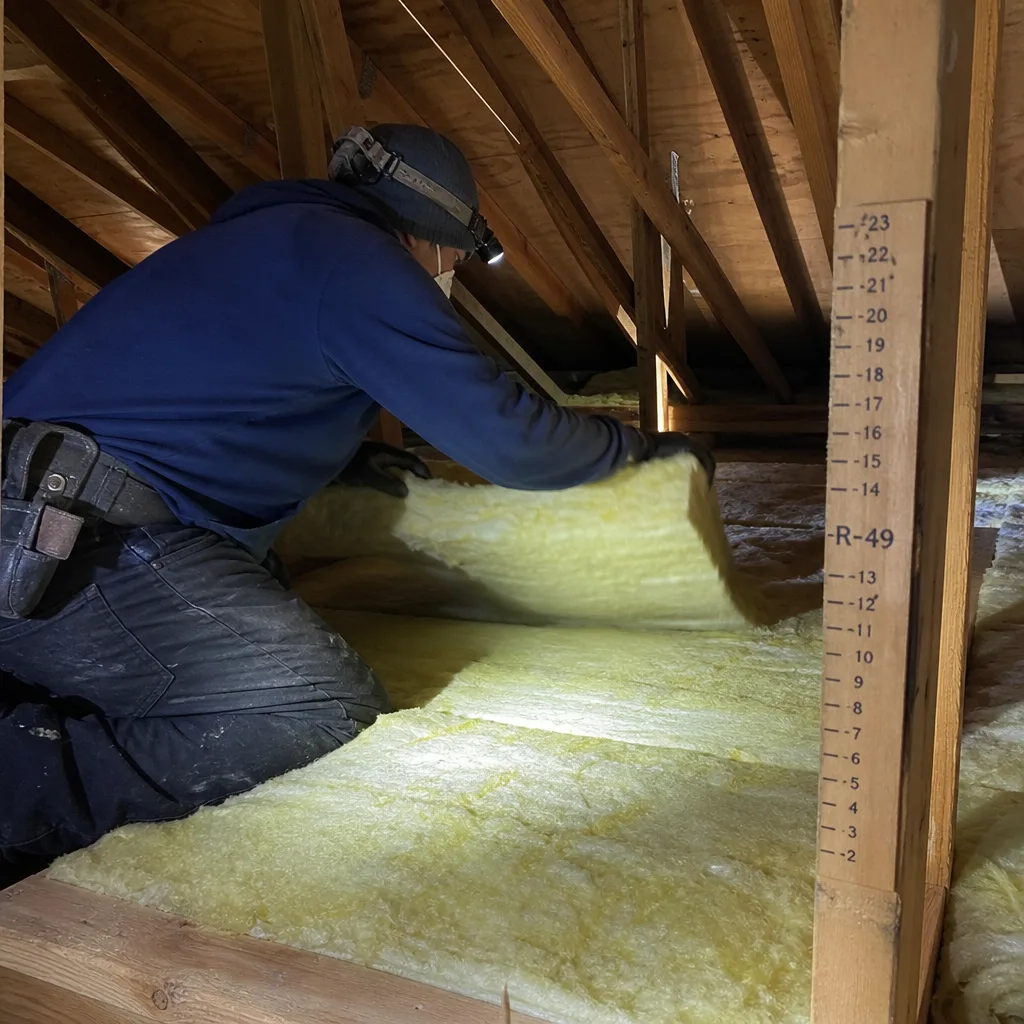
The fastest way to identify which areas of your attic are failing is to map the difference between your ceiling surface temperature and the room temperature at each location. You don’t need to enter the attic. A $12 infrared thermometer from any hardware store, plus ten minutes on a 95°F+ day, tells you more than a visual inspection of the insulation itself, because it measures what the assembly is actually doing right now.
Here’s the method:
- Pick a hot afternoon (2 to 5 p.m.), after the HVAC has been running for at least 20 minutes.
- Stand in each room you want to test, at eye level, and record the room air temperature from the thermometer.
- Point the thermometer at the ceiling, straight up, in the center of the room. That’s the ceiling surface temperature.
- Point again at the ceiling near any recessed light or ceiling penetration. Those spots run hotter.
- Subtract the two. A well-insulated, well-sealed Boulder City ceiling on a 105°F day should read within about 10 to 12°F of room air. A ceiling reading 18°F hotter than room air is losing meaningful heat through the assembly.
- Take one more reading near an exterior corner of the room, where ceiling and wall meet. Corners that read hotter than the room’s center point to air bypass on the top plates or a corner framing gap.
If you have a two-story home – common in Boulder City subdivisions built between 1990 and 2010, such as those near Veterans Memorial Park and along Adams Boulevard – do this in both the upstairs bedroom closest to the attic hatch and the hallway or stairwell landing closest to the downstairs zone. Rooms with failure patterns cluster: the hottest ceiling readings tend to sit over the exterior wall side of the house, not the interior. That’s the diagnostic no contractor can fake; it points to the actual failed area, not the average.
3. Musty or Earthy Smells at Supply Registers: A Faster Diagnostic
If your nose catches a musty, earthy, or damp-cardboard smell coming from a supply register when the HVAC kicks on in late spring or early summer, that signal is faster than a visual inspection, and it points to two different attic problems at once.
The first is moisture. Attic insulation that has absorbed moisture – from a roof leak, an unvented bath fan dumping humid exhaust into the attic, or summer condensation on cold ducts – loses thermal resistance quickly. CertainTeed fiberglass loses R-value as moisture uptake climbs; rock wool from Rockwool or CertainTeed is more moisture-tolerant, but no insulation does well when water is present. The smell is often the first sign that the insulation is wet and needs to be checked and, in some cases, replaced.
The second is air leakage. The supply duct running through the attic to a register is often the most poorly sealed component of your entire HVAC system. When the duct joins the register boot or ceiling collar with an exposed gap, the attic’s air – which in Boulder City can include dust, dry rot particles from roof framing, and rodent evidence near the hatch – gets drawn directly into your conditioned space. A musty smell on supply is a bypass problem, and bypass problems are air-sealing problems before they are insulation problems. That’s the reason air sealing comes before adding insulation, always. Blowing new insulation on top of an unsealed duct void leaves the smell in place and just charges you for insulated air you never see.
Freeze this: if the smell only shows up when the air handler runs, the duct or its junction is the suspect. If it shows up through a wall cavity or a duct chase without the HVAC running, it’s a moisture problem in the insulation itself. Either way, it’s worth a professional trace.
4. Visual Warning Signs You Can See from the Attic Hatch
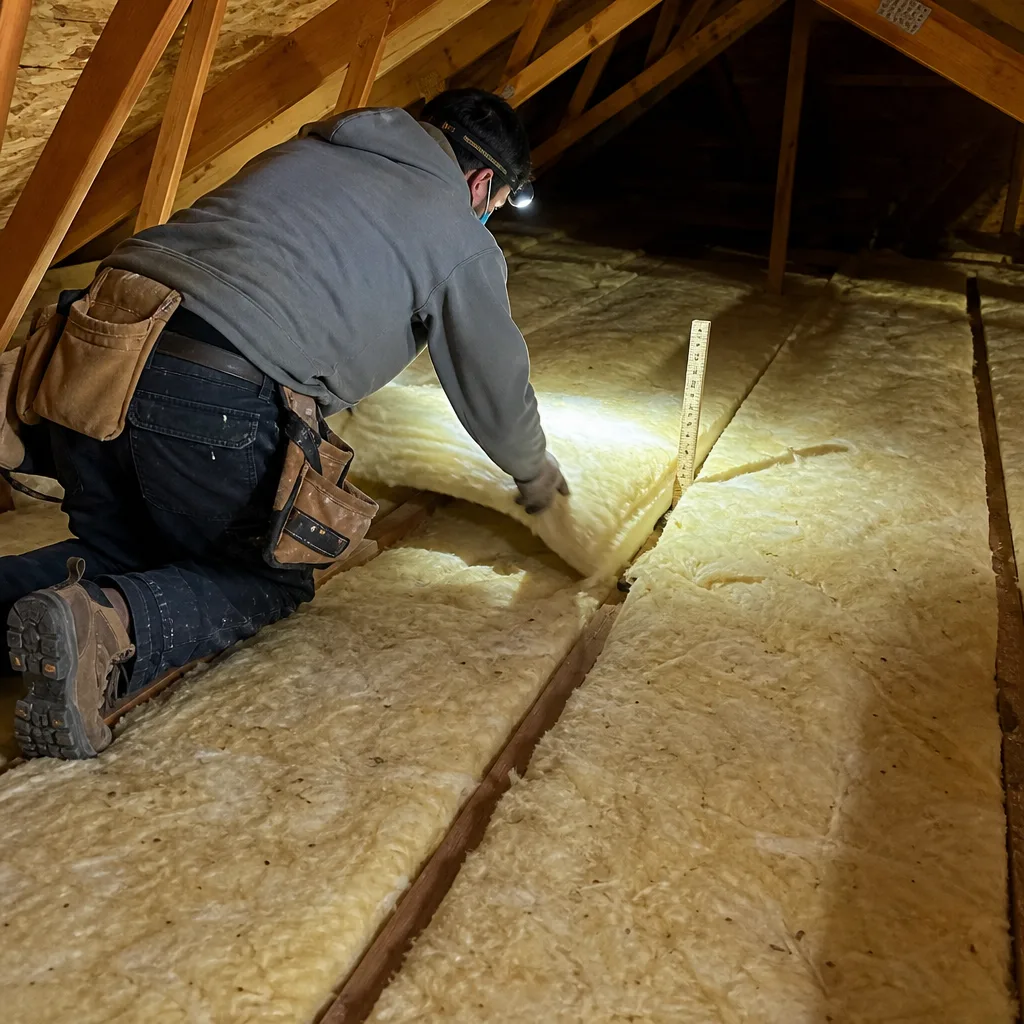
You don’t need to crawl into the attic to find these. Stand on a step stool at the attic hatch, flip on a strong headlamp, and look carefully across the attic floor. Three things stand out immediately. All three are visible from the hatch of a ranch-style Boulder City home:
- Visible joists. The wooden “ceiling joists” are the structural members the insulation is blown over. If the tops of the joists are clearly visible across most of the attic floor, the insulation depth has dropped. In Boulder City attics, blown-in fiberglass and cellulose settle over time, and home inspectors regularly find a Boulder City attic originally blown to 12 inches has settled to 8 or 9. That’s a meaningful loss from what it was designed to do.
- Dark streaking on the insulation surface. If you see dark, sooty streaks running in lines or patches across the top layer of insulation, those are air bypass stains. Conditioned air and heating/cooling air have been leaking through the top plates of the walls or through recessed light cans, dusting the insulation surface over the years. The dark streak marks the leak; the insulation next to the streak is doing nothing useful until the leak is sealed.
- Sagging duct insulation. Look at the flexible duct runs. If the foil or insulated jacket that wraps the duct is drooping at the corners or hanging low, that duct is short on thermal protection and is losing conditioned air into the attic before it ever reaches the register. In our experience, the ducts within 8 to 10 feet of the air handler are the most likely to be sagged and unsealed.
While you’re looking, note whether recessed light fixtures have any insulation touching them, and whether the vapor barrier on the attic floor (if there is one) is intact or visibly torn. Both details change the scope of the estimate you’ll receive.
5. HVAC Runtime Patterns That Point to the Attic
Your HVAC system’s runtime is the second-most reliable signal, and it’s the one homeowners most often misattribute. A system that “short cycles” in cooling season is usually blamed on equipment. In Boulder City, the truth is often the reverse: the equipment is fine, and the building envelope is forcing it to run longer to hold the set point upstairs.
Look for these runtime patterns:
- The upstairs zone runs more than 20% longer than the downstairs zone. If your thermostat app logs show that, or you can measure it from the equipment runtime history, the upstairs attic assembly is failing to reject summer heat. This is the pattern to investigate first.
- Long runtimes with a perfectly cool return air temperature. If the air coming out of the registers is properly cold (you can check with the same infrared thermometer) but the room still creeps up above set point, the system is working and the envelope can’t hold what the system delivers.
- Start-up fan running longer after the room is satisfied. Some modern systems have a “fan-only” post-cycle to pull moisture and residual heat from the system. If that cycle is stretching to several minutes on a 105°F day and the room is still warm, the attic is re-heating the space.
If your system is running longer than it used to and the house still feels warm, don’t buy a new AC first. The runtime data alone doesn’t diagnose the cause – it just points the finger at the attic assembly, which is a much less expensive place to investigate than a compressor. That’s a call we’ve made thousands of times in Boulder City, and the equipment replacement is almost never the first answer.
6. Why Boulder City’s Climate Makes These Signals Arrive Faster
Boulder City sits at roughly 2,500 feet in the Mojave Desert, which creates a specific attic failure profile. Two forces drive it: dry heat and daily thermal swing. The outside air in July routinely peaks above 105°F and drops 30 to 40°F overnight, but the attic does not drop as fast as the outside air because the roof holds heat. That cycle means the attic assembly goes through a partial heat-rise/heat-settle every single day for five months. Over a summer, a weak attic floor doesn’t just lose energy on an average day – it loses it through a thermal pump that runs 150+ cycles every season.
The other force is the dry climate’s effect on insulation materials themselves. Blown-in fiberglass and cellulose hold up well in dry heat, but they don’t shrink or compress when wet in the same way as they might in a humid climate. That means attic moisture problems often hide: the insulation looks fine on top but has failed at the bottom layer, near the ceiling deck. In our experience, that’s why a Boulder City attic that smells musty comes from an active water source – an HVAC condensate drain dumping into the attic, a roof flashing defect, or a fan vent dumping into the attic rather than outside – and not from ambient humidity. The right answer is finding and stopping the source before touching the insulation.
The Boulder City building code also has a specific requirement worth knowing: new construction and major remodels are held to a specified attic R-value minimum for the climate zone, and additions trigger the attic insulation check even when the rest of the home isn’t touched. When an estimate is written, ask what R-value the contractor is targeting and confirm it against what the Boulder City permit record requires for your project type. That is a question you can ask without owning a code book.
And the local construction stock matters: many Boulder City homes built between the 1980s and early 2000s around Lakeview and near the Boulder Creek subdivisions still have the original blown insulation at the original depth. When we check those attics, they’re typically 20 to 35 percent thinner than they were at installation, and the top plates were never air-sealed in the first place. If your home dates from that period and you’ve never had a blower-door test – the pressurization reading that shows, in one number, how much air your building envelope is losing – that’s the first thing worth doing. You can see our attic insulation service in Boulder City to understand what a full scope typically looks like.
7. How to Document Warning Signs So Any Contractor Can Give You a Scoped Estimate
A vague “we have an insulation problem, it feels warm upstairs” gets you a vague estimate. A stack of specific evidence gets you a scoped price. This is the documentation routine we recommend to every Boulder City homeowner who’s gathering evidence before making a call:
- Photograph your NV Energy usage screen. Capture 24 months of monthly kWh and the corresponding daily high temperatures for the last two summers. Screenshot the app or photograph the statements.
- Write down the infrared thermometer readings by room. Room air, ceiling center, ceiling near recessed light, ceiling near exterior corner. Note the date and outside temperature for each set of readings.
- Photograph the attic hatch view. One wide shot of the joists and top layer of insulation, plus a close shot of any dark streaking and any sagging duct jacket. Attach a note about what you think you’re seeing.
- Note the location of any musty smell and whether the HVAC was running when you noticed it.
- Track HVAC runtime from your thermostat or smart-thermostat app for upstairs and downstairs zones, and export the logs if they’re available.
- Note the age and type of any duct system you can see at the hatch – flex, rigid, or a mix.
- Write down the home’s build year and the last permitted work on the HVAC or roof, if you know it.
That packet is what a contractor can turn into a scoped estimate instead of an educated guess. When we see a Boulder City homeowner who hands over this documentation, we can usually tell them within a few minutes what the likely scope is: attic air sealing first, then insulation top-up to a target depth, and a blower-door reading before and after to confirm the result. That last part is the difference between a promise and a documented measurement. You can see the same approach in spray foam insulation in Boulder City, where the sealing step is even more load-bearing because the foam itself is the air barrier.
Common Mistakes to Avoid
- Replacing the HVAC system before checking the attic. A Boulder City system that runs long in August may be working perfectly while the attic assembly can’t hold the cool air. Get a blower-door reading on the attic before you pay for a new condenser.
- Blowing new insulation over an unsealed attic floor. Adding depth without first sealing top plates, recessed light cans, and ceiling penetrations traps the leaks you already have. The insulation you buy pays for a bypass it will never fix, and the summer bill doesn’t drop by the amount you spent.
- Judging insulation performance by its visible depth alone. Six inches of dense rock wool from Rockwool can outperform twelve inches of loosely blown fiberglass, and settled insulation almost never matches its nominal depth. Depth is not the same as performance.
- Assuming a musty smell is “just old house smell.” If a musty smell shows up on supply air when the HVAC runs, that’s a duct or attic moisture problem you can diagnose, and it’s worth fixing before it damages the insulation or the framing.
- Waiting until the bill is obviously painful. In Boulder City, the widest gap between the first warning signs and the visible symptom is about three summers. Catching a rising kWh baseline in the first summer costs meaningfully less than dealing with an attic that’s now moisture-laden and needs the insulation replaced rather than extended.
- Accepting an estimate without a written scope, a written price, and a target R-value. A number on a napkin is not a scope. Insist on a written price before any work starts, and a written target depth or R-value that the contractor will confirm at the end of the job.
- Skipping the second opinion. On a job that changes your home for the next 20 years, having a second contractor read the estimate with you is standard practice, not a sign of distrust.
When to Call a Professional
Call a professional when you see the first of these patterns and you want a documented answer rather than a guess: your upstairs HVAC zone runs more than 20% longer than your downstairs zone through the summer; your NV Energy July/August kWh has climbed year over year while equipment and square footage haven’t changed; you’re seeing musty or earthy smells on supply air when the HVAC is running; or your infrared thermometer shows a ceiling surface running 18°F or hotter than the room air in multiple rooms. Also call if you have any reason to suspect moisture in the attic, or if you’ve never had the top plates and recessed light cans checked. Envelope Insulation Boulder City offers free estimates in Boulder City – call (844) 320-7926 to schedule a documented evaluation. We’ll read your existing evidence with you, and if you already have a written estimate on hand, we’ll read that with you too.
You can also see our full range of envelope services, including crawl space encapsulation and vapor barrier in Boulder City, on our Envelope Insulation Boulder City home page. Our technicians have up to 10 years of experience, and on applicable jobs we publish before-and-after blower-door numbers – the measurement that shows, in one figure, how much conditioned air the home was losing before and after the work.
Frequently Asked Questions
The first signs are usually not in the attic at all: your NV Energy summer kWh total climbs year over year at the same outdoor temperatures, and your upstairs HVAC zone starts running more than 20% longer than the downstairs zone. Both point at the attic assembly before any visual damage is visible. Call (844) 320-7926 for a free estimate – we can read the evidence you’ve gathered.
Yes. Three of the most reliable warnings are visible and measurable without entering the attic: a $12 infrared thermometer reading of your ceiling surface versus room air, the attic hatch view of joists and insulation surface, and a musty smell on supply air. Together these give you substantial evidence to bring to a contractor.
A musty or earthy smell on supply air usually means attic air is being drawn directly into the HVAC system through an unsealed duct junction, a register boot gap, or a ceiling collar – which is an air-sealing problem, not an insulation depth problem. It can also indicate moisture has entered the attic insulation. In either case, the fix is to trace the bypass and seal it before adding any insulation.
It’s almost always cheaper to investigate the attic first. A system that runs long may be working correctly while the attic can’t hold the set point. A blower-door reading – the pressurization measurement that shows how much air your envelope is losing – is the diagnostic that separates an equipment problem from an envelope problem. If the equipment checks out, replacing the unit doesn’t change the attic’s performance, and you’ve still got the attic bill.
Most attic insulation replacement jobs in a typical Boulder City home run between $2,400 and $6,800 depending on square footage, target R-value, and whether air sealing is done first. A smaller top-up job can run lower, and a job that includes insulation removal runs higher. A written price before work starts – which is standard for us – is the only quote that holds, so we recommend gathering your kWh and infrared thermometer data before calling. Call (844) 320-7926 for your free estimate.
Yes, especially if the attic floor was never air-sealed and your home dates from before the mid-2000s. The blower-door test gives you a single measurable number – CFM50 – and a before-and-after comparison is the only way to confirm the job actually reduced air loss. Without those two readings, you can’t tell whether the insulation you paid for did what it was supposed to.
Ask for the target R-value and installation depth, the actual air-sealing scope (top plates, recessed light cans, and ceiling penetrations), whether the price includes insulation removal if needed, and the warranty terms in writing. Under Haven Standard, we always deliver a written price, a written scope, and a written warranty before any work starts. Bring us a competing estimate and we’ll read it with you.
The Bottom Line
Attic insulation failure shows up first as a performance problem, not a visual one. In Boulder City, the strongest early signals are a rising summer kWh baseline on your NV Energy statements, HVAC runtime patterns that show your upstairs zone running more than 20% longer than the downstairs zone, musty smells on supply air, and ceiling surface temperatures running 18°F or hotter than room air. These signals are measurable, documentable, and – read together – point at the specific areas that need attention. Take photos, note the readings, and gather the evidence before you make a call. A scoped estimate is worth ten times more than a guess, and you can generate the evidence yourself in an afternoon. See our attic insulation service in Boulder City and crawl space encapsulation and vapor barrier in Boulder City for related work, or read how we approach spray foam insulation in Boulder City.
If you’ve documented any three of the warning signs above, we can read your evidence with you and offer a written price before any work starts. Call (844) 320-7926 for a free estimate. We serve Boulder City and the surrounding area with attic insulation, air sealing, and a documented before-and-after blower-door reading on every applicable job – and a live person answers the phone 24/7.
Written by the team at Envelope Insulation Boulder City.