
Last updated November 17, 2026
DIY vs Professional Blown-In Insulation: What’s Safe to Do Yourself
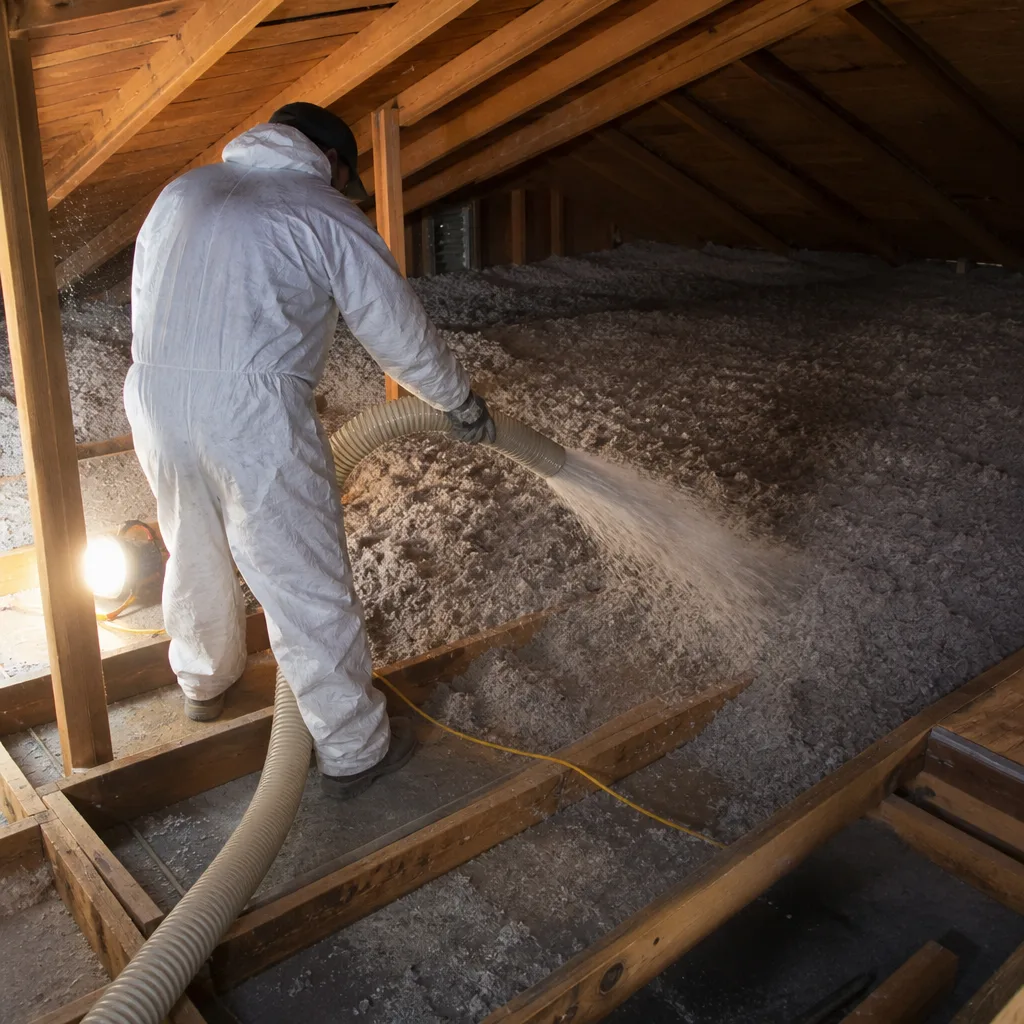
Home-improvement retailers rent blowing machines for around $150 a day and sell cellulose by the bag. The machine is not the hard part. The hard part is the two to four hours of foam and mastic work that has to happen underneath the insulation – and that most DIY tutorials skip entirely because it’s unglamorous and unfilmable. In Boulder City, where summer attic temperatures push past 140°F and winter nights still drop into the twenties, the layer beneath the fluff is what actually decides whether your house holds its conditioned air. This guide draws a clear line between what a careful homeowner can do and what they can’t, so you can size the job honestly before you rent anything.
Quick Answer
You can safely self-perform measuring depth, calculating bag count, operating a rental blower, and installing baffles in a straightforward attic. You should not DIY air sealing at top plates and penetrations, a before-and-after blower-door verification, or diagnosing existing moisture damage – those are where mistakes become permanent and invisible. The insulation layer is DIY-able; the air barrier underneath it is not.
Table of Contents
- Where the DIY line actually falls: air barrier, not R-value
- The tasks a mechanically confident homeowner can safely do
- The tasks that are not safely DIY, regardless of skill
- Why a blower-door test is the only proof your sealing worked
- Cost per square foot: materials-only DIY vs full professional in Boulder City
- What documentation a professional job produces (and what you lose without it)
- Common mistakes to avoid
- When to call a professional
Where the DIY Line Actually Falls: Air Barrier, Not R-value
Most comparisons of DIY versus professional insulation focus on R-value and bag count: how thick to blow it, how many bags to buy, how to read the depth ruler stapled to a rafter. That framing misses the point. In our experience across Boulder City attics, the R-value is the easy variable. It’s arithmetic. The air barrier is the variable that decides whether you get the performance you paid for, and it’s the part the tutorials leave out.
Here’s the trade logic: blown-in insulation is a porous material. It slows conductive heat transfer, but it does not stop air movement. An attic floor with 15 inches of cellulose and a hundred unsealed penetrations will still leak conditioned air upward all summer and lose warm air all winter. The insulation has no work to do if the air is allowed to bypass it. That’s why the sequence matters – seal first, then insulate. A house that seals first and insulates second performs differently than a house that did the reverse, even at identical R-values.
In Boulder City specifically, the failure mode we see most is high-desert attic air that moves through top-plate gaps and recessed light cans during the monsoon months and the cold snaps, depositing dust and moisture on the underside of the insulation where nobody sees it. You can blow new material right over the top and the number on your thermostat won’t move. That’s not a materials problem. It’s a sequencing problem.
So the line isn’t “can I operate a blower?” The line is “can I build and verify an air barrier?” Those are two different skills, and only one of them is DIY-appropriate.
The Tasks a Mechanically Confident Homeowner Can Safely Do
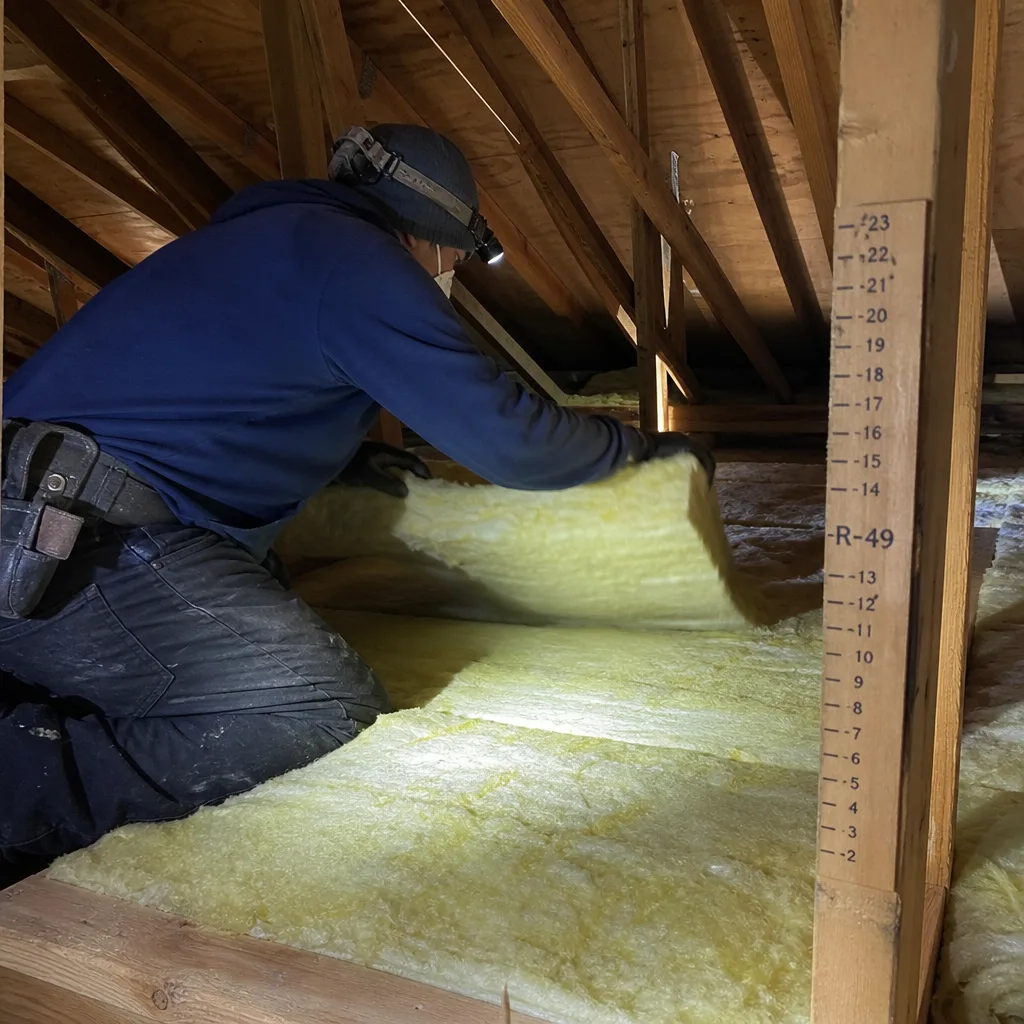
If your attic is uncomplicated – accessible, dry, free of knob-and-tube wiring, no history of pest damage, and your air sealing is already done and documented – the insulation layer itself is genuinely within reach. These are the tasks we consider fair game:
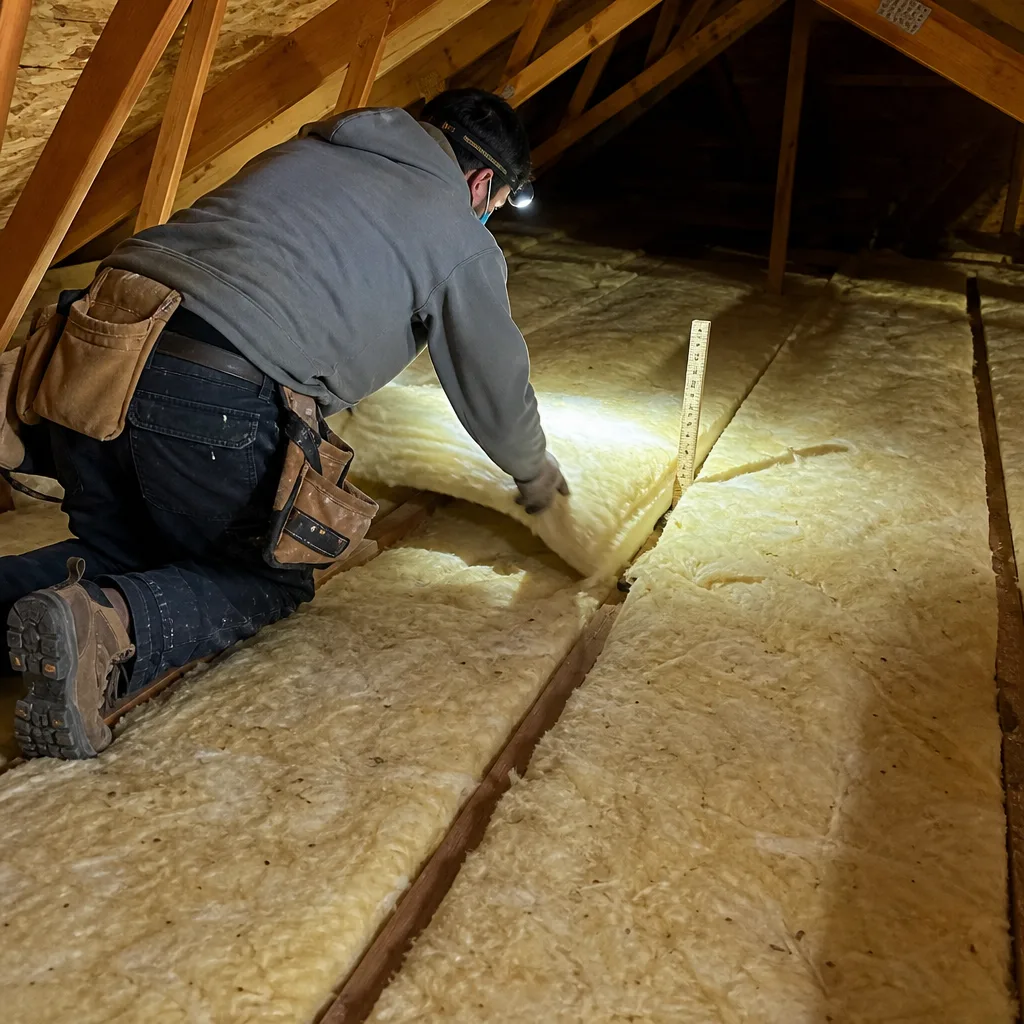
- Measure existing depth. Use a tape measure and check in at least six spots, because depth varies wildly across an attic. Write the lowest number down; that’s your baseline.
- Calculate bag count from the manufacturer’s chart. GreenFiber and Owens Corning both publish coverage charts per bag at a target depth. Read the chart, don’t guess.
- Install baffles at the eaves. These keep the blown material from blocking the soffit vents. It’s stapling work at the edge of the attic, hot and slow but not hazardous.
- Operate a rental blower. Two people are better than one – one feeds the hopper, one aims the hose. Keep the hose level and work backward from the far end.
- Mark depth with rulers. Staple a marked stick or depth gauge to rafters every few feet so you’re not guessing when to stop.
If you’re doing this in Boulder City, schedule the work for early morning. Attic temperatures in July and August climb fast, and a two-hour job can turn into an unsafe one around 10 a.m. Hydrate, take breaks, and don’t send anyone up alone.
A note on materials: any of the standard brands – GreenFiber, Owens Corning, Johns Manville, Knauf – will make a defensible product. The brand is less important than the installation depth and the coverage of the space. Get the number right and the brand matters less than you’d think.
The Tasks That Are Not Safely DIY, Regardless of Skill
These are the jobs we’d decline to hand a homeowner a caulk gun for, no matter how handy they are. Not because the work is difficult, but because the consequences of getting it slightly wrong are permanent and invisible.
- Air sealing at top plates and penetrations. Every wire, pipe, or duct that passes through a top plate is a leak. Sealing involves foam, mastic, and access to the framing from both sides. On an attic floor with 60 to 100 penetrations in a typical Boulder City home, that’s a full day’s work and it’s the single most important part of the job. A missed penetration is a hole you’ll never see again once insulation is over it.
- Diagnosing existing moisture damage before adding coverage. A blower door and a moisture meter together will tell you whether you have a hidden problem. Blowing insulation over a damp sheathing and calling it done traps the moisture and makes the problem worse. This diagnostic step is not optional.
- Verifying your work with a blower-door test. You can seal every penetration you can find and still not know whether you moved the number. The only way to know is a before-and-after pressurization reading. If you can’t run it, you can’t verify it.
- Working around recessed light cans, gas appliances, and chimneys. Clearances around heat sources are code-defined for a reason. In Boulder City, this is the single most common DIY failure we get called to fix.
If you’re doing the insulation part yourself but want the air sealing part done right, this is exactly the scope where a professional job makes sense. We handle the pole and the sealing; you can blow the material – or let us. Either way, the number on the blower door is the number that matters, and it has to be measured.
For a deeper look at how we sequence that work, see our page on attic insulation in Boulder City.
Why a Blower-Door Test Is the Only Proof Your Sealing Worked
A blower-door test – a pressurization reading that shows, in one number, how much air your building envelope is losing – is the only honest way to know whether your air sealing worked. You can look at every penetration in an attic and swear you sealed it. The blower door tells you what you actually did.
The test works by mounting a calibrated fan in a door frame, pressurizing the house to 50 Pascals, and measuring the airflow required to hold that pressure. The result is expressed in CFM50 – cubic feet per minute at 50 Pascals. A tighter house reads lower. A leaky house reads higher. That’s the whole story in one figure.
What it cost to hire separately depends on the market and the scope, but in our experience a standalone residential blower-door test typically runs in the range of a few hundred dollars for a single test, and double that for a before-and-after pair with a written report. If you’re doing DIY air sealing in Boulder City, that cost is the difference between guessing and knowing. A typical leaky home in the area reads over 3,500 CFM50 before sealing. A well-sealed one reads under 2,000. The gap in that number is what your energy bill is actually paying for.
If you want to know more about how we use blower-door data to document a job, that’s covered in our page on Envelope Insulation Boulder City home.
Cost Per Square Foot: Materials-Only DIY vs Full Professional in Boulder City
Where the math gets interesting for a homeowner is the actual cost comparison. Here’s what we see in the field for a typical 1,200-square-foot attic floor in Boulder City:
| Line item | Materials-only DIY | Full professional |
|---|---|---|
| Blowing machine rental | $150 | Included |
| Cellulose (per bag) | $12 to $16 × 40 bags | Included |
| Baffles, mastic, foam, tape | $80 to $150 | Included |
| Air sealing labor | Your weekend | $500 to $1,200 |
| Blower-door test (before/after) | $400 to $800 (hired) | Included |
| Documented photo record | None | Included |
| Written warranty | None | Included |
| Total | $1,000 to $1,400 | $2,400 to $3,600 |
On paper, DIY saves $1,000 or more. In practice, the gap narrows to a fraction of that if you hire out the air sealing and the blower-door verification separately – which you should. And if the sealing is done wrong, the savings evaporate entirely in the following season’s energy bill, because you’ve paid for an R-value you’re not actually getting.
The honest answer is this: DIY makes financial sense for a homeowner who can genuinely verify the air sealing was done well. It rarely makes sense for a homeowner who can’t. And the resale documentation – which we’ll cover next – is worth something on its own.
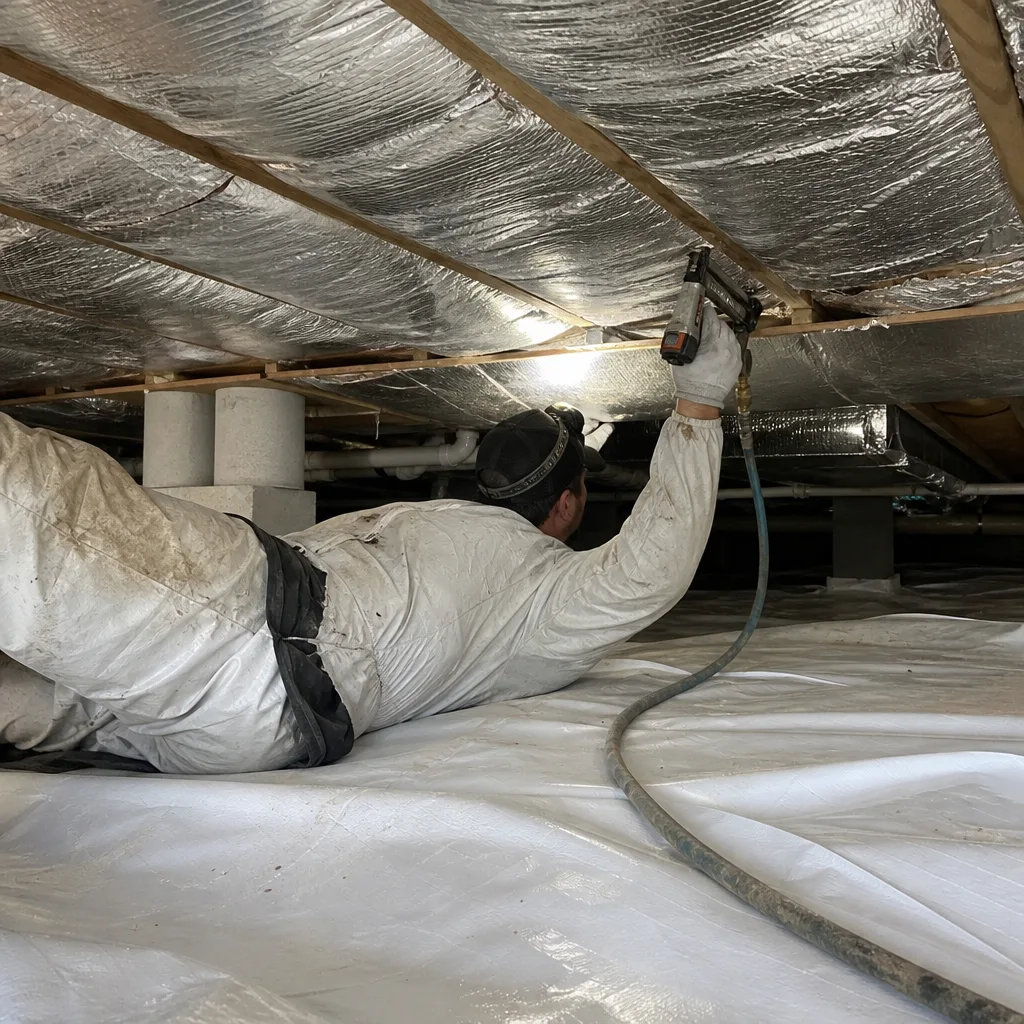
For a service that combines sealing and coverage in a single scope, see our page on spray foam insulation in Boulder City. If your attic is over a crawl space, the moisture dynamics change entirely, and that’s covered in crawl space encapsulation and vapor barrier in Boulder City.
What Documentation a Professional Job Produces (and What You Lose Without It)
When we finish a job in Boulder City, the homeowner walks away with four things: a written price signed before the work started, a blower-door reading before sealing, a blower-door reading after, and a documented photo record of every sealed penetration. That package is the record of what was actually done. It’s also, not incidentally, what a home inspector or a buyer’s agent will want to see at resale.
A DIY job can produce the price and the photos, but it can’t easily produce the CFM50 figures. If you skipped the before-and-after test, you have no way to tell a buyer, or a lender, or yourself, what changed. The house is either “insulated” or it isn’t, and “insulated by the previous owner” reads a lot weaker to a buyer than a written record with numbers. In a Boulder City market where summer cooling is the primary energy cost, that documentation has cash value.
The other loss is performance confidence. You paid for material either way. The only way to know whether the money bought the performance you expected is to compare the two numbers. A professional job produces both on the invoice.
Common Mistakes to Avoid
- Insulating over unsealed penetrations. This is the number-one mistake and it’s permanent once the insulation is down. If you haven’t sealed, don’t blow.
- Blowing to a guessed depth instead of a measured one. The depth ruler stapled to the rafter exists so the pile is even and correct. Guess and you’ll be over or under across the entire space.
- Blocking soffit vents with baffles installed in the wrong position. Roofs in Boulder City cook on 105°F days; the soffit vents are doing real work. Blocked vents lead to moisture and premature shingle failure.
- Working at midday in July or August. Attic temperatures above 140°F are a heat-illness hazard. Schedule early morning, take breaks, and don’t work alone.
- Assuming your 2015-2025 build is air-sealed because it’s newer. Newer construction is better sealed than pre-war stock, but it isn’t perfectly sealed. We routinely find penetrations in homes built in the last decade.
- Skipping the before-and-after blower-door reading. It’s the only number that proves the sealing worked. Without it, you’re guessing.
- Using a single contractor’s quote as the price. Get a written second opinion. Any written estimate can be compared against another written estimate; free second opinions exist specifically so you can do that.
When to Call a Professional
Call a professional when your attic has any of the following: existing moisture damage or visible staining on the sheathing, a history of pest activity, knob-and-tube wiring, recessed light cans that need clearance work, gas appliances or a chimney in the attic, or a scope large enough that the sealing itself is more than a half-day job. Call a professional if you can’t get a before-and-after blower-door test and the documentation that comes with it. And call a professional if a written estimate you’ve received is confusing you, because a fair comparison is the whole point of getting one. Envelope Insulation Boulder City offers free estimates in Boulder City. Call (844) 320-7926 and we’ll walk through the scope in writing before anyone touches a tool.
Frequently Asked Questions
Yes, if your attic is uncomplicated and your air sealing is already complete and verified. You can handle the insulation layer – measuring depth, buying the right bag count, installing baffles, and running the rental blower. You should not self-perform the air sealing or the blower-door verification. Call (844) 320-7926 if you want a written scope to compare against your DIY plan – estimates are free.
A standalone residential blower-door test typically runs a few hundred dollars for a single test, and roughly double for a before-and-after pair with a written report. Boulder City homeowners who seal DIY often hire this out as the only verification step. Call (844) 320-7926 for a written quote on a combined seal-and-test scope – estimates are free.
For cellulose that’s been contaminated by moisture or pests, removal and replacement is usually the right call; insulation doesn’t re-cover well after water damage and pest intrusion. For intact material that’s simply too thin, adding more over the top is the cheaper option, provided the air sealing underneath is addressed. Call (844) 320-7926 for a written assessment before you commit to either path.
For a typical 1,200-square-foot attic floor, materials-only DIY runs roughly $1,000 to $1,400 including rental and the insulation itself. A full professional job with sealing, blower-door verification, and documentation runs $2,400 to $3,600. The gap narrows considerably once you hire out the sealing and testing separately. Call (844) 320-7926 for an exact quote – estimates are free.
In many cases, yes – we answer calls around the clock and can often schedule a same-day or next-day assessment in Boulder City, depending on the current schedule. The visit produces a written price and scope before any work begins. Call (844) 320-7926 to check the current schedule.
CFM50 stands for cubic feet per minute at 50 Pascals – the airflow required to hold a standard pressure difference during a blower-door test. It’s the single number that shows how much conditioned air a house is losing. A lower reading after sealing means the work actually tightened the envelope. Without a before-and-after pair, you have no way to know if the sealing worked. Call (844) 320-7926 for a written scope that includes both readings.
The Bottom Line
The lines in this job aren’t drawn by skill. They’re drawn by the air barrier. A careful homeowner can rent a blower and blow insulation over a sealed attic floor in Boulder City and get a defensible result. What a homeowner can’t do is the sealing and the verification – the two to four hours of mastic and foam work and the blower-door numbers – because those are where mistakes become permanent and invisible. If you can get a written scope, a before-and-after blower door, and a documented photo record, you’ve got the value. If you can’t, call someone who can. The insulation is the cheap part. The proof is what you’re paying for.
Ready to get the number before the work? Envelope Insulation Boulder City offers free written estimates in Boulder City. Call (844) 320-7926 and we’ll walk the attic with you and put the price in writing before anything starts.
Written by the team at Envelope Insulation Boulder City.