
Last updated November 17, 2026
How Long Does Blown-In Insulation Take? Timelines and What to Expect
The blower hose is the fastest thing that happens in your attic all day. A typical Boulder City attic reaches full depth in two to four hours once the machine starts running. The rest of the clock? That belongs to air sealing, curing, and the documentation nobody puts in the estimate. Contractors who promise “one day for a standard attic” are quoting the blowing phase and quietly hoping you don’t ask about the other four. If air sealing is done correctly first, the job clock really starts when the technician pulls out foam cans and mastic, not when the hose goes in. Here’s where every hour actually goes, with numbers from real jobs.
Quick Answer
Blown-in insulation itself takes two to four hours in a standard Boulder City attic. The full job – including an initial blower-door test, air sealing at top plates and penetrations, cure time, and post-install documentation – usually runs six to eight hours and is often completed in a single day. Larger attics, heavy existing debris, or more access points push it into the next morning.
Table of Contents
- The Five Phases of a Blown-In Job, With Real Durations
- What Changes the Schedule in Boulder City
- Fast for the Wrong Reason: How to Spot a Skipped Step
- What Same-Day Completion Actually Requires
- Where the Surprise Time Hides: Attic Access and Prep
- What You Get at Job Close (and How Long It Takes)
- Common Mistakes to Avoid
- Frequently Asked Questions
The Five Phases of a Blown-In Job, With Real Durations
Think of a correct blown-in insulation installation as five separate jobs layered together. Skipping any one of them is how a fast timeline gets fast in the wrong way. Here’s the honest breakdown we hand homeowners before the first can of foam is opened.
- Initial blower-door test (45 – 75 minutes). A blower-door test is a pressurization reading that shows, in one number, how much air your building envelope is losing. The technician sets up a calibrated fan in an exterior door frame, seals everything else, and records a baseline in CFM50 – cubic feet per minute at 50 pascals of pressure. That reading becomes the “before” number you’ll see again at close. Setup alone runs 20 minutes because ceiling fans, HVAC registers, and any open flue have to be dealt with first.
- Air sealing at top plates and penetrations (90 minutes to 3 hours). This is the slow part, and it’s the part that matters. Top plates are the horizontal framing at the top of each wall; on a residential attic there are usually 60 to 120 linear feet of them. Every one gets caulk, spray foam, or mastic. Add in can lights, plumbing boots, electrical penetrations, and any dropped soffits, and a 1,500-square-foot Boulder City attic typically eats two and a half hours of sealing before a single bag is loaded into the hopper.
- Cure time before insulation (30 – 45 minutes). Foam needs to skin over before you bury it. Blow insulation wet over fresh expanding foam and you trap moisture and compromise the seal. The crew uses this window to stage bags, verify the depth markers against your written scope, and prep the ceiling-fan removal noted below.
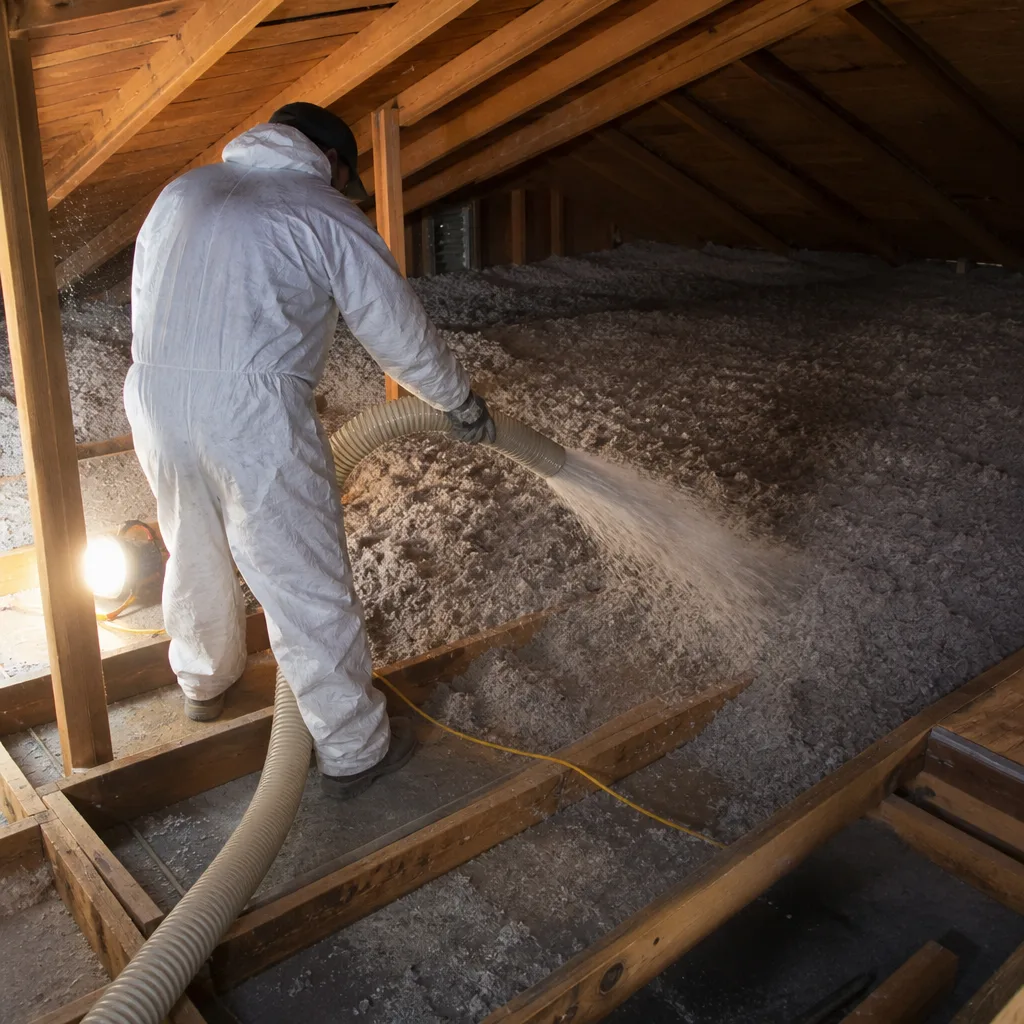
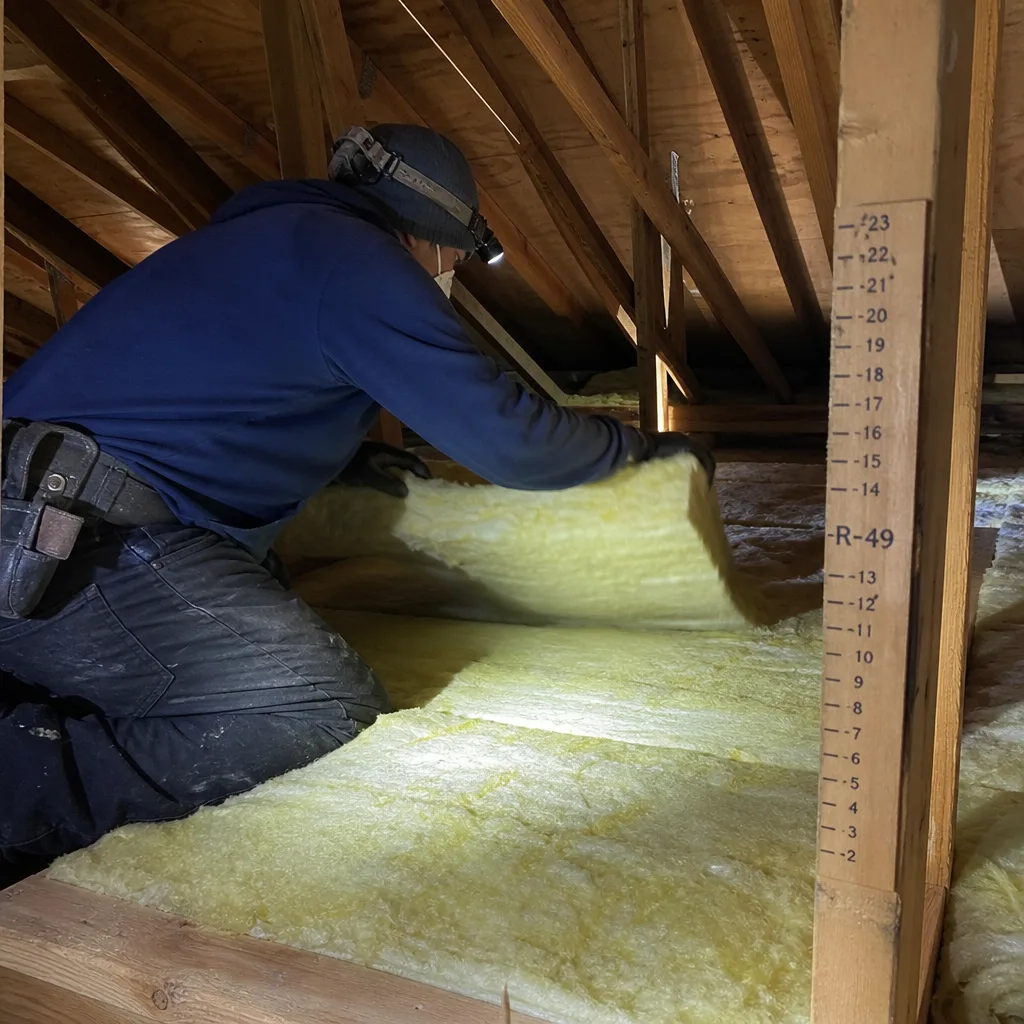
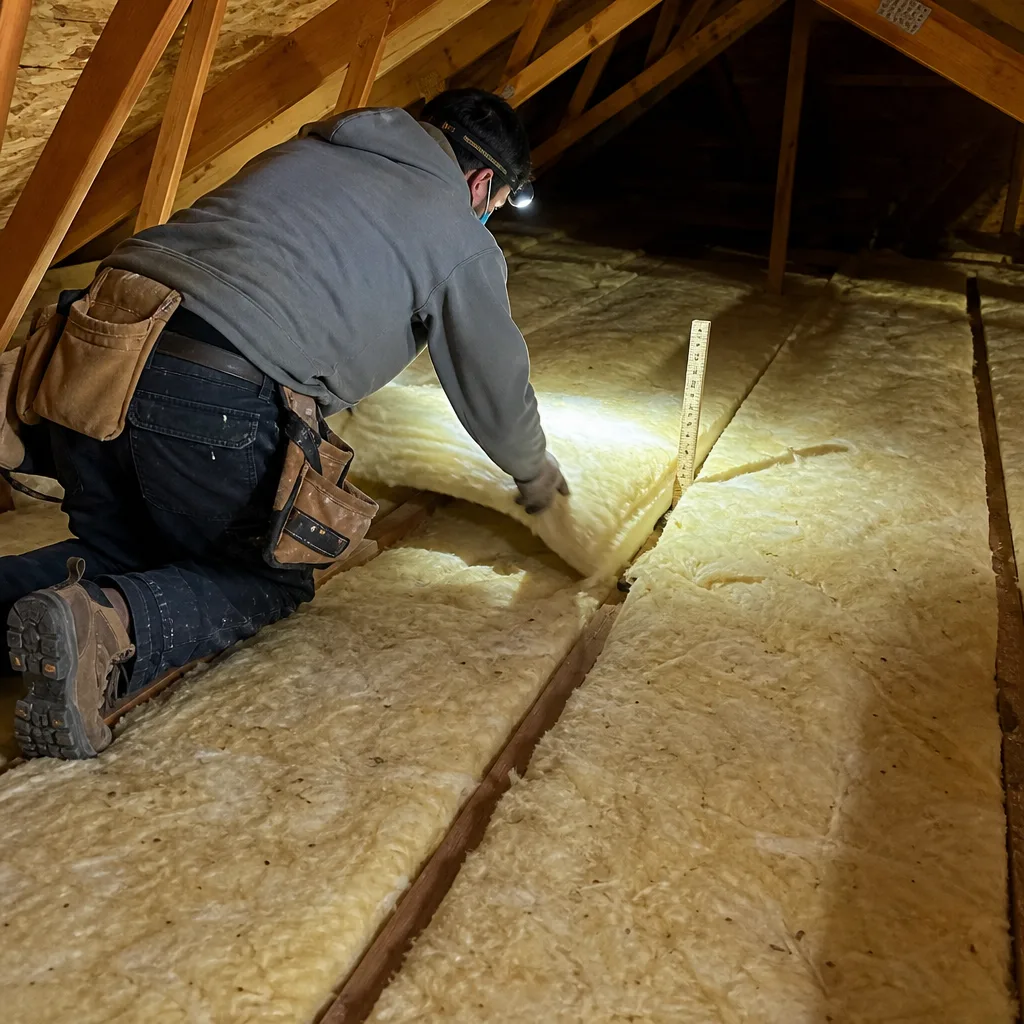
- Blowing to depth (2 – 4 hours). This is the part people quote. Bags go in, the hose gets worked along the joist bays, and depth markers at roughly every 300 square feet get eyeballed the whole time. R-49 to R-60 – the range we target for Boulder City – means a final settled depth of 15 to 20 inches depending on the material. Johns Manville and Knauf fiberglass blow at slightly different settled densities, which is why the depth marker matters more than the bag count.
- Post-install documentation (45 – 60 minutes). The secondary blower-door reading, the depth photos at each marker, the written before-and-after report, and the product data sheet all get assembled here. Nobody’s swinging a hammer, but this is real job time and should be in the estimate.
What Changes the Schedule in Boulder City
Boulder City is not a high-rainfall climate, but it has its own set of insulation-specific complications. Drying windows for blower-door testing, for example, matter here in ways they don’t in Omaha. Humidity sits low, but morning temperatures between November and March can drop into the 30s and 40s, and blower-door readings are less stable in cold weather if the house is also running heat. On a winter job in Boulder City, the crew often lets the house sit at ambient for 30 minutes before the initial test so the reading isn’t skewed by the furnace cycling.
Here’s what actually moves the schedule, with figures from real local attics.
- Attic access point count. A single scuttle in a hallway closet keeps setup tight. Two scuttles, or a knee-wall access plus a hatch, adds 45 to 90 minutes across the job because the crew has to stage equipment twice and repeat the depth checks in each zone.
- Existing insulation depth. Older homes in the historic district often have three to four inches of settled, compacted fiberglass. That requires removal before new material goes in – a full extra day, not a phase. Homes built in more recent subdivisions typically have six to nine inches and can be topped up in place.
- Linear feet of top plate. Every 30 linear feet of top plate adds roughly 20 to 25 minutes of sealing. A simple rectangular 1,400-square-foot footprint has about 160 linear feet. An L-shaped plan or one with a bump-out often hits 220+ linear feet and adds an hour.
- Obstructions and debris. Rodent damage, old loose-fill that’s been walked through by every previous contractor, or abandoned ductwork adds a session. Removal and rodent proofing runs an additional half to full day when it’s needed.
- Ceiling-fan removal and reinstall. A blower-door setup wants unobstructed airflow through the envelope. Fans at the access point and near the fan-door get pulled and reinstalled, which adds 20 minutes on each end.
If the written scope doesn’t mention at least three of these variables, ask why. A quick written price doesn’t tell you the timeline; a written scope does. When we quote a Boulder City attic, the estimate names the access count, the existing depth, and the estimated linear feet of top plate. If you’d rather see the full range of services behind that quote, our Envelope Insulation Boulder City home page breaks down the full building-envelope lineup.
Fast for the Wrong Reason: How to Spot a Skipped Step
A blown-in insulation job that finishes in four hours flat is usually a job that skipped the initial blower door and sealed nothing. The homeowner gets a same-day “done” and a house that still leaks at every top plate. The blown-in insulation is new; the envelope hasn’t changed.
Three signs a fast timeline is a shortcut, not efficiency:
- No initial blower-door reading. If nobody put a calibrated fan in an exterior door before the hose came out, there’s no baseline to compare against. Any promise of “before and after” performance is fiction without the before number.
- No air sealing on the scope. Blowing insulation over an unsealed attic floor is the single most common mistake in this trade. Foam cans and mastic should show up on the material list before the first bag. If they don’t, ask what’s being sealed.
- No setup time blocked for ceiling fans, registers, or drying. Reading changes require controlled conditions. A crew that skips the wait is skipping the data.
At Envelope Insulation Boulder City, sealing is a hard prerequisite, not an upsell. We won’t blow insulation over an unsealed attic floor even when the homeowner asks us to just add material – it’s a documented waste of the product and a promise we can’t back with numbers. On projects where spray foam is the right call (usually rim joists and cathedralized ceilings), the same rule applies; you can see how that works in our Spray Foam Insulation in Boulder City service page.
What Same-Day Completion Actually Requires
Same-day completion is genuinely realistic for most single-family attics in Boulder City. It’s not automatic. It depends on four things coming together, and knowing them lets you prep the house accurately instead of guessing.
- A two- or three-person crew. One person on the blower machine and depth-checking, one in the attic on the hose, and a third on sealing and documentation. A one-person crew cannot reasonably seal, blow, and document properly in a single day.
- Equipment staged at the access point. The blower unit, the bag staging area, and the hose run should be planned before anyone climbs the ladder. On Boulder City jobs with tight driveway access or a broad historic-district lot, this planning takes real time.
- Ceiling fans removed for the blower-door setup. Fans at the door frame and near the access hatch come out, get bagged, and go back at close. Plan for the fan in the hallway to be down for the middle part of the day.
- Drying window respected. If you’ve run a humidifier overnight or the house just got a fresh coat of interior paint, the envelope needs time to stabilize before the initial test. A crew that waits for this is doing it right.
Homeowner prep is straightforward: clear the attic access, park away from the driveway the crew needs, plan for two people to be in and out of the house for the day, and give the crew the Wi-Fi password if you’d like the documentation photos texted to you at close. Everything else is on us and it’s in the written scope.
Where the Surprise Time Hides: Attic Access and Prep
The phases above are the visible work. Here’s the invisible work that anyone who has actually done the job knows about, and that a “one day, standard attic” quote tends to leave out.
- Bag staging at altitude. Boulder City sits at roughly 2,500 feet, and blown-in material expands at a slightly different rate than at sea level. It’s not a big factor at this elevation, but the crew checks settled density against the product data sheet, not just the bag count. Knauf and CertainTeed specify coverage per bag; matching that in a low-humidity climate takes attention.
- Depth-marker layout. Roughly one marker per 300 square feet, plus one at each corner and one on each side of a large attic. On a 1,600-square-foot attic that’s eight to twelve markers, and photographing each adds 15 to 20 minutes to the close.
- Attic furnace and HVAC in the way. Boulder City homes with a second-floor furnace in the attic need the unit protected and resealed after. That’s 30 to 45 minutes on its own. Homes with a ceiling-mounted air handler have a similar footprint.
- Rodent cleanup. If a Boulder City attic has had a rodent problem – and many historic-district homes have – the crew needs to remove contaminated material and run proofing before insulation. This is a documented scope addition and one of the honest reasons a job pushes to a second day. If it’s skipped, you’ve just insulated over a problem.
- Blower-door number verification. Slower than people expect. The technician takes the reading, waits, and takes it again to confirm stability before writing anything down. Expect 45 to 75 minutes for the closing test alone.
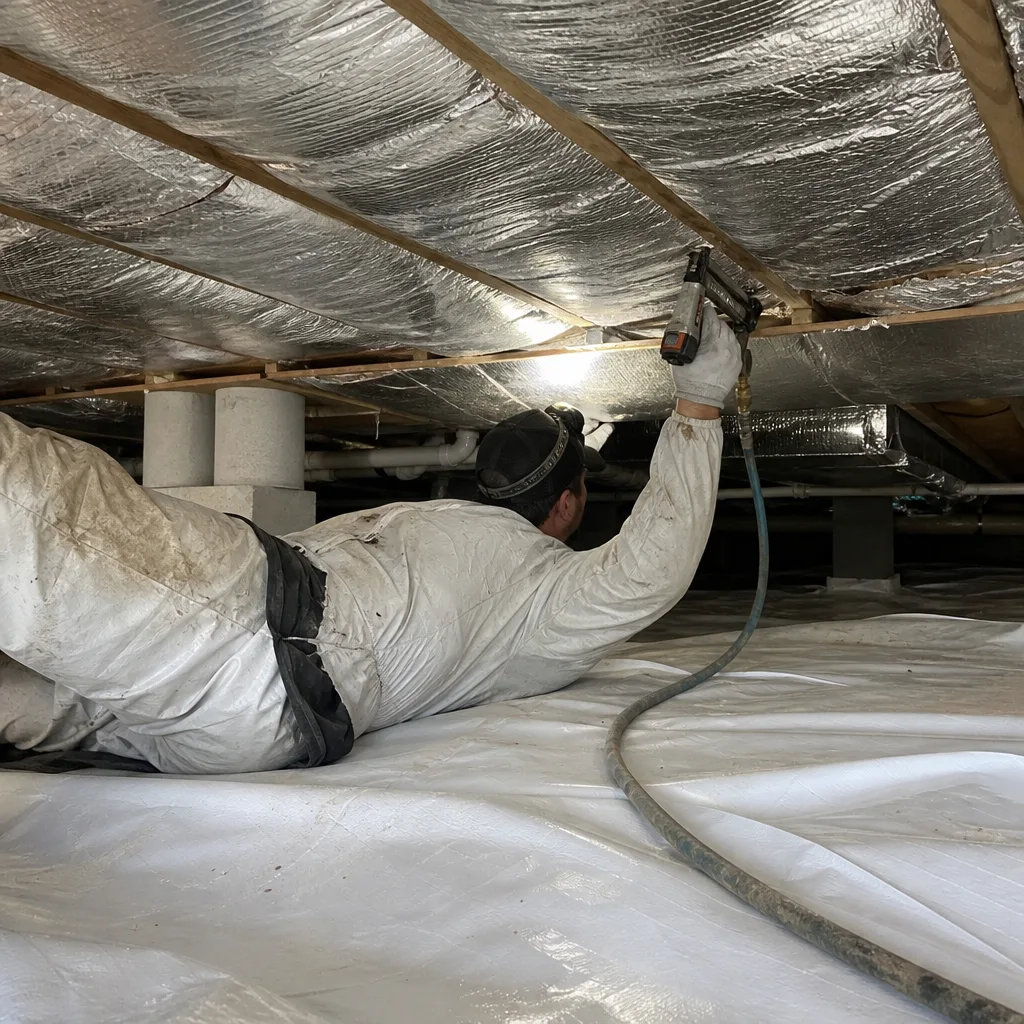
When we see a home with multiple access points, existing depth over six inches, and an attic-mounted HVAC unit, we schedule the job as a seven-to-eight-hour day and tell the homeowner up front. The written price includes that scope. Nothing gets discovered at the end. And if you’re dealing with moisture issues or a vented crawl space at the same time, the crawl space work is a separate day entirely – see our Crawl Space Encapsulation & Vapor Barrier in Boulder City page for its own timeline.
What You Get at Job Close (and How Long It Takes)
The close of a blown-in job is where most contractors leave the customer holding a verbal description and a handshake. That’s a documentation gap, and it’s exactly what we don’t skip. Budget 45 to 60 minutes for the closing steps, and expect to receive:
- The written before-and-after blower-door report. Two numbers, in CFM50, with the test conditions noted. Example from a recent Boulder City job: baseline reading at 4,200 CFM50, post-seal reading at 2,100 CFM50. That’s the performance you can verify.
- Depth photos at each marker. Photographed with a tape measure in frame so the settled depth is documented, not estimated.
- The product data sheet. Manufacturer coverage and density specifications for the material we actually used. If you were quoted R-49 and got R-49, this is how you know.
- The written warranty. Delivered before anyone lifted a tool, and confirmed at close under our 365-Day Done Right Promise – if it’s not done right, we make it right.
- The Documented Photo Record. Included on every visit, not available on request. It’s a photo record of the work done, so you have it alongside your own files.
The blower-door report tells you, in one figure, how much conditioned air your home was losing before we arrived and after we left. It’s not a story; it’s a number. If you have a competing estimate you’re weighing against ours, the Free Second Opinion we offer will read that estimate with you line by line – including what timeline the other contractor quoted and what they might be leaving out. For the attic work specifically, our Attic Insulation in Boulder City page lays out the full scope.
Common Mistakes to Avoid
- Booking a blown-in job that skips the initial blower door. Without a baseline reading, the before-and-after claim is unverifiable. In a Boulder City attic, that first test is where the entire job’s value is anchored.
- Adding insulation over an unsealed attic floor. Blown-in material over open top plates and unsealed penetrations is insulation sitting on a sieve. The seal comes first, then the blow – always in that order.
- Accepting a “standard attic” quote with no scope. Attic size, access count, existing depth, and top-plate footage change the timeline more than square footage does. Ask for these named in writing.
- Forgetting the ceiling fan on the day of the visit. The fan in your hallway comes down for the blower-door setup and goes back up at close. Knowing this in advance saves an awkward discovery mid-morning.
- Skipping depth verification at settled density. Bags blow up more than they settle down. R-49 requires a settled depth of 15 to 20 inches depending on material – verify against markers, not the empty bag pile.
- Sanitizing over rodent-damaged insulation instead of removing it. In the historic district, this is easy to get wrong. Contaminated material gets removed and the access points get proofed before new insulation goes in.
- Treating documentation as an afterthought. A job without a written before-and-after report is a job you can’t verify a year from now. Ask for it in writing before you sign the scope.
When to Call a Professional
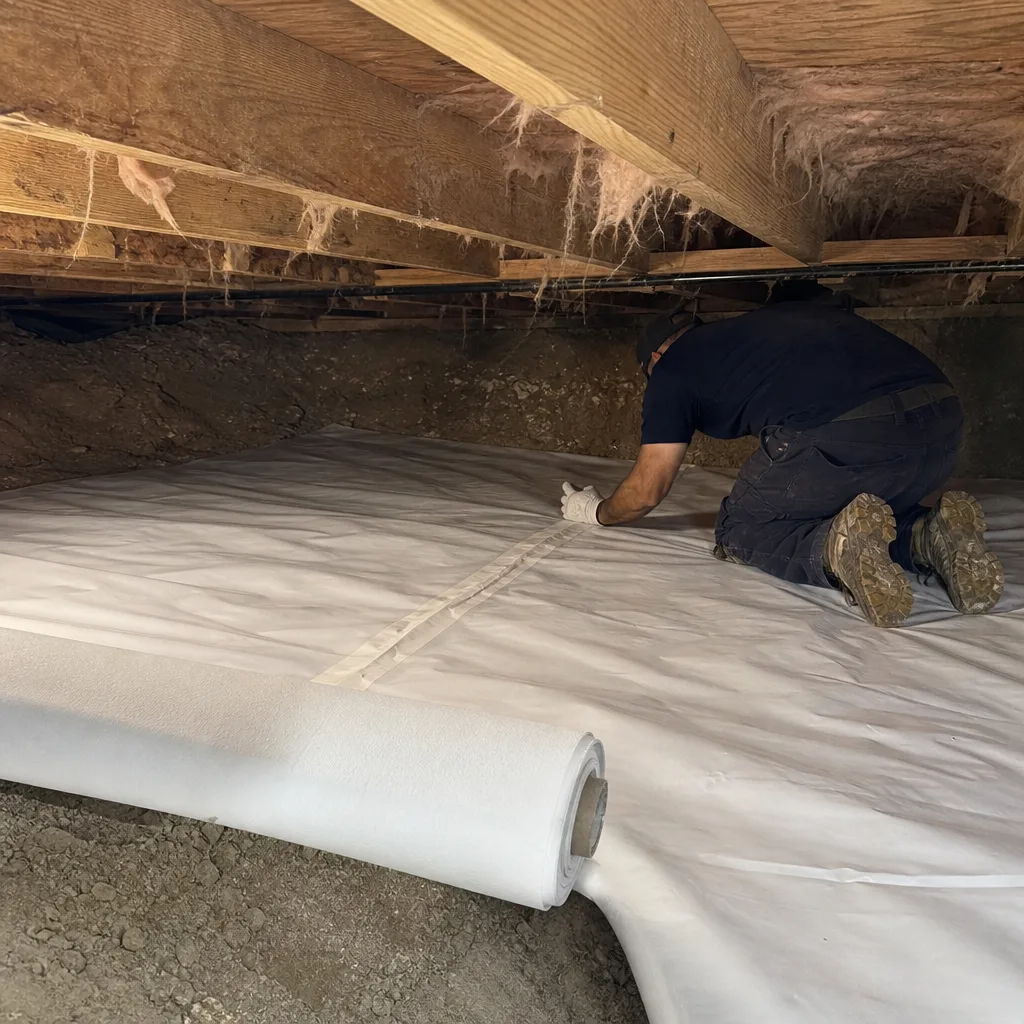
Most blown-in insulation jobs are not a weekend project, and the reason isn’t the blower. It’s the sequence: sealed first, then insulated, with a blower-door reading on both ends. That sequence needs calibrated equipment, trained hands, and a written scope. Call a professional if your attic has unsealed top plates, existing insulation under four inches that needs removal, any sign of rodent activity, an attic-mounted furnace or air handler, or if you’ve never had a blower-door test and want to know what your envelope is actually losing. Envelope Insulation Boulder City offers free estimates in Boulder City – call (844) 320-7926, and you’ll get a written price before any work starts, a concrete timeline against the scope, and a live person on the other end any hour of the day.
Frequently Asked Questions
Blowing the material takes two to four hours in a standard Boulder City attic. The full job – including the initial blower-door test, air sealing, cure time, and documentation – typically runs six to eight hours and is often done in a single day. Call (844) 320-7926 for a written timeline against your specific attic.
Yes, for most single-family homes with one or two access points and existing insulation under six inches of settled depth. Homes with attic-mounted HVAC, multiple access points, or heavy existing debris may need a second day, and the estimate will say so before you sign. Call (844) 320-7926 to schedule a walk-through.
Setup for the initial test runs 45 to 75 minutes because the technician has to seal the building envelope first: pull ceiling fans down, close registers, block flues, and let the house stabilize before taking the baseline CFM50 reading. That baseline is the number the final report compares against. Skipping the wait skews the reading and makes the documentation meaningless.
Most attic blown-in insulation jobs in Boulder City run between $1,800 and $3,800 for a typical 1,400- to 1,800-square-foot home, depending on existing depth, access, and whether removal is required. Air sealing is priced into the scope, not added later. Call (844) 320-7926 for a written price before any work starts – the estimate is free.
The insulation goes in faster, but the envelope doesn’t change. Open top plates, unsealed can lights, and unsealed plumbing penetrations leak the same as before, so the R-value you paid for doesn’t deliver R-value in the conditioned space. Fast in that case is fast for the wrong reason. Sealing is a prerequisite, not an upgrade – that’s a hard line for us.
At minimum, a written before-and-after blower-door report with the CFM50 readings, depth photos at each marker, the product data sheet for the material installed, and a written warranty. We include all of these on every applicable job, along with a documented photo record of the work.
The Bottom Line
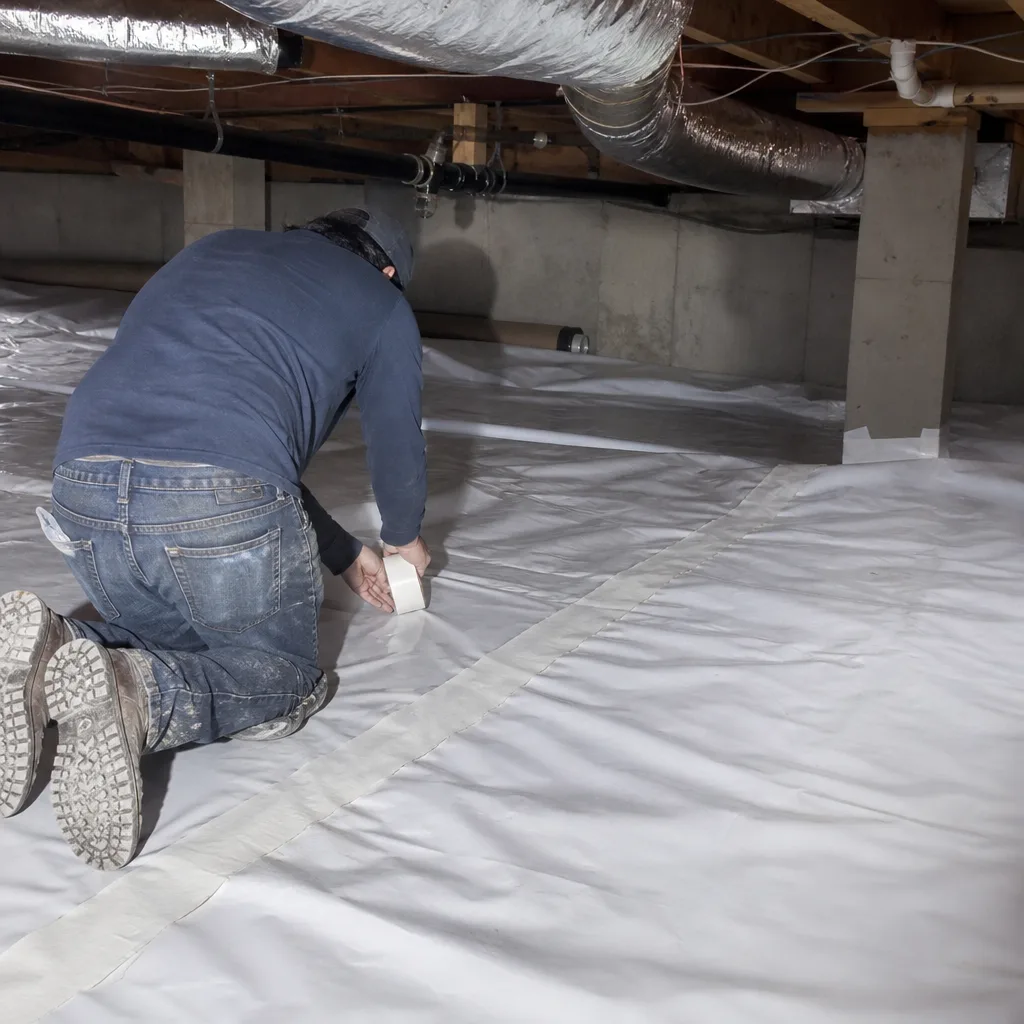
Blown-in insulation itself is a fast job – two to four hours of actual blowing in a standard Boulder City attic. The honest total is six to eight hours once you count the initial blower-door test, air sealing at the top plates and penetrations, the cure window before material goes in, and the documentation at close. Fast timelines that skip any of those steps are fast for the wrong reason. A written scope names the access points, existing depth, and linear feet of top plate, and the job ends with a before-and-after blower-door number, depth photos, and a written warranty. That’s the full picture you’re paying for.
If you’re ready for a written timeline and a written price before anything gets blown, call Envelope Insulation Boulder City at (844) 320-7926 for a free estimate. Bring a competing quote and we’ll read it with you, line by line.
Written by the team at Envelope Insulation Boulder City.