
Last updated November 17, 2026
Insulation Emergency Preparedness Guide for Boulder City Homes
During the July 2023 Southwest heat event, homes in Boulder City without functioning cooling held interior temperatures below 90°F for roughly 4 to 6 hours after grid failure. In homes with attic insulation below R-30 and high air leakage, that same window collapsed to under 2 hours. The difference wasn’t the thermostat. It was the envelope. In this guide, we’ll walk through how insulation works as a passive safety system during Boulder City grid outages and monsoon flooding, what R-value and air sealing actually buy you in an emergency, and the exact documents and inspection steps a Boulder City homeowner needs before the next event hits.
Quick Answer
In Boulder City, insulation functions as a passive safety system: attic insulation at R-38 or better, combined with a sealed envelope, extends how long your home stays habitable during a summer grid outage to roughly 4 to 6 hours, while R-19 with high air leakage cuts that window to under 2 hours. During monsoon flash flooding, saturated crawlspace insulation must be removed and replaced within 48 to 72 hours to prevent mold, and the two documents that matter most for insurance and replacement verification are your blower-door report and material spec sheet.
Table of Contents
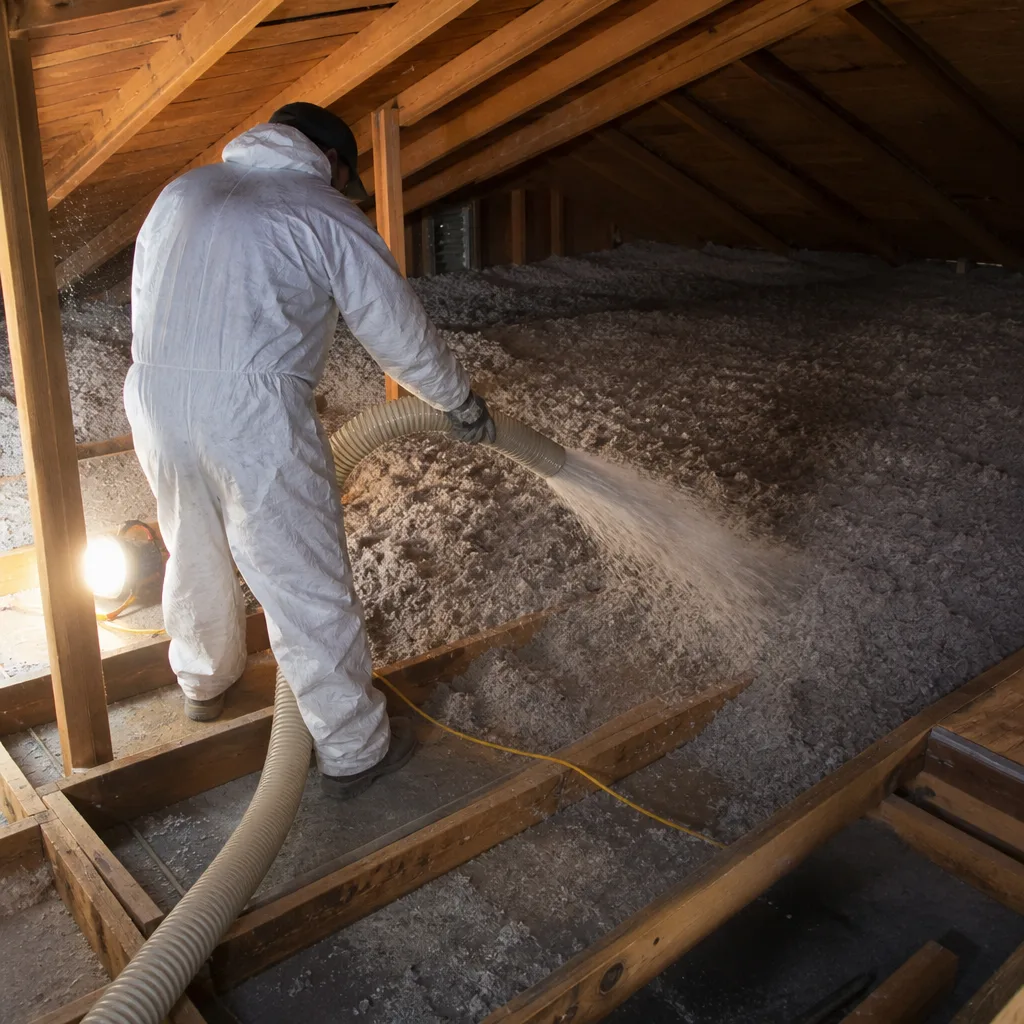
- How R-Value and Thermal Mass Decide Your Safe Window During an Outage
- R-38 vs. R-19: What a Boulder City Grid Outage Actually Looks Like
- Flash Floods and Crawlspace Insulation: The 48 to 72 Hour Window
- Post-Storm Inspection Checklist for Boulder City Crawlspaces
- Wildfire Smoke, Air Sealing, and ACH50 Levels That Matter
- The Two Insulation Documents Every Boulder City Emergency Binder Needs
- How to Prepare Before the Next Event
- Common Mistakes to Avoid
How R-Value and Thermal Mass Decide Your Safe Window During an Outage
Ventilation and mechanical cooling do almost all the visible work in a normal Boulder City summer. When the grid drops, they stop. What continues working is the thermal envelope: the combination of R-value (resistance to heat flow), air sealing (how much conditioned air escapes), and thermal mass (the walls, floors, and interior contents that hold cooler air once it’s been conditioned).
R-value slows heat coming through the ceiling, walls, and floor. Air sealing keeps the cooler air already inside from leaking out through top plates, can lights, and rim-joist gaps. Thermal mass holds whatever cool air remains. The three work together, and the weakest link sets the ceiling on your safe window.
A useful way to think about it: when the AC stops, your home becomes a cooler box with a slow leak. R-38 in the attic and good sealing turn that box into a four to six hour safe haven in Boulder City’s July conditions. R-19 with visible gaps around recessed fixtures turns it into a 90-minute window, especially if the home was built in the 1980s or 1990s when attic insulation in Boulder City homes was often installed to lower standards than today.
Boulder City’s climate makes this matter more than it does in, say, coastal California. Summers routinely hit triple digits, and afternoon attic temperatures can exceed 140°F. That means heat flow through the ceiling during an outage is aggressive. Insulation is the only thing between a 78°F interior and the 110°F air above the roof deck.
R-38 vs. R-19: What a Boulder City Grid Outage Actually Looks Like
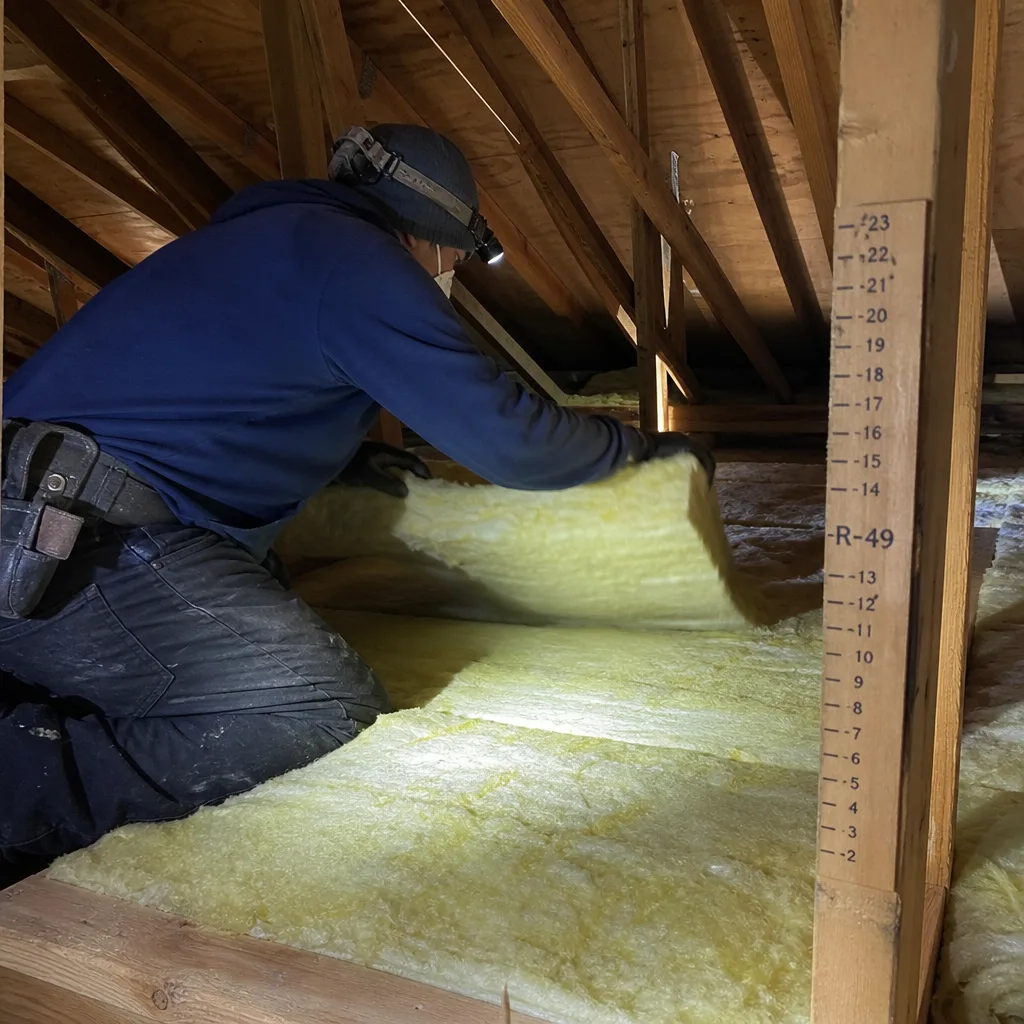
The difference between these two insulation levels in an outage isn’t subtle. It’s the difference between riding out an evening outage comfortably and driving to a hotel at 9 p.m.
Here’s a comparison drawn from our experience with Boulder City homes, using typical single-family construction:
- R-38 attic insulation with a sealed envelope: Interior stays below 90°F for roughly 4 to 6 hours after sunset grid failure on a 105°F day. Interior stays below 95°F for most of a 6 to 8 hour outage when outdoor temps fall after dark.
- R-38 with high air leakage (ACH50 above 5.0): Safe window drops to roughly 2.5 to 4 hours. Cooler air escapes faster than the walls can hold it.
- R-19 attic insulation with low leakage: Window shrinks to about 2 to 3 hours. The ceiling is the weak point; heat pours in from above.
- R-19 with high air leakage (ACH50 above 6.0): Under 2 hours. Often under 90 minutes in a west-facing bedroom during an afternoon outage.
Two variables decide which category your home lands in: attic R-value and envelope leakage. You can’t fix the first without adding insulation. You can’t fix the second without air sealing first. Under our Haven Standard, we seal top plates, can lights, and penetrations before any insulation goes in. Blowing insulation over an unsealed attic floor traps the leak in place and inflates the R-value number without delivering the safe window it promises.
For homeowners curious what their current numbers actually are, a blower-door test gives the answer in one reading: a pressurization measurement that shows how much air your envelope is losing. On applicable jobs, we publish the before-and-after numbers so the improvement is visible in figures rather than adjectives. You can see how we frame this on our attic insulation page for Boulder City.
Flash Floods and Crawlspace Insulation: The 48 to 72 Hour Window
Boulder City sits in a drainage basin where monsoon storms in July, August, and September can drop an inch of rain in 30 minutes. Water that can’t absorb into caliche-heavy soil runs downhill. In crawlspace-construction homes near the washes feeding Lake Mead, that runoff finds the foundation vents.
What happens to crawlspace insulation when it gets wet is predictable and ugly. Fiberglass batts absorb water like a sponge. The vapor barrier underneath puddles and sags. Within 24 hours the batts are heavy enough to fall off the subfloor, leaving the joists exposed. Within 48 hours, we typically find visible mold growth on the joist bays in Boulder City crawlspaces that flooded during monsoon events. By 72 hours, the damage extends to the subfloor itself, and in some cases to the framing.
The 48 to 72 hour window isn’t a marketing number. It’s the practical limit before remediation costs multiply. Saturated fiberglass insulation cannot be dried in place and cannot be reused. It has to come out.
The steps for a flooded crawlspace are:
- Stop the water source. Turn off any irrigation or shut off supply if a pipe burst caused the flood.
- Photograph everything before touching it: standing water depth, wet insulation (stapled and fallen batts), water line on the rim joist, and any visible mold.
- Remove wet insulation within 24 to 48 hours. Bag it and set it outside.
- Set up fans and a dehumidifier rated for the cubic footage of the crawlspace. Run them continuously for 72 hours.
- Have the framing and subfloor moisture-checked before new insulation goes in. Replacement insulation over wet framing traps moisture.
- After the space is dry, replace with moisture-tolerant materials like closed-cell spray foam or rigid foam board rather than fiberglass batts.
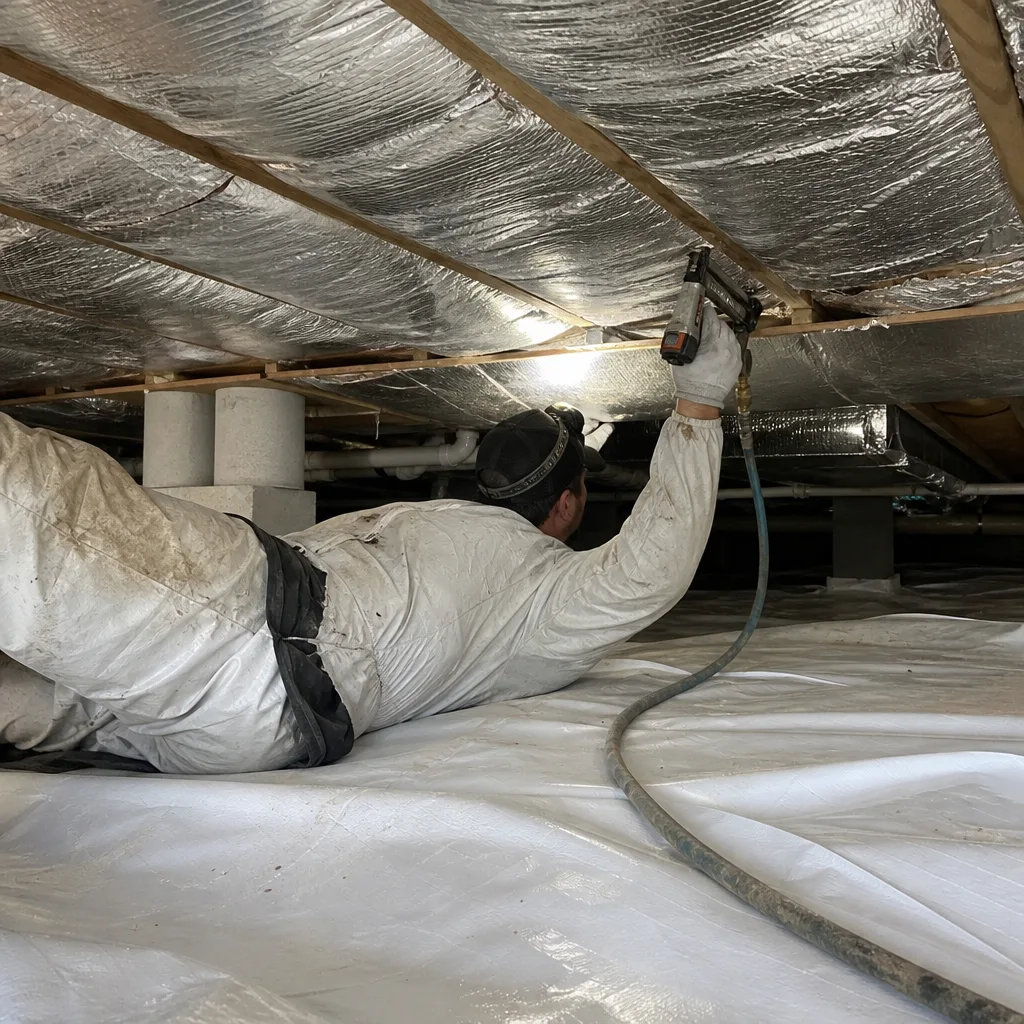
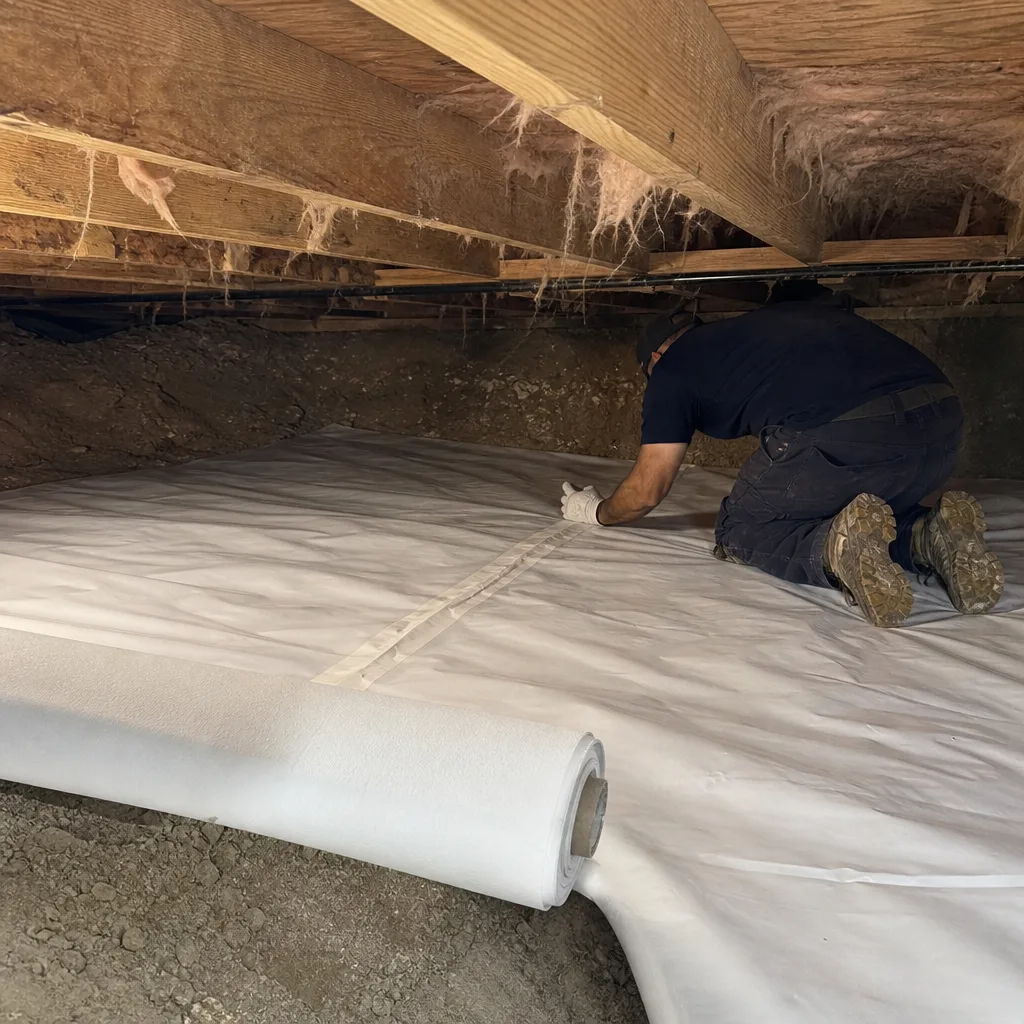
Our crawl space encapsulation and vapor barrier service in Boulder City is often the right call after a major flood, because encapsulation removes the underlying vulnerability instead of just replacing what got damaged.
Post-Storm Inspection Checklist for Boulder City Crawlspaces
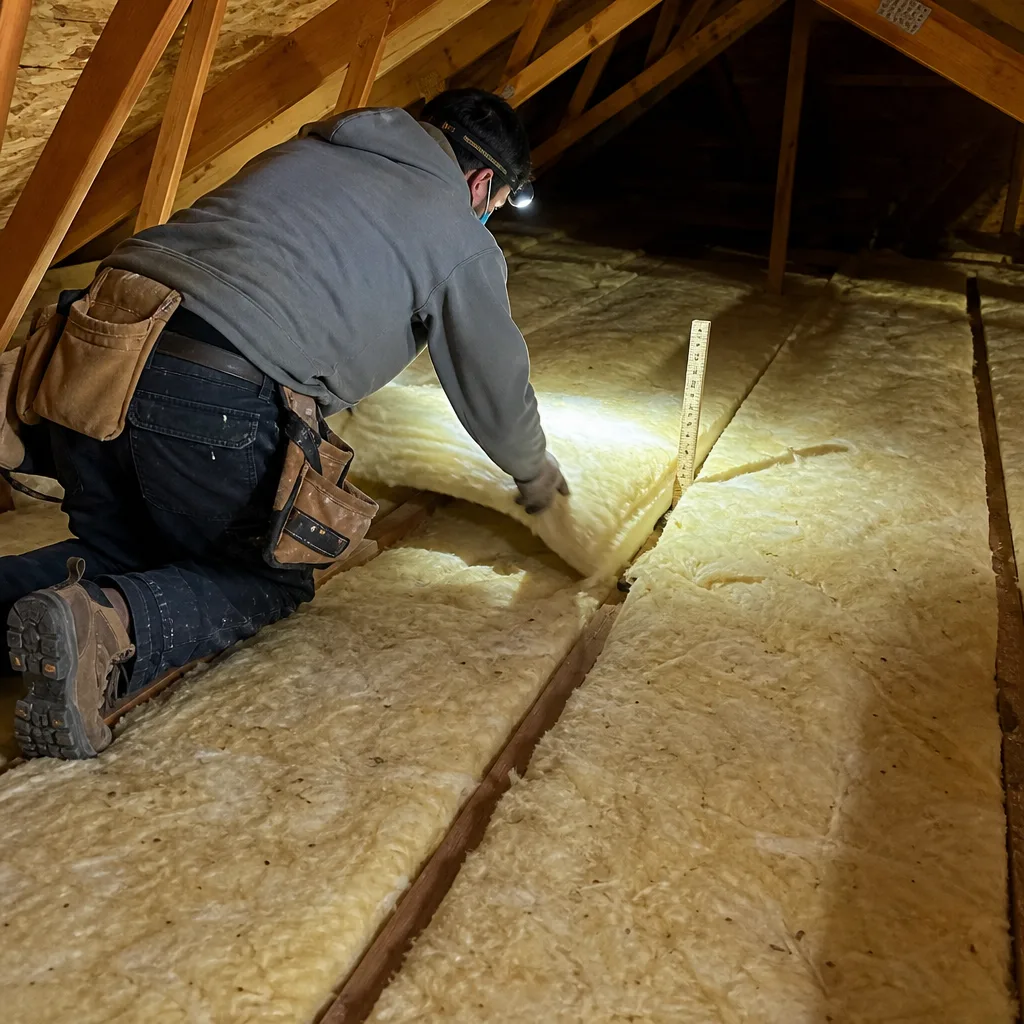
Once the storm has passed and water has receded, walk the crawlspace with a flashlight and take these steps. Do this within 24 hours if there was any visible surface water, and within 72 hours even if you don’t think water got in.
- Check the vapor barrier. Look for standing water on top of the plastic, sagging between joists, or tears at seams. A sagging barrier holds water against the subfloor.
- Inspect fiberglass batt stapling. Look for batts that have fallen, sagged, or pulled away at the tabs. Wet batts sag first, then fall.
- Check rim-joist insulation. Rim joist batts are the most common failure point in a flood. They absorb water from the sill plate up and often go unnoticed until mold appears.
- Smell the space. A musty, earthy odor after 48 hours usually means mold is starting. Trust your nose before you can see it.
- Look for mud and debris lines. In Boulder City, silt markings on the foundation walls show peak flood depth. Photograph them for insurance.
- Test the insulation itself. Pinch a sample of fiberglass batt. If it holds water or feels heavy or matted, it’s done.
- Check the dehumidifier drain. If you’ve already got one running, confirm it’s draining. A stalled dehumidifier turns a dry-out into a re-flood.
Any one of these findings is a signal to call in a professional inspection. Water damage to envelope systems spreads quietly and the cost jumps once mold establishes on framing.
Wildfire Smoke, Air Sealing, and ACH50 Levels That Matter
Regional wildfire smoke from fires in the Spring Mountains or across the California border has become a seasonal reality in Boulder City. When the air quality index climbs above 150 and windows stay closed, indoor air quality becomes a function of how well the envelope holds.
Air sealing matters here in a way that surprises most homeowners. Smoke doesn’t just come through open doors and windows. It infiltrates through the same envelope gaps that leak cooled air: top plates at partition walls, recessed can lights, plumbing and electrical penetrations, attic hatches, and rim-joist gaps in the crawlspace.
ACH50 (air changes per hour at 50 Pascals of pressure) is the standard leakage figure. Higher numbers mean more gaps. In our experience with Boulder City homes:
- ACH50 above 6.0: High infiltration. Wildfire smoke penetrates noticeably within hours of an air quality event. Windows don’t help much.
- ACH50 between 3.0 and 5.0: Moderate. Smoke infiltration is slowed but not stopped. Filtration and a closed envelope are necessary.
- ACH50 below 3.0: Tight. Combined with a quality HVAC filter, indoor air quality holds meaningfully better during smoke events. Most of the reduction correlates to sealed top plates, can lights, and penetrations.
Sealing is what gets you from the top category into the middle or bottom. Once the envelope is sealed, filtration becomes effective. Without sealing, a HEPA filter pulls against a leaky envelope and the smoke keeps coming in.
On applicable jobs, we publish before-and-after blower-door readings so Boulder City homeowners see their ACH50 improvement as a number, not a claim. Reaching the tightest category often involves a mixed approach, which is where spray foam insulation in Boulder City is useful because closed-cell foam seals and insulates in one pass.
The Two Insulation Documents Every Boulder City Emergency Binder Needs
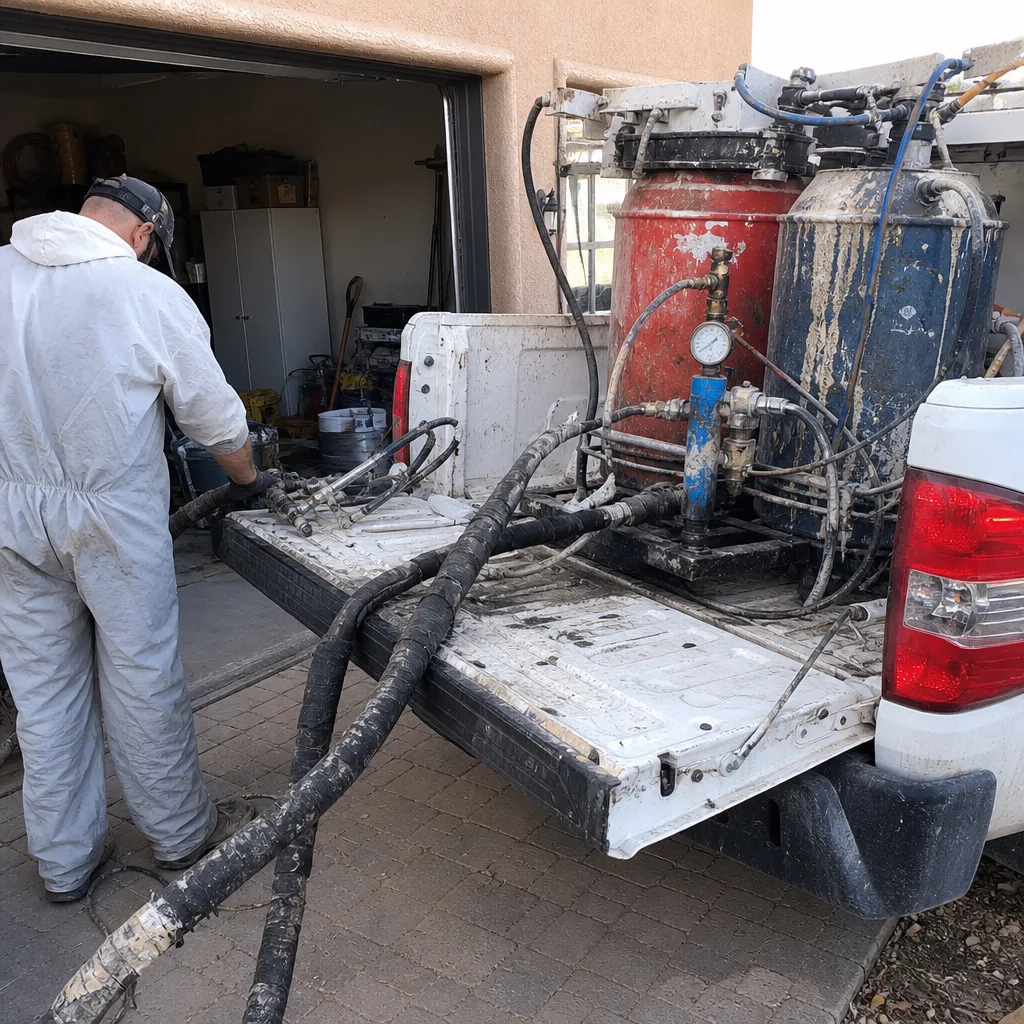
Preparing for the next heat event or groundwater event isn’t just about the envelope itself. It’s about the paper. Two documents belong in every Boulder City home emergency binder, and most homeowners don’t have either.
1. The blower-door report. This is your envelope’s record of performance at a known point in time. Insurers increasingly ask for this when evaluating storm damage claims. It also proves the home was in a specific condition when an event hit, which matters if you’re claiming flood damage to crawlspace insulation or fire/smoke damage affecting the envelope. Without the report, “it was tight before the flood” is an opinion. With it, it’s a measured baseline. Our crews provide this on applicable jobs, and it’s part of the Documented Photo Record we leave with every homeowner.
2. The material spec sheet. If your attic or walls contain Owens Corning, Johns Manville, Knauf, or GreenFiber products, keep the spec sheet on file. After any flood or smoke event, your insurance adjuster or replacement contractor needs to know exactly which product was installed to specify the correct replacement and prove the value. Without the spec sheet, an adjuster may default to a cheaper material or deduct based on an unknown product. With it, you’re reimbursed to replace what you actually had.
We also recommend keeping a smartphone photo set of every insulation installation: the attic before, the installation mid-process, and the completed job with a ruler to show depth. Photos alone settle 80% of the disputes we see about what was there before.
How to Prepare Before the Next Event
The best time to prepare your Boulder City home for the next grid outage or monsoon flood is when the sky is clear. Not during the crisis. Sequence matters if you want a safe window that actually holds.
- Start with a home energy audit and blower-door test. Get a measured baseline for your envelope before you spend anything on insulation. The reading tells you where the leaks are and what your current safe window looks like. Our Envelope Insulation Boulder City home page covers what a full audit includes.
- Air seal before adding insulation. Top plates, can lights, plumbing and electrical penetrations, and the attic hatch. Insulation installed over leaks delivers less than insulation installed on a sealed envelope. This isn’t an upsell; it’s the order that matters.
- Bring attic insulation to R-38 or better if it’s below R-30. That’s the threshold where a Boulder City home starts delivering a 4 to 6 hour safe window during peak summer grid failure. Below R-30, the safe window shrinks fast.
- Encapsulate and inspect the crawlspace before monsoon season. A properly installed vapor barrier keeps the crawlspace dry and gives you a known starting condition. Failing barrier or dry-rotted stapling means a flood will do more damage.
- Assemble the emergency binder. Blower-door report, material spec sheets, installation photos, contractor contact list. Add it to the folder with your insurance policy and utility contacts.
- Test the smoke plan. When regional wildfire smoke events hit Boulder City, close the envelope, run the HVAC fan continuously with a quality filter, and keep indoor air moving. If your ACH50 is above 6.0, plan for a portable air cleaner in the main bedroom.
The whole preparation sequence runs from audit to insulated and documented in a single project, typically a few days of work. Once it’s done, the envelope keeps doing its job whether the grid is up or down.
Common Mistakes to Avoid
- Adding insulation over an unsealed attic floor. This is the most common mistake we find in Boulder City homes. The new insulation hides the leaks rather than fixing them, and the R-value number goes up while the safe window doesn’t.
- Assuming fiberglass batts survive a flood. Saturated fiberglass insulation cannot be dried and reused. Homes that leave wet batts in place for a week typically face mold remediation on top of insulation replacement.
- Running a dehumidifier without a moisture baseline. You can’t tell when crawlspace framing is dry without a reading. Skipping the moisture check before reinstalling insulation traps moisture inside the assembly.
- Trusting the “R-value on the bag” instead of the installed depth. Manufacturer ratings assume specific installed depths. Compressed insulation loses R-value, and a home that “has R-38” in the paperwork often measures well below it.
- Waiting on flood damage “to see if it dries.” In Boulder City’s monsoon season, wet crawlspace insulation rarely dries. The 48 to 72 hour replacement window doesn’t extend because the humidity went down.
- Not documenting before-and-after. Photographs taken during the storm, before cleanup, are the basis for most insurance claims. Homeowners who wait until after remediation starts lose most of their documentation leverage.
- Treating smoke infiltration as an HVAC problem. Better filters help, but a leaky envelope lets smoke in regardless of the filter. Air sealing is the upstream fix.
When to Call a Professional
Call a professional when you find standing water or wet insulation in the crawlspace after a monsoon event, because the 48 to 72 hour window before mold starts is too short for trial and error. Call when your home stayed above 90°F within three hours of a grid outage during a summer heat event; that’s a specific signal your envelope isn’t carrying its safe window. Call when you see smoke visibly entering around outlets, can lights, or the attic hatch during a regional air quality event, because that points to a leak you can’t reach from inside the living space. Call when you’re about to add insulation and nobody has air sealed first. Call when you don’t have a blower-door report or material spec sheet in your binder, because replacing either after a loss without them costs real money.
Envelope Insulation Boulder City offers free estimates in Boulder City. We start with a written price, a written scope, and a blower-door baseline before any work happens, and we can read a competing estimate with you line by line if you want a second opinion. Call (844) 320-7926 to schedule.
Frequently Asked Questions
Homes with attic insulation at R-38 or better and a sealed envelope typically hold interior temperatures below 90°F for roughly 4 to 6 hours after grid failure during a Boulder City heat event. Homes at R-19 with high air leakage often hold under 2 hours. The two variables that matter are attic R-value and ACH50 leakage; both can be measured before the next outage. Call (844) 320-7926 to schedule a blower-door baseline and know your number in advance.
Yes. Saturated fiberglass batts cannot be dried in place and begin growing mold on the surrounding framing within about 48 hours. By 72 hours, damage often extends to the subfloor and rim joist. In Boulder City monsoon events, we routinely find wet batts a full week after the storm when homeowners tried to dry them in place. Call us for a moisture check before the timeline runs out.
Two documents top the list: your blower-door report (to prove your envelope’s condition at a known point in time) and your material spec sheet (to prove the product installed so the adjuster specifies the right replacement). Installation photos from the day the job finished round out the file. Our crews include all of these in the Documented Photo Record on applicable jobs, so your binder has them from day one.
Yes, meaningfully. Wildfire smoke infiltrates through top plates, can lights, plumbing and electrical penetrations, and rim-joist gaps, not just open windows. Homes sealed down to ACH50 below 3.0 with a quality HVAC filter hold noticeably better air quality during regional smoke events than homes above 6.0. Filtration is much more effective once the envelope is sealed. Call (844) 320-7926 for a blower-door test and a written scope to reach the tighter range.
In most cases, yes, if you call within the first 48 hours. Our sequencing is: extract water, remove wet insulation, dry the framing with fans and a dehumidifier, moisture-check, then install moisture-tolerant replacement materials. The full sequence is typically two to five days depending on the size of the crawlspace and how quickly the water is stopped. Call (844) 320-7926 and we’ll give you a written timeline before any work starts.
R-38 in the attic, combined with a sealed envelope and a documented blower-door reading, is the practical target for a Boulder City home to deliver a 4 to 6 hour safe window during a peak-summer grid outage. Below R-30 with high leakage, the safe window shrinks under 2 hours. R-38 with proper air sealing is the practical threshold. Our written estimate always shows the depth, product, and target R-value, along with the blower-door numbers we expect to hit before and after.
The Bottom Line
In Boulder City, insulation isn’t just about utility bills; it’s the passive system that decides how long a home stays habitable when the grid fails or a monsoon storm pushes water through the crawlspace. Two figures govern the outcome: attic R-value and envelope leakage (ACH50). R-38 with a sealed envelope delivers a 4 to 6 hour safe window; R-19 with unsealed leaks cuts it under 2 hours. Flooded crawlspace insulation has 48 to 72 hours before mold, and the blower-door report plus material spec sheet are the two documents that carry you through an insurance claim. Prepare with air sealing first, then insulation, then documentation.
If you want a written price, a measured baseline, and a documented record for your Boulder City home, call (844) 320-7926 for a free estimate. We’ll bring the blower door, walk the crawlspace with you, and put the plan in writing before any work starts.
Written by the team at Envelope Insulation Boulder City.