
Last updated November 17, 2026
DIY vs Professional Spray Foam Insulation: What’s Safe to Do Yourself
A two-component spray foam kit rated at 600 board feet can lose 15 to 20 percent of its stated yield when it’s sprayed onto a 65°F substrate instead of the 75°F the manufacturer specifies. The homeowner pays for 600 board feet, gets closer to 480, and doesn’t find out until a cold snap exposes the thin spots or a blower-door test reads far higher than expected. This guide draws a hard line between the spray foam work a careful homeowner can genuinely handle and the applications where a consumer kit creates a problem that costs more to fix than the original job. We’ll cover temperature windows, respirator requirements most kit instructions understate, the specific jobs suited to DIY, and how to verify a professional job delivered what was promised here in Boulder City.
Quick Answer
Consumer spray foam kits are safe and appropriate for small jobs: rim joist sections under 50 linear feet, sealing around a single pipe or cable penetration, and detailing the perimeter of an attic hatch, all applied within the manufacturer’s temperature window with a full-face respirator rated for organic vapor. Whole-attic and whole-wall cavity applications are not DIY work. Off-ratio mixing without heated proportioner equipment, unverifiable coverage depth, and the cost of tearing out a failed closed-cell application all point to a professional job with documented before-and-after blower-door numbers.
Table of Contents
- Why temperature decides whether a DIY kit works
- Where consumer spray foam kits are genuinely appropriate
- The protective equipment kit instructions understate
- Why whole-attic and whole-wall cavity jobs shouldn’t be DIY
- Cost comparison that includes remediation
- How to verify a professional job delivered what was promised
- What Boulder City’s climate demands of spray foam
- Common mistakes to avoid
Why Temperature Decides Whether a DIY Kit Works
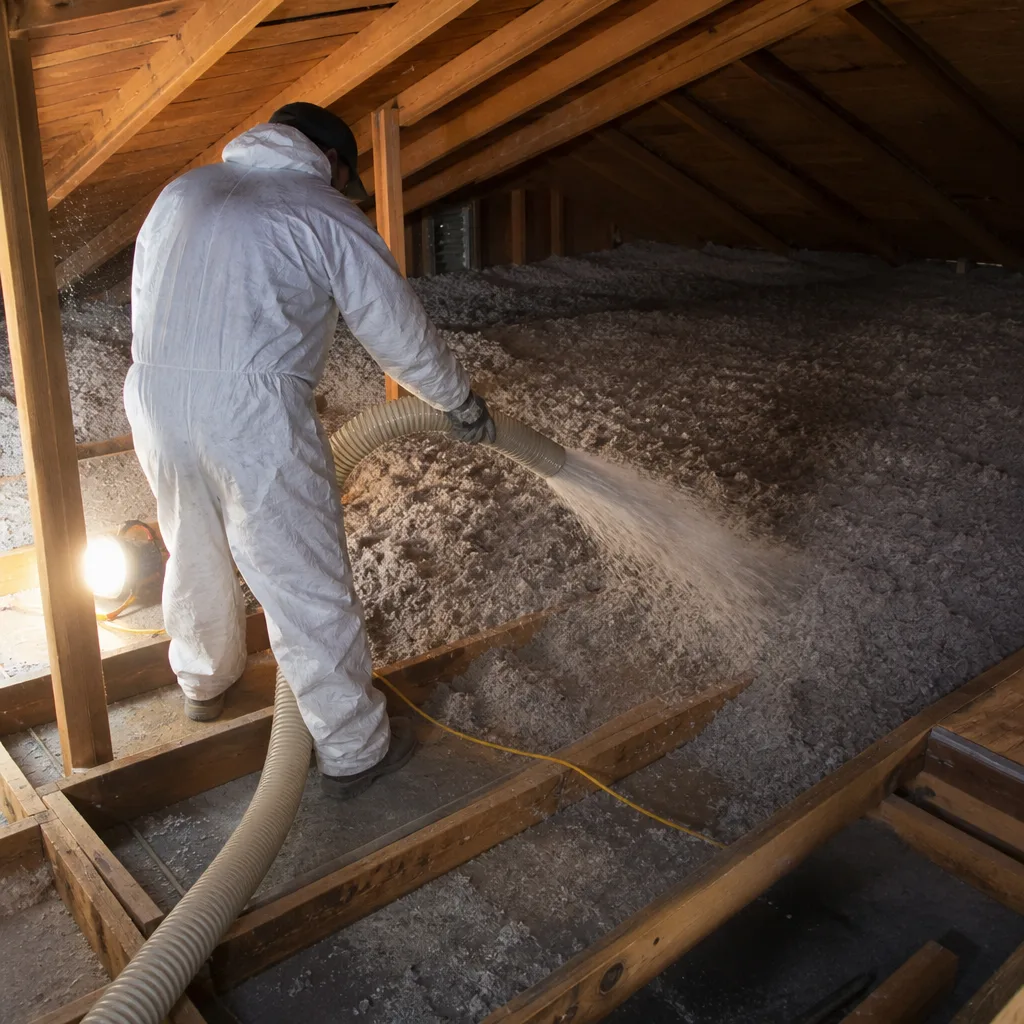
Two-component foam chemistry depends on the two liquids – an A-side isocyanate and a B-side resin – meeting at the right ratio and the right temperature to react into a stable closed-cell or open-cell matrix. Consumer kits carry a substrate and ambient temperature window, usually somewhere between 60°F and 80°F, and yield is quoted at the optimal end of that window. Spray at 65°F and the reaction runs slow: the foam rises less, cures softer, and doesn’t bond to the substrate with the same tenacity. That’s where the 15 to 20 percent yield loss comes from.
The problem compounds in a desert climate. An attic in Boulder City can hit 130°F in July while a garage slab sits at 80°F the same afternoon. Homeowners working around that swing without a heated proportioner – the equipment that keeps both chemicals at a stable, usually 100°F to 130°F, temperature from the drum to the gun – get inconsistent yield from one area of the job to the next. Lay down 600 board feet of rated coverage and you might get 480 usable board feet across a handful of passes. You won’t know the difference until the wall reads cold in February.
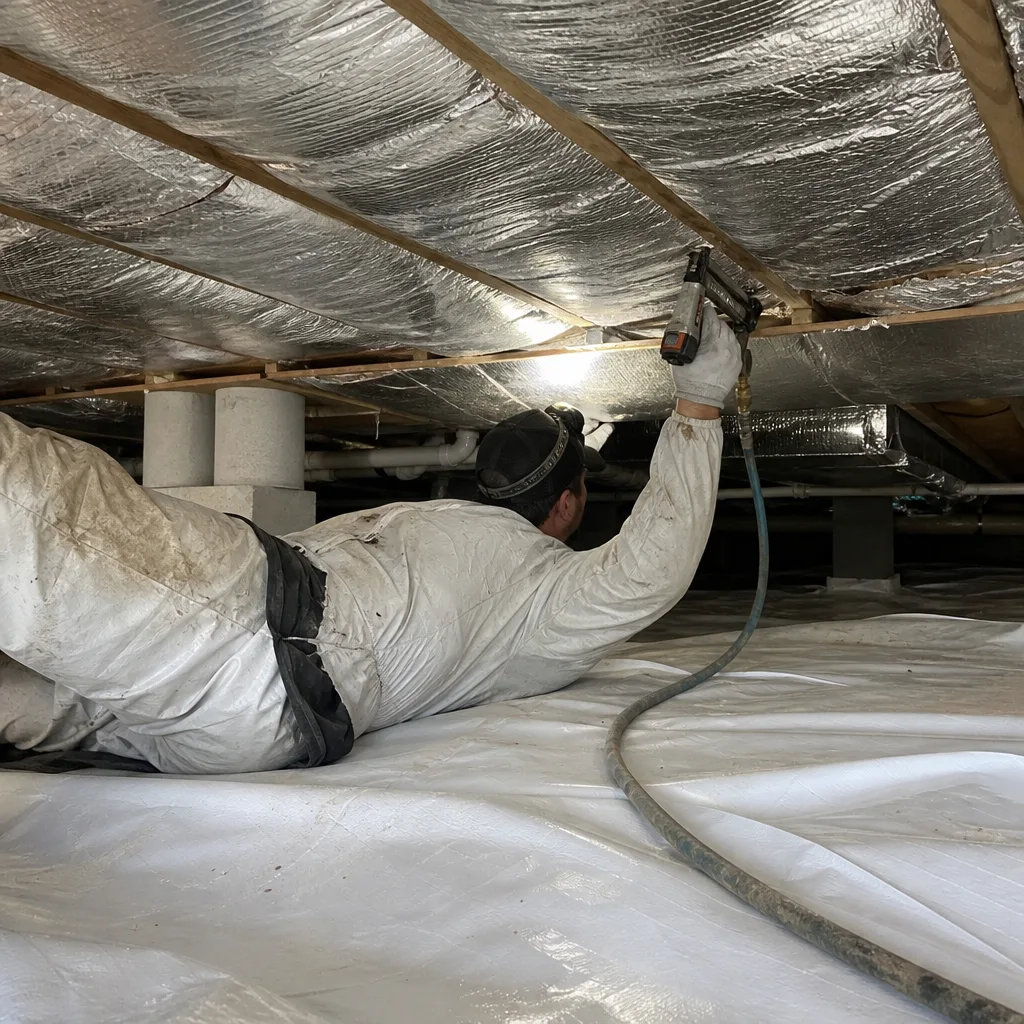
Professional rigs solve this with equipment a homeowner can’t buy: heated hose, heated proportioner, calibrated flow meters, and a gun that stops and starts without dribbling uncured material. When we spray closed-cell foam in Boulder City, the material arrives at the substrate at a controlled temperature regardless of whether the day hits 55°F or 105°F. That control is what makes the difference between a foil-backed Icynene application that bonds tight and one that pills off the sheathing a year later.
- Ideal substrate temperature: 75°F to 85°F for most two-pound closed-cell products.
- Yield loss below the window: roughly 15 to 20 percent at 65°F, worse in unheated attics and crawl spaces.
- Above-window risk: flash cure, poor adhesion, and uneven cell structure.
- Material you can’t recover: foam sprayed at the wrong temperature or ratio cannot be re-mixed; it has to be removed.
Where Consumer Spray Foam Kits Are Genuinely Appropriate
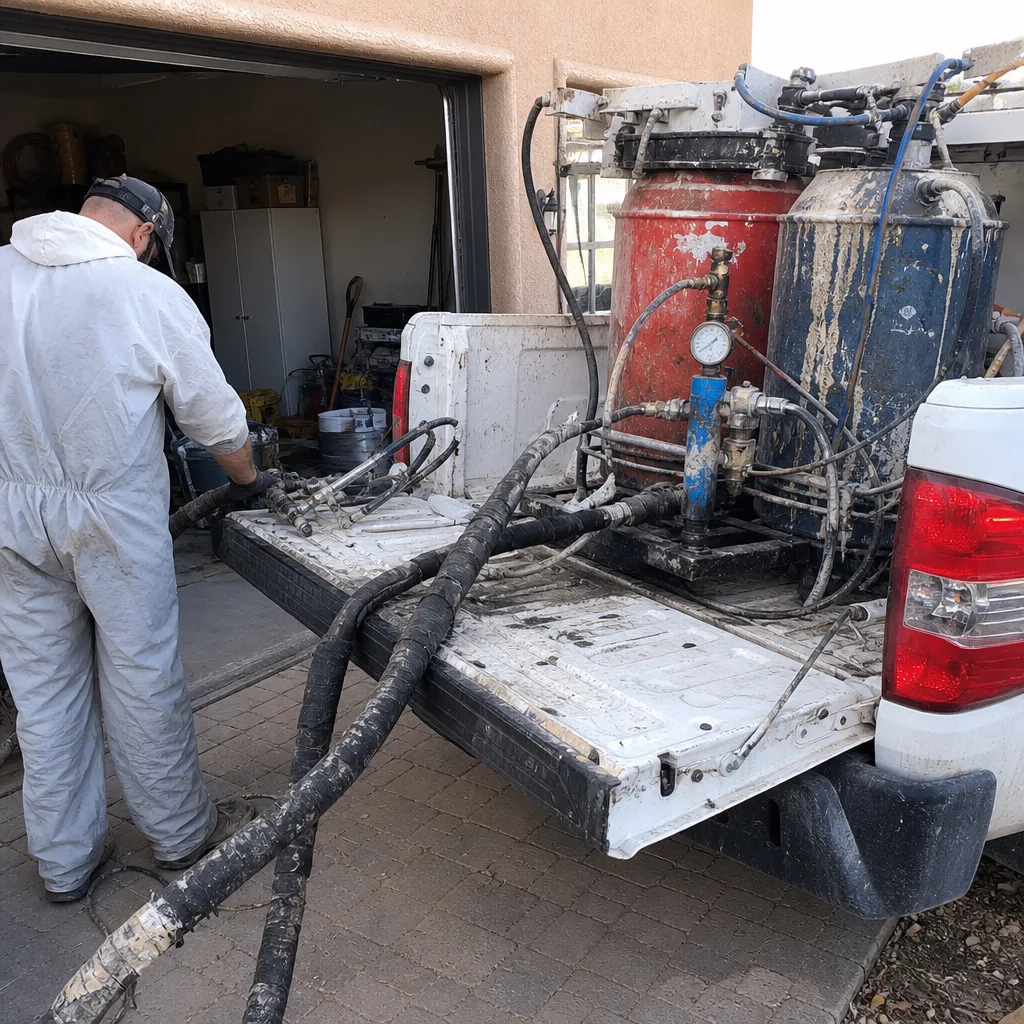
There are three jobs a careful homeowner can handle with a consumer kit, and it’s worth being disciplined about which one you’re actually doing. The line is roughly 50 linear feet of coverage, single penetrations, and detail work that doesn’t depend on a uniform thickness.
- Rim joist sealing on small sections. Rim joists – the band where the floor framing meets the foundation wall – are a top source of air infiltration in Boulder City homes built before 2000, and a 50-linear-foot section is within reach of a two-tank consumer kit. Clean the wood first, check the temperature window, and don’t spray over dust or framing that’s damp. Anything past 50 linear feet is professional territory.
- Sealing around single penetrations. A pipe, cable, or dryer vent running through an exterior wall or top plate can be sealed with a one-component foam or a small two-component kit in an afternoon. This is detail work, not coverage work, and it’s where consumer kits shine.
- Attic hatch perimeter detailing. The attic hatch is one of the highest-value air-sealing spots in any home, and sealing the perimeter with foam is a solid DIY job if the hatch assembly is stable and the gap is under an inch. We see hatches in Boulder City with 1/2-inch gaps around the frame that pull conditioned air up all summer – a $15 can of one-component foam solves that.
Kit recommendations matter less than the temperature discipline. A two-component closed-cell kit around the 200 to 600 board-foot range is the workhorse for rim joist detail work, and one-component cans are appropriate only for gaps under an inch. Match the foam chemistry to the job (closed-cell for rim joists and any surface below grade, open-cell for interior sound control) and read the substrate-temperature label before you lay down a single pass.
If you’d like a sense of how the same detail work looks on a professional job, our Spray Foam Insulation in Boulder City page walks through depth verification and coat-by-coat documentation.
The Protective Equipment Kit Instructions Understate
Consumer kit instructions carry a safety data sheet and a short equipment list. What they usually don’t stress is that isocyanate – the A-side chemical in two-component foam – is a known respiratory sensitizer. Once sensitized, a homeowner can react to isocyanate exposure at concentrations 100 times lower than the trigger. A dust mask does nothing against the vapor. This isn’t a caution we can soften: any application in an enclosed space, including a crawl space or a small attic, requires a full-face respirator with organic vapor cartridges and a supplied-air option in tight quarters.
- Full-face respirator with organic vapor cartridges – not a dust mask, not a half-mask with particulate filters. Cartridges need to be fresh and fitted to a face seal test.
- Nitrile gloves and forearm coverage – isocyanate bonds to skin quickly; a long-sleeve barrier isn’t optional.
- Sealed goggles or a full-face shield – foam overspray that lands in the eye is a chemical burn, not a splash.
- Ventilation first, respirator second – cross-ventilate the space before spraying and keep airflow running for the recommended cure window.
- Isolate the space from the rest of the home – plastic sheeting and negative air pressure if you’re working in an occupied home.
Professional crews run supplied-air respirators in any enclosed space and monitor isocyanate vapor with a meter that reads parts per billion, not a smell test. The difference between a two-hour job and a hospital visit usually comes down to equipment discipline, not skill.
Not all insulation carries the same exposure profile. Blown fiberglass and mineral wool – the Rockwool and CertainTeed products we install regularly in Boulder City – require particulate protection and skin coverage, but they don’t present an isocyanate sensitization risk. That tradeoff is part of why Attic Insulation in Boulder City often routes through blown fiberglass rather than spray foam for open attic floors.
Why Whole-Attic and Whole-Wall Cavity Jobs Shouldn’t Be DIY
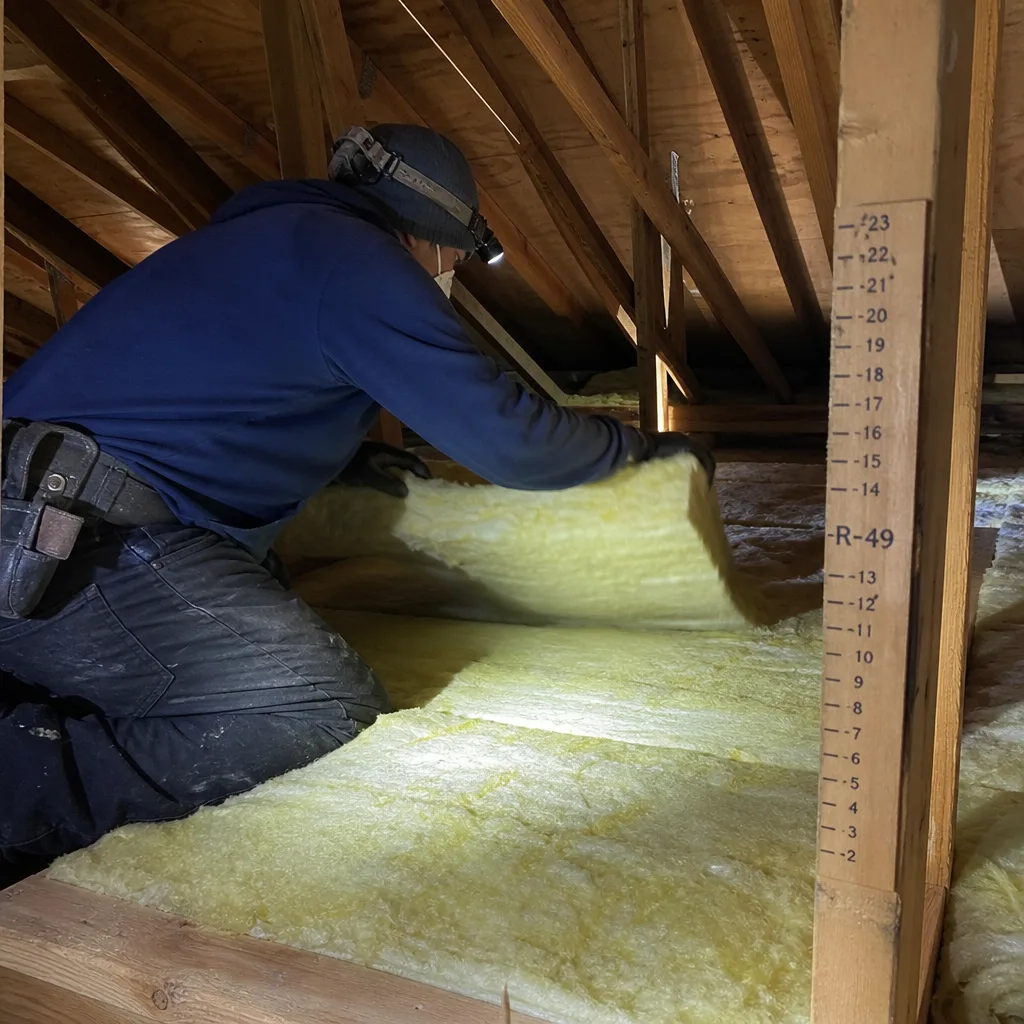
The whole-attic or whole-wall cavity job is where DIY spray foam stops being a reasonable decision. Three factors converge: yield variability, off-ratio risk, and the impossibility of verifying coverage depth without a probe. Each one, on its own, is a strong argument. Together, they’re the reason we’ve never seen a homeowner come out ahead on a cavity job attempted with consumer kits.
Yield variability. Consumer kit yield ratings assume optimal temperature, correct gun technique, and no waste. Real-world conditions – a 90°F attic in July, an unheated crawl space in January – move enough material into the ambient air that a rated 600 board feet produces 480 to 500 usable. At $550 to $750 per kit, you’re paying roughly $1.15 to $1.55 per board foot for material you didn’t get to use.
Off-ratio risk. When the A-side and B-side don’t meet at the manufacturer’s specified ratio, the foam cures tacky, brittle, or not at all. Consumer kits are designed to hold ratio within a range, but the range narrows with temperature and gun technique. Professional proportioners use calibrated flow meters to hold ratio to the tight tolerances the manufacturer specifies. Off-ratio foam cannot be re-mixed. It has to come out.
Unverifiable depth. A closed-cell application rated for R-6.5 per inch has to hit thickness to deliver the R-value. Without probing – driving a thin rod through the cured foam to measure thickness at multiple points – a homeowner has no way of confirming the coverage. Sprayed foam can look uniform and still be 1.5 inches thick in one bay and 2.5 in the next.
There’s a fourth reason, and it’s the one we hear about most often: spray foam over an unsealed attic floor traps the air leakage in place. The foam is the insulation; the air sealing is the top plates, can lights, and penetrations underneath it. Foam applied first, sealant later, and the blower-door number lands 20 to 30 percent higher than it should. That’s why every job at Envelope Insulation Boulder City home starts with air sealing and only then moves to insulation.
Cost Comparison That Includes Remediation
Cost comparison gets honest when you build remediation into the DIY side of the ledger. A consumer kit runs $550 to $750 for a 600 board-foot closed-cell product, and covers roughly 480 to 500 usable board feet if the temperature cooperates. A professional closed-cell application in the Boulder City market runs about $2.50 to $4.50 per board foot, including labor, material, air sealing, and the before-and-after blower-door documentation.
- DIY attempt on a 600-board-foot cavity: $550 to $750 in kits, plus $80 to $150 in respirator cartridges and PPE, plus $40 in plastic sheeting. Effective coverage closer to 480 board feet.
- Yield-recovery cost for the missing 120 board feet: another $110 to $150 in kit material, or $300 to $540 for a professional spot-treatment.
- Partial tear-out if the foam goes off-ratio or fails adhesion: $600 to $1,800 per cavity, depending on square footage and access.
- Blower-door test to verify: $250 to $450 as a standalone service in most Boulder City-area markets.
The break-even point arrives quickly. Any DIY job that requires more than one remediation pass – a spot re-spray, a partial tear-out, or a blower-door test to find a gap – is more expensive than a professional closed-cell application with documentation included. On jobs under 50 linear feet, DIY still wins on pure cost. Above that, it rarely does.
What professional documentation actually includes
When a professional job includes a pre-and-post blower-door test, the number is the receipt. A blower-door test – a pressurization reading that shows, in a single figure, how much air the building envelope was losing before and after the work – is the closest thing to a verified performance result available. On a typical 2,000-square-foot home in Boulder City, we regularly see readings drop from 5,000 CFM50 before air sealing and insulation to 2,400 CFM50 after, and we publish the number on the job record.
How to Verify a Professional Job Delivered What Was Promised
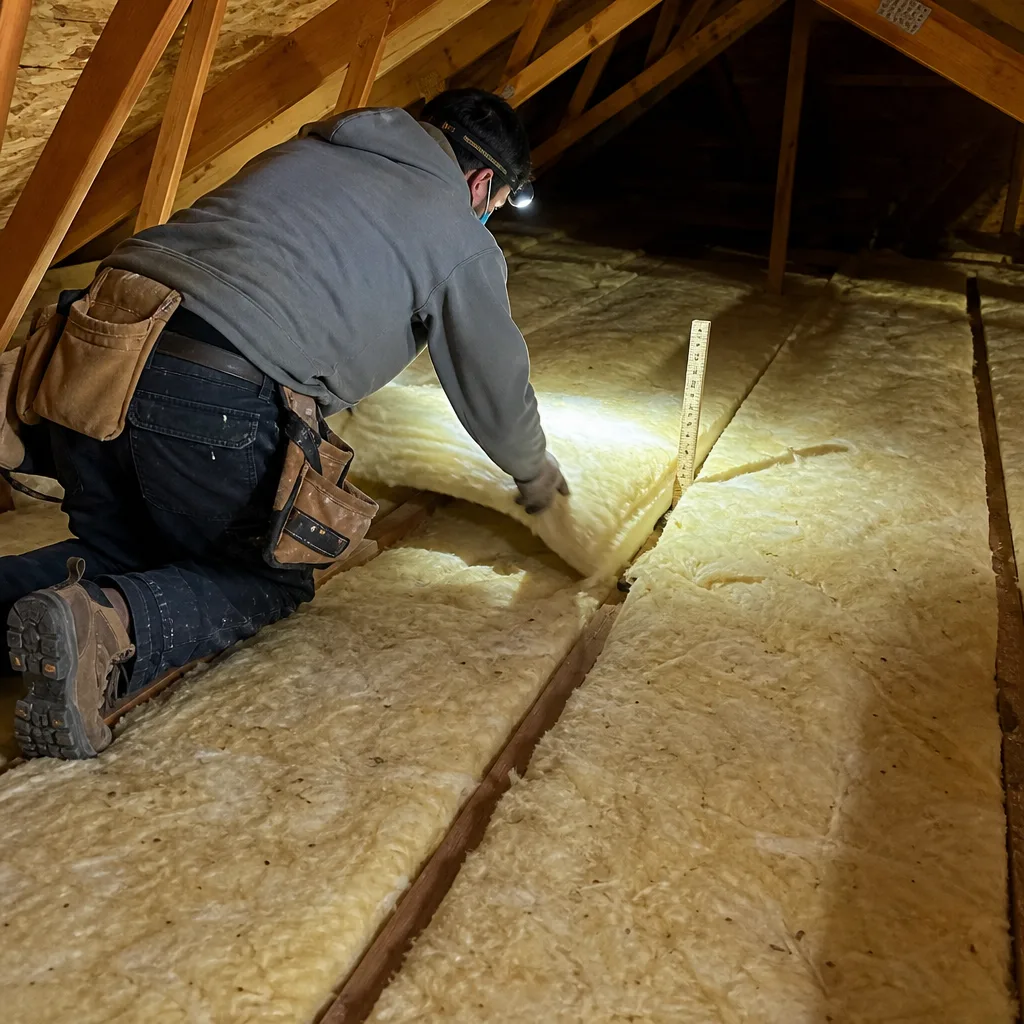
The homeowner’s leverage on any professional spray foam job is the verification step. Ask for these four measurements in writing, before the job is scheduled. Any contractor who can’t produce them on request is telling you something about their documentation standard.
- Probe depth readings. Ask for probe measurements at 10 to 12 points across the area, taken at the finish of the job. A 2-inch closed-cell application should read 2 inches, ±1/4 inch, across the whole field.
- Infrared camera scan. An IR scan after cure shows any area where the foam wasn’t applied to full coverage. Ask for the images saved to the job file.
- Pre-job blower-door reading. Recorded before any work begins, on the home as it sits. This is your baseline CFM50 number.
- Post-job blower-door reading (ACH50). The air changes per hour at 50 pascals – the ACH50 number – is the one the homeowner cares about. For a Boulder City home, an ACH50 of 3 or below after enclosure work is a strong result; the pre-job number should be tracked so the improvement is measurable.
Documented photo records, written scope, and written warranty should all arrive before the crew starts, not on request after the fact. If a homeowner is comparing quotes and one contractor offers a written second opinion on a competitor’s estimate at no cost, that’s one more signal to weigh.
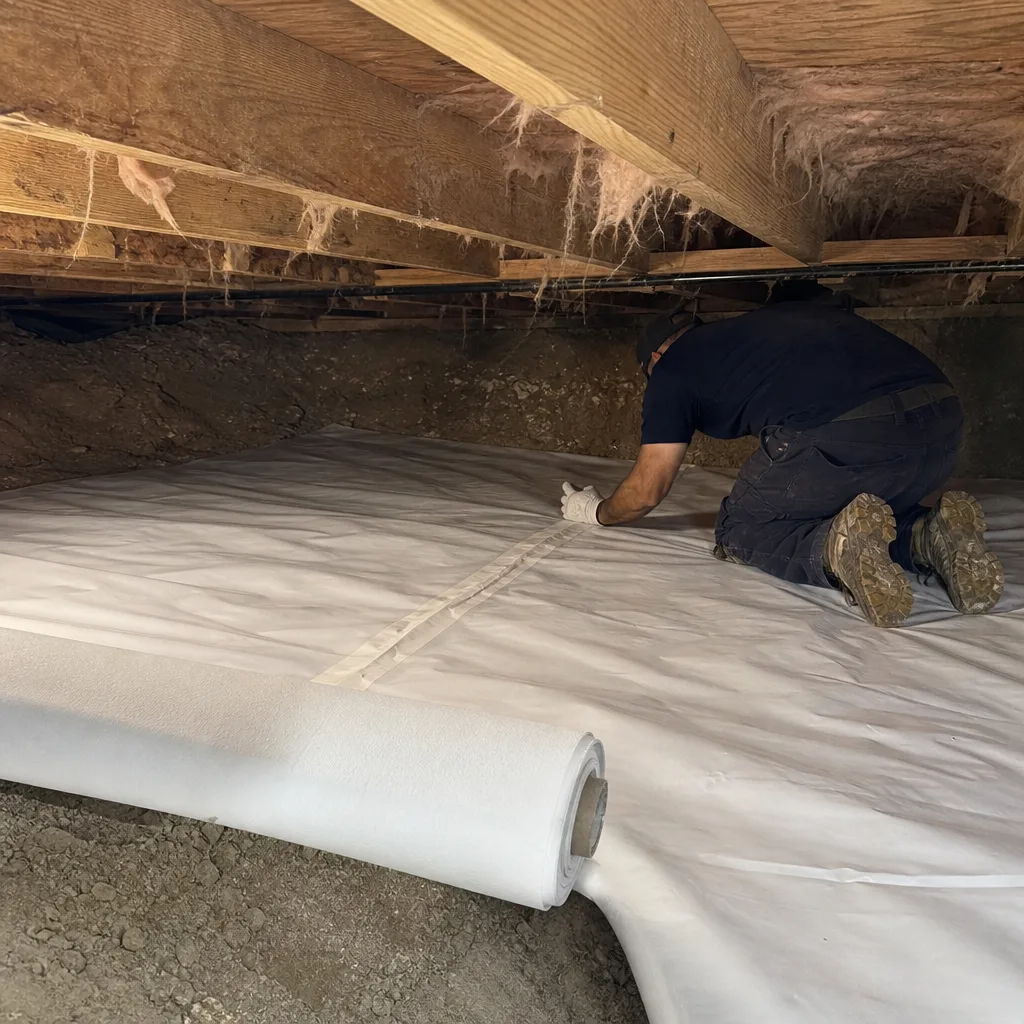
Related work has its own verification standard. Crawl Space Encapsulation & Vapor Barrier in Boulder City documentation includes vapor barrier thickness, seam sealing, and post-install humidity readings.
What Boulder City’s Climate Demands of Spray Foam
Boulder City sits in a high-desert climate with summer attic temperatures that routinely top 130°F and winter night lows that can push into the low 20s. That swing is exactly what separates a well-installed spray foam job from a poorly installed one. Closed-cell foam applied in July to a heated attic substrate cures fine; the same foam applied to a 65°F substrate in November may cure tacky at the interface. Attic work here gets scheduled around the temperature, not the calendar.
The bigger climate factor in Boulder City is solar load on the roof deck. A dark shingle roof absorbs heat through the day and radiates it back into the attic and into the foam layer above the ceiling. Closed-cell foam at 2 inches handles that cycle well; open-cell foam at the same depth can lose R-value above 100°F ambient. Foil-faced products from CertainTeed and similar radiant-control assemblies are part of how we manage the summer thermal cycle on Boulder City homes that face full south or west sun.
Homes built in Boulder City between 2015 and 2025 generally sit in a modern thermal envelope where the spray foam decision is about detail work (rim joists, penetrations, cantilevered floors) rather than whole-attic cavity fill. Homes built before 2000 usually need the whole attic floor addressed, and that’s where the professional job earns its cost, because the air sealing beneath the insulation matters as much as the foam itself.
Common Mistakes to Avoid
- Spraying below the temperature window. Consumer kit yield drops 15 to 20 percent at 65°F versus 75°F, and the failure doesn’t show up until a cold snap. Read the substrate-temperature label and check the substrate with an IR thermometer before you spray.
- Using a dust mask instead of a full-face respirator. Isocyanate vapor passes straight through a particulate mask. Any application in an enclosed space, including a crawl space in Boulder City, requires organic vapor cartridges.
- Foam over an unsealed attic floor. Top plates, can lights, and penetrations need sealing first. Spray foam over an air-leaky floor traps the leakage and shows up on the blower-door test 20 to 30 percent higher than it needed to be.
- No probe depth verification. “Looks even” is not an R-value measurement. Probe the cured foam at 10 to 12 points or ask the contractor for the readings.
- Spraying over damp framing. Moisture trapped under the foam has nowhere to go, and crawl space framing in Boulder City picks up enough ambient humidity to be a real risk in spring. Check moisture content before you spray.
- Odd storage of leftover kits. Two-component kits have a limited shelf life once the chemicals are unmixed, and the isocyanate component degrades faster than the resin. The kit you bought in March may be off-ratio in July; buy the kit the week you intend to use it.
- Skipping the blower-door baseline. Whether you DIY or hire out, measure the envelope before the work starts. Without a pre-job number, no one can show you what changed.
When to Call a Professional
If the job exceeds 50 linear feet of rim joist, involves whole-attic or whole-wall cavity coverage, needs closed-cell foam below grade, or requires any kind of documentation the homeowner can present to a buyer or an insurance carrier, it’s time to call. Envelope Insulation Boulder City offers free estimates in Boulder City – call (844) 320-7926. Every job starts with a written price before any work begins and closes with a documented photo record; on applicable jobs, before-and-after blower-door numbers are published so the homeowner sees the performance change they paid for. Technicians have up to 10 years of experience, materials come from Owens Corning, Rockwool, Icynene, and Demilec, and the 365-Day Done Right Promise backs every completed job.
Frequently Asked Questions
You can spray small sections yourself – rim joist coverage under 50 linear feet, single-penetration sealing, attic hatch perimeter detail – with a consumer kit and a full-face organic vapor respirator, as long as the substrate is within the kit’s temperature window. Whole-attic cavity coverage is not a DIY job because yield loss and off-ratio risk without heated proportioner equipment produce a result you can’t verify. Call (844) 320-7926 for a free professional estimate on any attic-wide job.
A dust mask won’t protect you. Isocyanate – the A-side chemical in two-component foam – is a respiratory sensitizer that passes through particulate filters, so any enclosed-space application requires a full-face respirator with fresh organic vapor cartridges. Even in a well-ventilated space, the manufacturer’s safety data sheet specifies respiratory protection; we recommend supplied-air in any crouch-height attic or crawl space. Call (844) 320-7926 if you’d rather have a professional crew handle the enclosed-space work.
Closed-cell spray foam in the Boulder City market runs roughly $2.50 to $4.50 per board foot installed, including air sealing, labor, and blower-door documentation. A typical 600-board-foot rim joist and floor band job lands in the $1,500 to $2,700 range; a whole-attic 1,200-board-foot application runs $3,000 to $5,400. Call (844) 320-7926 for an exact quote – every estimate comes with a written price before any work starts.
Roughly 50 linear feet of coverage. Below that, a consumer kit at $550 to $750 plus PPE gets the job done for less than a professional call. Above 50 linear feet, one remediation pass – a spot re-spray, partial tear-out after an off-ratio cure, or a blower-door test to find a gap – pushes the DIY total above the $2.50 to $4.50 per board foot a professional job costs. Call (844) 320-7926 for a second opinion on any written estimate you’re weighing.
Ask for three things before the job starts: probe depth readings at 10 to 12 points across the finished area, IR camera images saved to the job file, and a post-job blower-door ACH50 number compared to the pre-job reading. A 2-inch closed-cell application should probe 2 inches ±1/4 inch across the whole field. Call (844) 320-7926 to schedule a free estimate with documented verification built in.
Yes, and the main factor is roof-deck solar gain. Closed-cell foam at 2 inches handles the 130°F attic swings Boulder City sees in summer without losing R-value; open-cell foam at the same depth can degrade above 100°F ambient and needs either additional depth or a foil-faced assembly. For homes built before 2000, the whole attic floor usually needs air sealing first and insulation second. Call (844) 320-7926 and we’ll walk through what we’d recommend for your envelope.
The Bottom Line
The DIY spray foam question comes down to scale and temperature. Under 50 linear feet, with the substrate in the manufacturer’s temperature window and a full-face organic vapor respirator on, consumer kits are a reasonable tool for detail work – rim joists, single penetrations, attic hatches. Above that, the yield loss, off-ratio risk, and unverifiable depth combine to make a professional job with air sealing first, documented probe depths, and before-and-after blower-door numbers the cheaper option once you build in remediation. Spray foam reward is real. The question is who should install it to earn that reward.
For a written price, a documented photo record, and a verified blower-door result, call (844) 320-7926 for a free estimate in Boulder City.
Written by the team at Envelope Insulation Boulder City.